
Why are you still paying 14.55% in bank fees when digital-only providers have slashed that cost to just 3.55%? It's a question that defines the shift toward borderless finance in 2026. If you've ever felt the sting of a "hidden" exchange rate markup or waited five days for a wire transfer to clear, you know the old system is broken. Finding the right digital wallet for international transfers isn't just about convenience anymore. It's about taking control of your global reach and keeping more of your money where it belongs.
We understand the frustration of complex verification and limited payment options in specific regions. You need a solution that bridges the gap between traditional cards, Apple Pay, and digital assets. This article shows you exactly how to select a secure wallet that offers instant P2P transfers and transparent fee structures. We'll explore the essential features for 2026, from multi-currency support to specialized corridors like Cuba, so you can move money across borders with total confidence and zero friction.
Key Takeaways
- Learn why choosing a digital wallet for international transfers allows you to bypass slow legacy networks for near-instant cross-border payments.
- Discover the essential security protocols, such as tokenization and end-to-end encryption, that keep your global transactions safer than traditional banking.
- Identify the critical features to compare before committing, including support for specific corridors like Cuba and diverse funding methods like Apple Pay.
- Understand how to streamline your setup by completing verification early, ensuring your first transfer moves without friction or unexpected delays.
- Explore how specialized platforms like DUC App provide a bold alternative for high-friction regions through an integrated ecosystem of P2P transfers and international recharges.
What is a Digital Wallet for International Transfers?
A Digital wallet for international transfers is a secure software application that stores your payment credentials and facilitates instant cross-border transactions. It functions as a borderless financial hub that replaces physical cash and plastic cards for global users. By centralizing your financial life on a smartphone, these tools remove the friction of traditional geography. You can store multiple currency balances, convert funds at the touch of a button, and execute peer-to-peer (P2P) transfers that arrive before you've even closed the app.
The real magic happens under the hood. Traditional banks rely on the aging SWIFT system, a series of intermediary banks that each take a cut and add a delay. Modern wallets bypass this entirely. They utilize P2P networks and digital assets to move value directly from sender to receiver. This decentralized approach ensures that your money isn't stuck in "pending" status for days. It puts the power back into your hands, allowing for a seamless, borderless experience that prioritizes your convenience and peace of mind.
This empowerment extends to how you manage your liquidity; for instance, if you're awaiting a paycheck but need to move funds now, QuickCashDirect can provide the necessary short-term cash advance to keep your global transfers on schedule.
The Evolution of Wallets in 2026
We've moved far beyond simple "e-wallets" that just mirrored your credit card. In 2026, the industry has embraced the "Super App" model. These platforms are now comprehensive financial ecosystems. They integrate everything from international recharges and gift cards to sophisticated API tools for e-commerce. You aren't just sending money; you're managing a global lifestyle. New regulatory standards established this year have also leveled the playing field. These rules provide robust consumer protections, making top-tier digital wallets as reliable and secure as any legacy bank account you've ever owned.
Digital Wallets vs. Traditional Wire Transfers
Choosing between a digital wallet and a bank wire is the difference between a high-speed fiber connection and a dial-up modem. The advantages of the digital wallet for international transfers are impossible to ignore when you look at the raw data.
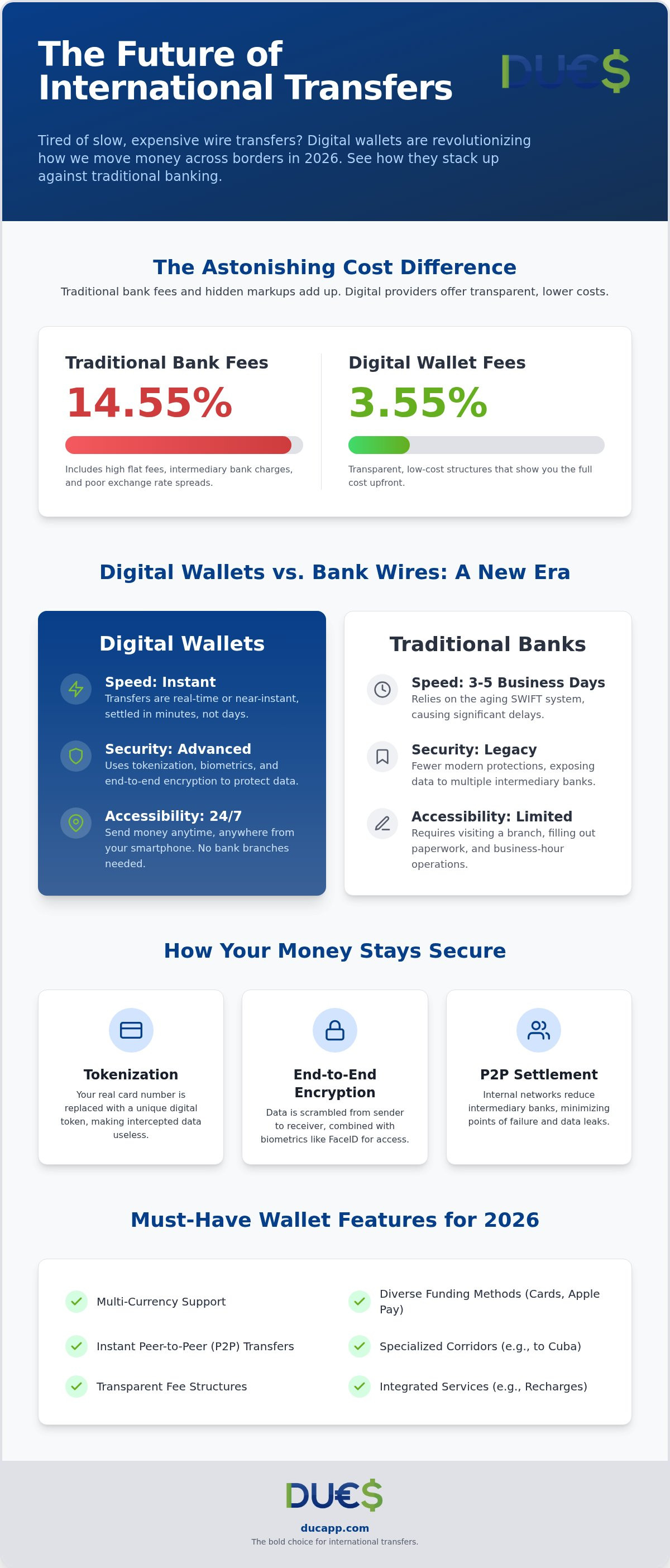
- Speed: While a bank might take 3 to 5 business days to clear a foreign transfer, digital wallets offer real-time or near-instant settlement.
- Cost: Banks often charge high flat fees and hide additional costs in poor exchange rate spreads. Digital wallets favor transparent, low-cost structures that show you exactly what you're paying upfront.
- Accessibility: You don't need to visit a branch or fill out stacks of paperwork. If you have a smartphone and an email address or phone number, you're ready to go.
This shift represents a total liberation from the detached formality of traditional banking. It empowers you to support family abroad, pay global freelancers, or fund international travel without the headache of legacy systems. You're no longer bound by the operating hours of a physical building or the slow pace of 20th-century technology.
How International Wallet Transfers Work Safely
Security in the digital age is about more than just a strong password. When you use a digital wallet for international transfers, you're stepping into a high-tech ecosystem designed to protect every cent. Modern wallets utilize a process called tokenization. This means your sensitive financial data is replaced by a unique, one-time digital identifier. Even if a bad actor intercepted the signal, the data would be useless to them. Your actual bank details or card numbers never travel across the open web.
The safety of these platforms also relies on internal Peer-to-Peer (P2P) settlement networks. By moving funds within a single, controlled ledger, wallets eliminate the need for multiple intermediary banks. Fewer stops on the journey mean fewer opportunities for data leaks or processing errors. In 2026, real-time fraud monitoring has reached new heights. Advanced AI systems now analyze transaction patterns in milliseconds. If a transfer looks out of character for your profile, the system flags it instantly, providing a level of proactive defense that traditional wire transfers simply can't match.
Encryption and Data Privacy
Privacy is the new currency. Leading platforms employ end-to-end SSL encryption combined with biometric authentication like FaceID or fingerprint scanning. You are the only person who can approve a move. For high-value transactions, multi-signature protocols add an extra layer of protection, requiring multiple approvals before funds leave the account. Many users now prefer to transfer money internationally using only an email address. This method is inherently safer than sharing full IBAN or BIC details, as it limits the amount of personal information exposed to the recipient.
Regulatory Compliance and Fund Security
Trust is built on accountability. Secure digital wallets operate as licensed financial institutions, adhering to strict Know Your Customer (KYC) and Anti-Money Laundering (AML) regulations. These systems verify your identity upfront to prevent fraud and ensure your money isn't caught in regulatory crossfire. In 2026, compliance engines also help users track reporting thresholds. For instance, U.S. residents can better manage the $100,000 foreign gift reporting limit through their app's built-in history tools.
Specialized platforms like the DUC App excel here by managing complex compliance requirements for specific corridors like Cuba. If a transaction is ever interrupted by a connection failure, "atomic swap" technology ensures the transfer either completes entirely or returns the funds to your balance immediately. Your money never disappears into a digital void. This level of technical reliability provides the empowerment and liberation you need to manage a global lifestyle without fear. It's about moving fast while staying shielded.
Key Features to Compare in a Global Wallet
Not all platforms are created equal. When you select a digital wallet for international transfers, you must look beyond the slick interface. In 2026, the standard for excellence is defined by four pillars: speed, reach, funding versatility, and total transparency. If a wallet can't settle a transaction in real-time, it's already behind the curve. Look for "instant" or "real-time" settlement claims. Waiting days for money to move is a relic of the past that you no longer have to tolerate.
Reach is equally vital. A wallet might work perfectly in Europe but fail when you need to send funds from Canada to Cuba. Verify that your chosen provider supports your specific corridors. Beyond geography, examine the funding methods. A truly global connector supports everything from Apple Pay and Google Pay to localized systems like Interac in Canada or SEPA in Europe. Finally, demand fee transparency. Many providers lure users with "zero fees" only to hide a 3% or 5% markup in the exchange rate spread. Always compare the final amount received by your recipient, not just the upfront service charge.
P2P and Mobile Top-Up Capabilities
A modern wallet should simplify your daily life. High-performance apps now integrate mobile recharges directly into the balance. For example, you can send Cubacel or MLC recharges to family in Cuba without leaving the platform. Peer-to-peer (P2P) transfers should feel as effortless as sending an email. Whether you are splitting a dinner bill or sending monthly support to a relative, the process must be frictionless. Instant gift card delivery is another essential feature for 2026, allowing you to send usable value to international recipients in seconds.
Developer and E-commerce Integration
The gap between personal finance and business is closing. Modern merchants require a digital wallet for international transfers that offers a robust API. If you run a store on WooCommerce or Odoo, your wallet should integrate seamlessly to handle global payouts. A reliable platform provides a documented sandbox environment. This allows developers to test international payment flows and currency conversions without risking real capital. The DUC App stands out as a bold innovator here, facilitating complex business-to-consumer (B2C) global payouts. This infrastructure empowers small businesses to compete on a global stage, removing the barriers that once made international e-commerce the exclusive domain of giant corporations.
Setting Up Your Wallet for International Success
Transitioning from research to action is where your financial liberation begins. Setting up a digital wallet for international transfers should be a swift, empowering experience. Your first priority is compatibility. Ensure the platform you choose supports your specific funding source, like Interac or SEPA, and functions in your recipient's region. This is especially critical for high-friction corridors. Once you've confirmed the reach, link your preferred payment method immediately. Connecting Apple Pay or Google Pay allows for one-click funding, removing the need to manually enter card details for every transaction.
Don't rush your first major move. Start with a small test transfer to verify the recipient's details and the actual network speed. This "dry run" confirms that the wallet ID or email address is correct and that the funds settle as promised. It's a simple step that provides massive peace of mind before you handle larger sums. By taking these methodical steps, you ensure your global financial engine is tuned for high performance.
Verifying Your Identity (KYC)
Security is the foundation of trust. To comply with 2026 global standards, you must complete a Know Your Customer (KYC) process. This isn't a barrier. It's a shield for your assets. Generally, you will need to provide the following items for a digital wallet for international transfers:
- A valid, government-issued photo ID like a passport or driver's license.
- A recent utility bill or bank statement as proof of address.
- A real-time biometric scan for transaction approval.
Biometric verification is the gold standard for 2026 wallet security. A quick FaceID scan ensures that only you can authorize a transfer. To speed up approval, use high-resolution images and ensure your documents are current. Completing this process early prevents frustrating delays when you need to move money urgently.
Funding and Sending Your First Transfer
Once your account is verified, adding funds is a hassle-free process. Use local payment rails like SEPA in Europe or Interac in Canada for the lowest fees and fastest deposits. When selecting your recipient, modern wallets offer multiple paths. You can use an email address, a phone number, or a unique wallet ID. Email-based payments are often the most seamless option, as they don't require sharing sensitive bank details. Before you finalize the transaction, the app will display the current exchange rate and all applicable fees. Check these figures carefully to ensure the final amount received matches your expectations.
Ready to experience a borderless financial world? Sign up for DUC App today and start moving your money with total confidence.
Why DUC App is the Bold Choice for International Transfers
Choosing a digital wallet for international transfers often feels like a compromise between security and speed. DUC App eliminates that trade-off. As a Bold Innovator in the fintech space, we've built a platform that functions as a Reliable Global Connector. We don't just move money; we remove the barriers that keep families and businesses apart. Whether you're a casual user or a professional developer, our ecosystem is designed to solve the hard problems before you even open the app.
What sets DUC App apart is our comprehensive approach to global finance. We provide a single, high-performance hub for all your needs. You can execute instant Peer-to-Peer (P2P) transfers, send international recharges, deliver digital gift cards, and manage e-commerce payouts from one screen. Our infrastructure supports modern funding methods including Apple Pay, Google Pay, SEPA, and Interac. This versatility ensures a hassle-free experience regardless of your location. We've replaced the cold, detached formality of traditional banking with a vibrant, fast-paced interface that prioritizes your peace of mind.
For merchants, the integration process is equally seamless. If you run a store on WooCommerce or Odoo, our documented API and sandbox environment allow you to test international payment flows without friction. We've already solved the technical integration puzzles so you can focus on growing your global footprint. This developer-first mindset ensures that even complex business-to-consumer (B2C) payouts are handled with absolute precision.
Empowering the Cuban Diaspora
We specialize where others fail. DUC App is the trusted successor to the legacy Duales platform, carrying forward a reputation for security and reliability in high-friction regions. We understand the unique challenges of sending support to Cuba. Our platform allows you to send MLC and Cubacel recharges instantly from the US, Canada, or Europe. These P2P transfers bypass the slow, legacy banking hurdles that often stall funds for days. By focusing on these specific corridors, we provide a sense of liberation to users who have been underserved by traditional financial systems for far too long.
A Modern Financial Tool for Everyone
Simplicity is our greatest strength. Every feature within our digital wallet for international transfers is built for speed. From the initial biometric login to the final transaction confirmation, the process is streamlined and energetic. We combine professionally reassuring protocols with a modern, user-centric design that makes you feel supported and capable. You deserve a financial partner that is as ambitious as you are. Stop settling for legacy systems that slow you down. Experience the future of global finance—Download DUC App today!
Claim Your Borderless Financial Freedom
The era of high bank fees and waiting days for a wire transfer is over. By selecting a high-performance digital wallet for international transfers, you've chosen speed, transparency, and total control over your global assets. You now understand how encryption and biometric tools protect your wealth. You know why specialized corridors like Cuba require a more focused, reliable approach. This knowledge is your first step toward a hassle-free financial life that moves at the speed of your ambition.
DUC App is ready to be your global connector. We combine the flexibility of Apple Pay and Google Pay with specialized tools for instant P2P transfers to Cuba. If you're a merchant, our robust API ensures your WooCommerce or Odoo store is ready for a global audience from day one. It's time to experience a financial life without friction or boundaries. We have solved the hard problems so you don't have to. You're no longer bound by legacy systems or detached banking formalities.
Start your instant international transfer with DUC App today. You have the tools and the knowledge. Take the first step toward true financial empowerment and global reach.
Frequently Asked Questions
Is it safe to use a digital wallet for large international transfers?
Yes, it's safe because modern platforms utilize tokenization and end-to-end encryption to shield your sensitive data. Licensed wallets must adhere to strict KYC and AML regulations to protect high-value transactions. If you are a U.S. resident, remember that the 2026 IRS threshold for reporting foreign gifts is $100,000. Using a regulated provider ensures you have a clear, digital paper trail for compliance and peace of mind.
How long does a P2P transfer take with DUC App?
P2P transfers with DUC App are typically instant. Once you authorize the move, the funds settle in the recipient's balance in real-time. This speed is possible because the app uses internal ledgers rather than the aging SWIFT network. It is a seamless way to send support to family or friends without the multi-day waiting periods required by traditional banking institutions.
Can I send money to Cuba using Apple Pay or Google Pay?
Yes, you can fund your transfers to Cuba using Apple Pay or Google Pay through the DUC App. Simply link your preferred mobile wallet to your account for one-click funding. This allows you to send MLC or Cubacel recharges without manually entering card details for every transaction. It is a hassle-free solution for the Cuban diaspora living in the US, Canada, and Europe.
What are the fees for international transfers in 2026?
In 2026, the average transaction cost for digital-only providers is approximately 3.55%, which is significantly lower than the 14.55% charged by traditional banks. Fees for your digital wallet for international transfers usually consist of a transparent service fee and a currency exchange rate. Always check the final amount your recipient will receive to ensure there are no hidden markups buried in the exchange rate spread.
Do I need a bank account to use a digital wallet?
You don't necessarily need a traditional bank account to use a digital wallet. While you can link a bank for SEPA or Interac transfers, many wallets allow you to fund your balance using credit cards, debit cards, or Apple Pay. This flexibility is a key part of the borderless financial experience. It empowers users who prefer digital-first assets and modern payment rails over legacy banking systems.
How do I recharge a Cubacel phone from abroad?
Recharging a Cubacel phone is simple and immediate within the DUC App. You just enter the recipient's mobile number and select the amount of credit you wish to send. The app processes the international recharge instantly using your existing wallet balance. It is the most reliable way to keep your loved ones connected in Cuba without dealing with slow third-party agents or physical storefronts.
What is the difference between a digital wallet and a remittance app?
A digital wallet for international transfers is a comprehensive financial ecosystem where you can store, convert, and manage various currencies over time. In contrast, a remittance app is usually designed for a one-way, single transaction from sender to receiver. Wallets offer more versatility, including P2P transfers, gift cards, and e-commerce integrations. This makes them a more robust tool for managing a truly global lifestyle.
Can businesses use DUC App for international payouts?
Yes, businesses can utilize DUC App for global payouts through our specialized API integrations. We provide documented tools for merchants using platforms like WooCommerce and Odoo to handle B2C payments efficiently. Our sandbox environment allows your developers to test international payment flows safely before going live. This infrastructure helps small and medium businesses compete globally by removing the high costs of traditional corporate banking.


