

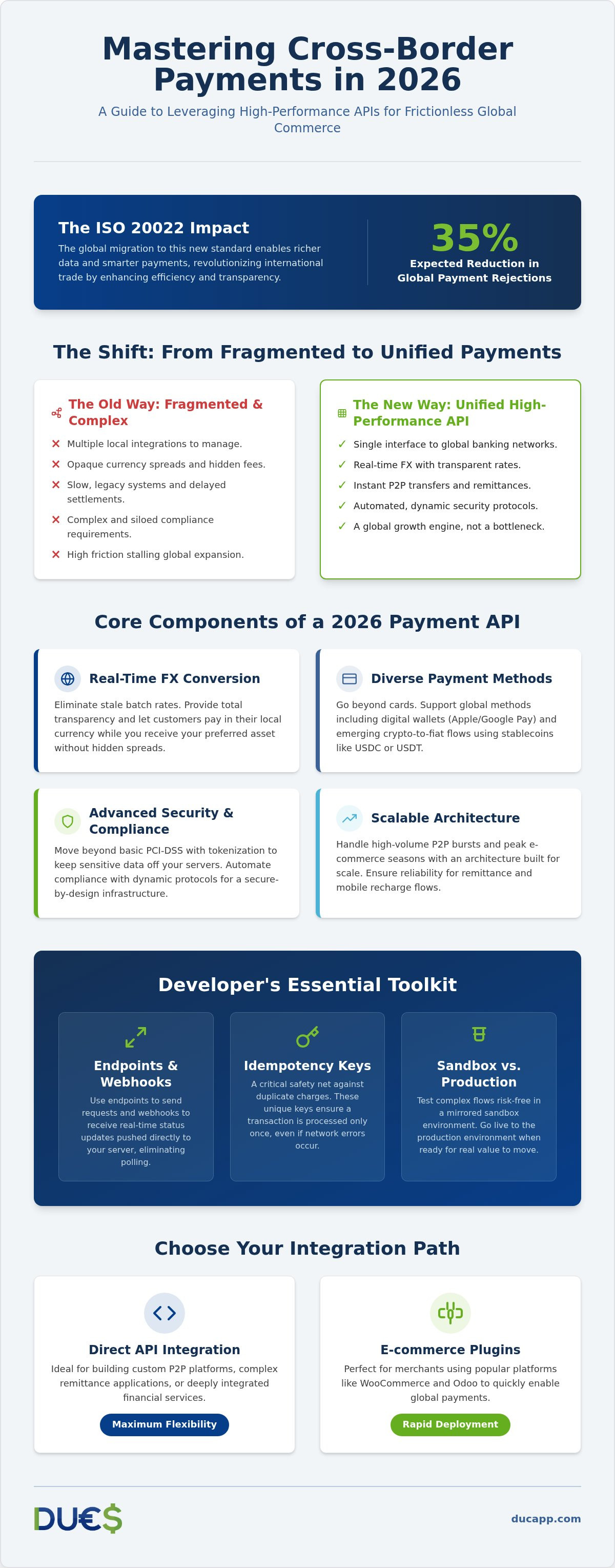
Did you know that the recent migration to ISO 20022 standards is expected to reduce global payment rejections by as much as 35%? For a merchant scaling in 2026, a high-performance cross-border payment api is no longer optional. It's a competitive necessity. You're likely tired of managing a fragmented stack of local integrations. You're done losing revenue to opaque currency spreads. It's frustrating to see your global expansion stalled by complex PCI-DSS requirements and the cold formality of traditional banking. You need a solution that moves at the speed of your code.
We understand that international growth shouldn't feel like a constant battle with borders. This guide will teach you how to master the complexities of international transactions with a high-performance API designed for modern developers and global merchants scaling in 2026. We'll explore how to unify your global commerce, automate compliance, and utilize real-time rails to ensure your money moves as fast as your data. Get ready to turn global friction into a growth engine. Let's build a borderless future together.
Key Takeaways
- Simplify your global operations by replacing fragmented systems with a unified software interface that connects directly to global banking networks.
- Optimize your tech stack with a high-performance cross-border payment api that manages real-time FX and dynamic security protocols automatically.
- Choose the right integration path, whether you need maximum flexibility for a custom P2P platform or rapid deployment via WooCommerce and Odoo plugins.
- Scale with confidence by utilizing a dedicated sandbox environment to test complex remittance and e-commerce flows before going live.
- Unlock high-friction markets and global corridors with a developer-first approach to international recharges and secure transfers.
What is a Cross-Border Payment API? Powering 2026 Global Trade
Modern commerce doesn't stop at the border. A cross-border payment api is the software bridge that links your application to a global network of banks, digital wallets, and decentralized systems. It's more than a simple payment gateway. It's a unified interface. One single connection now grants you access to hundreds of local payment methods. You don't need to build individual integrations for SEPA in Europe, Interac in Canada, or mobile wallets in Asia. The API handles the heavy lifting, translating complex financial protocols into clean code your developers can use immediately.
2026 has changed the game for everyone involved in international trade. Following the Fedwire migration to ISO 20022 on July 14, 2026, structured data is now the global standard. Card processing is just the baseline. Today's global merchants need P2P transfers, crypto-to-fiat capabilities, and mobile recharges to stay relevant. We've moved from basic gateways to intelligent payment orchestration layers. These systems analyze transaction data in real-time. They route payments through the most efficient rail available, ensuring that your business meets the mandatory November 2026 requirements for structured postal addresses to avoid rejection.
The Role of API in Modern Remittance and E-commerce
Digital borders are dissolving. APIs bridge the gap between traditional banking systems and modern digital wallets. They facilitate instant P2P transfers without the legacy delays of the old SWIFT era. The API is the connective tissue of 2026 global finance. It allows a user in Toronto to send funds to a family member's mobile wallet in Havana or London with a single click. This technology empowers businesses to handle complex remittance flows and standard e-commerce checkouts through the same streamlined pipeline.
Key Terminology for Developers in 2026
Building for global scale requires a specific vocabulary. You need to understand how these components interact to keep your transactions fluid and secure.
- Endpoints and Webhooks: These are the communication channels. Endpoints receive your requests; webhooks push real-time status updates back to your server so you don't have to poll for results.
- Idempotency Keys: These are critical for reliability. They ensure that if a network glitch occurs, a transaction isn't processed twice. It's your primary safety net against duplicate charges.
- Sandbox vs. Production: Never test with real money. A sandbox is a mirrored environment for risk-free debugging and configuration. Production is the live environment where the actual value moves.
By leveraging a cross-border payment api, you remove the friction from international growth. You gain the ability to scale into new regions overnight. The focus shifts from managing bank relationships to perfecting your user experience.
Core Components of a High-Performance Cross-Border Payment API
To thrive in the 2026 economy, your infrastructure must be agile. A high-performance cross-border payment api does more than just move numbers. It orchestrates value across diverse rails with surgical precision. Real-time FX conversion is now mandatory. You can't rely on stale, daily batch rates in a world of instant volatility. Modern APIs provide total transparency, allowing customers to pay in their local currency while you receive your preferred asset without hidden spreads. This level of fluidity is what separates global leaders from local players.
Your integration must handle a sophisticated mix of payment methods. Standard card processing and digital wallets like Apple Pay or Google Pay are just the beginning. The real competitive edge in 2026 involves crypto-to-fiat flows. With the GENIUS Act providing a clear regulatory framework for stablecoins, using USDC or USDT for near-instant settlement is a standard business requirement. These interoperable cross-border payment systems act as a gateway to economic development, especially in emerging markets where traditional banking infrastructure often lags. Your API must also offer scalable architecture capable of handling high-volume P2P bursts during peak remittance seasons.
Security and Compliance: Beyond PCI-DSS
Security in 2026 isn't just about a checklist. It's about data invisibility. Tokenization is your primary weapon here. It keeps sensitive card data off your servers entirely, reducing your compliance burden and protecting your reputation. Implement digital signatures and security hashes to validate the integrity of every request. This is exactly how a secure international money transfer app leverages advanced APIs to protect users without adding unnecessary friction to the journey. You can explore how DUC App implements these protocols to keep your transactions ironclad.
Global Reach and Local Payment Methods (LPMs)
Conversion rates live or die by local preference. In Canada, Interac is the gold standard. In high-friction regions, mobile top-ups and gift cards serve as vital payment alternatives for millions of users. Statistics show that accepting local methods can increase your conversion rates by 20% or more. Navigating these markets requires regional expertise and an API that understands the nuances of local compliance. Don't force your users into a one-size-fits-all checkout. Give them the methods they trust, and your global growth will follow naturally.
Direct API Integration vs. E-commerce Plugins: Choosing Your Path
Choosing your connection method is a strategic decision. It defines how fast you hit the market and how much control you maintain over the user journey. For some, a pre-built plugin is the fastest route to revenue. For others, a custom-built cross-border payment api integration is the only way to deliver a proprietary fintech experience. Your choice depends on whether you're scaling a standard store or disrupting a financial corridor. Scale faster. Build smarter. The technology should adapt to your business, not the other way around.
Speed often wins in the early stages of global expansion. Plugin solutions allow you to bypass months of development. You get instant access to global banking rails without writing a single line of payment logic. However, as your volume grows, you might find yourself outgrowing standard templates. This is where the hybrid approach shines. Use plugins to handle the front-end checkout while leveraging the API for custom reporting and back-office automation. It's about finding the balance between rapid deployment and long-term scalability. Don't let technical debt slow your global momentum.
WooCommerce and Odoo: The Low-Code Advantage
Automate your global sales instantly. If you're running a store on WooCommerce or Odoo, you don't need to be a senior developer to accept international payments. Ready-made plugins handle the heavy lifting. They manage international recharges, gift card delivery, and digital product sales within your existing CMS. This low-code path is liberating. It removes the technical barriers to entry for high-friction markets. For a deeper look at the technical architecture behind these connections, explore our global payment processing api guide. It's designed to help you scale your fintech integration without the usual stress.
Custom API Development for Fintech Innovators
Build something truly unique. When you're developing a proprietary P2P app or a custom remittance platform, you need a documented financial backend that doesn't get in your way. A direct cross-border payment api integration provides maximum flexibility. You can create custom email payment flows or specialized gift card systems that fit your specific brand identity. Use the dedicated sandbox environment to test complex currency conversion flows without risking live capital. This environment is your playground for innovation. It allows you to refine your transaction logic and ensure every callback is handled perfectly before you flip the switch to production. DUC App provides the tools to turn your vision into a functional, secure reality.
From Sandbox to Production: A Developer Implementation Roadmap
Moving from a concept to a functional global platform requires a disciplined approach. The first step is simple. Register for your developer account to obtain your unique Client ID. This credential is your passport to the financial grid. Once you're in, configuration begins in the sandbox. This is a mirrored environment where you can simulate transactions without risking live capital. It's the space where you perfect your logic before the world sees your code. High-performance integration isn't about luck. It's about rigorous preparation.
Security hardening is the next priority. Before you even think about the live environment, you must implement IP allow-listing. This ensures that only authorized servers can communicate with the cross-border payment api. Combine this with security hashes to validate every request's integrity. These layers of defense aren't just hurdles; they're the foundation of user trust. After you've secured the perimeter, perform a final User Acceptance Testing (UAT) phase. This is your last chance to catch edge cases in a controlled setting before flipping the switch to production.
Testing and Debugging Your Integration
Expect the unexpected. Your code needs to handle common API error codes gracefully so the user never feels lost. Simulating high-friction scenarios is vital. What happens during a failed authorization? How does your app react to an FX timeout? Use webhooks to keep your database in sync with real-time transfer status. This event-driven architecture ensures that your platform reflects the true state of every transaction instantly. It eliminates the need for manual polling and reduces server load, keeping your system lean and responsive.
Compliance and Launch Checklist
Global commerce is a regulated space. You must verify your AML and KYC hooks to stay compliant with international law. If you're building a p2p money transfer app, ensure your logic meets specific regional regulations for every corridor you serve. Conduct a final security audit focusing on shared secrets and credential management. Never hard-code your keys. Use environment variables to keep your production secrets safe. Ready to start your journey? Get your API keys from DUC App and begin building your borderless solution today.
Scaling Globally with DUC App: The API for Frictionless Fintech
Scaling your business shouldn't be a headache. DUC App provides a high-performance cross-border payment api that specifically targets the regions other providers ignore. While many competitors focus on easy US-EU corridors, we specialize in high-friction zones and complex remittance routes. It's a platform built by fintech innovators for fintech innovators. We understand the struggle of legacy systems. We know the value of a clean, documented interface. Our goal is to empower you to move value without the usual stress of traditional banking hurdles.
Take the complexity out of high-friction transfers. For example, DUC simplifies the process of sending money to cuba with credit card through a single, streamlined API call. You don't need to navigate bureaucratic roadblocks or hidden fees. The system handles the complex compliance backend and regional specificities while you provide a seamless front-end experience. This unified developer experience covers everything from standard card processing to crypto-to-fiat flows and mobile recharges.
Why Developers Choose DUC for International Transfers
Documentation matters. Our sandbox isn't just a stripped-down version of production; it's a robust, full-featured environment for risk-free testing. It allows you to simulate P2P flows and legacy migrations with total confidence. We also provide instant access to global telecommunications providers. This means mobile top-ups become a native part of your application. Whether you're transitioning from the legacy Duales infrastructure or starting a fresh project, the integration remains fluid and fast. You get the tools you need to build a borderless solution in days, not months.
Future-Proofing Your Payments with DUC
The financial world is evolving rapidly. While stablecoins currently account for approximately 1% of global payment flows, their adoption for near-instant settlement is a defining trend of 2026. DUC App is ready for this shift. Our infrastructure supports the next wave of decentralized finance and crypto-to-fiat settlement natively. We also maintain continuous updates to our WooCommerce and Odoo plugins. This ensures your business scales effortlessly as technologies and regulations change. You gain direct access to a support team that actually understands global financial borders. They don't just read from scripts. They help you solve real-world integration challenges so you can focus on growth. Stop fighting the system and start building with a partner that values your time.
Build Your Borderless Future Now
The global marketplace moves at the speed of your code. You've seen how a high-performance cross-border payment api functions as a regulatory abstraction layer. It hides regional complexity. It provides a unified developer experience. Whether you're deploying ready-made plugins for Odoo or building custom P2P flows in a documented sandbox, the objective is clear. You must remove obstacles. You need to scale without the bureaucratic weight of traditional banking. It's about liberating your business from the constraints of the past.
Embrace real-time FX, tokenization, and support for high-friction corridors to future-proof your commerce. Don't let borders define your growth. Take control of your financial infrastructure with a partner that understands the modern merchant's journey. It's time to turn global complexity into your greatest competitive advantage. Trust in a system designed for speed, security, and absolute reliability. Your expansion is no longer a challenge; it's an opportunity.
Start building with the DUC App API today. Your global audience is ready for a frictionless experience. Let's make international commerce feel as fluid as the digital world it serves. Success is just one integration away.
Frequently Asked Questions
What is a cross-border payment API and how does it differ from a local gateway?
A cross-border payment api is a software interface that connects your platform to global banking and decentralized networks. Unlike a local gateway that serves a single region, this API provides a unified connection to hundreds of regional payment methods. It functions as an orchestration layer. It handles complex FX and regional compliance automatically. This technology allows global merchants to scale into new markets without the technical debt of building individual integrations for every country.
How do I secure my API integration to prevent unauthorized transactions?
Secure your integration by implementing a multi-layered defense strategy. Start with IP allow-listing to ensure only your servers can access the API. Use security hashes to validate the integrity of every request. Tokenization is critical; it ensures sensitive card data never touches your infrastructure. Always manage your shared secrets and Client IDs using secure environment variables. These proactive steps create a robust perimeter that protects your revenue and your customers' sensitive financial data.
Can I use a payment API to send money to high-friction regions like Cuba?
Yes, you can serve high-friction regions like Cuba by using an API designed for complex remittance corridors. DUC App specializes in these underserved markets. The system handles the intricate compliance and regional backend requirements for you. This allows you to facilitate transfers via credit cards or P2P flows through one interface. It's a liberating solution for businesses that want to provide global financial access without getting bogged down in bureaucratic traditional banking hurdles.
What are the benefits of using a payment API for WooCommerce or Odoo?
Using a cross-border payment api through WooCommerce or Odoo plugins provides a low-code advantage for global scaling. You can automate international recharges and digital gift card sales without writing a single line of payment logic. These plugins connect your store directly to global banking rails and local payment methods like Interac or SEPA. It's an efficient way to expand your reach. You gain professional-grade financial infrastructure while maintaining the simplicity of your existing e-commerce CMS.
How does currency conversion (FX) work within a global payment API?
Currency conversion happens in real-time within the API using live market data. When a transaction occurs, the system calculates the FX rate instantly to ensure transparency for both the merchant and the customer. This removes the uncertainty of stale batch rates. The API routes the payment through the most efficient financial rail available. This process minimizes spreads and eliminates the hidden fees that usually plague traditional international transactions, ensuring more value reaches its final destination.
Is it possible to process cryptocurrency payments through a standard payment API?
Processing cryptocurrency is now a standard feature for modern payment APIs. You can accept stablecoins like USDC and convert them into fiat currency automatically for settlement. This method offers near-instant settlement speeds and significantly lower costs compared to traditional wire transfers. With the 2026 GENIUS Act providing a clear framework, these crypto-to-fiat flows are secure and compliant. It's a powerful tool for merchants looking to leverage decentralized finance within a professional, regulated business environment.
What is a developer sandbox and why is it essential for payment testing?
A developer sandbox is a secure, mirrored environment for testing your code without risking real capital. It's essential for debugging your integration and simulating edge cases like FX timeouts or failed authorizations. You use it to perfect your webhook responses and ensure your database stays synchronized with transaction statuses. This testing phase is critical for building a reliable user experience. It ensures that your production launch is smooth, secure, and free from logic errors.
How do I manage PCI-DSS compliance when using a direct API integration?
Manage PCI-DSS compliance by leveraging tokenization through your API provider. This technology ensures that sensitive payment data never reaches your servers. Instead, you handle secure tokens that have no value to attackers. By keeping data off your infrastructure, you qualify for simplified compliance assessments. It's a strategic move that reduces your liability and security costs. You maintain a high level of protection for your users while staying focused on scaling your global commerce operations.


