

Why are you still paying $50 in SWIFT fees and waiting three days for a transfer when the global economy moves in milliseconds? It's frustrating to watch your margins disappear into the black hole of traditional banking. You've likely dealt with the headache of complex KYC/AML requirements and settlement delays that feel like they belong in the last century. It shouldn't be this hard to move money across a border. Integrating a modern fintech api for international payments is no longer a luxury for big banks; it's your path to financial liberation.
We agree that the old way is broken. You need speed, transparency, and lower costs to stay competitive in 2026. This guide promises to help you master API integration to eliminate cross-border friction and enable instant transactions for your business. We'll explore how to set up a functional sandbox for testing, connect seamlessly with platforms like WooCommerce, and utilize P2P transfer capabilities. From navigating the new ISO 20022 standards to leveraging the latest MiCA regulations, you're about to turn your payment infrastructure into a high-speed global engine.
Key Takeaways
- Understand how a modern fintech api for international payments acts as your digital bridge. Translate complex banking protocols into simple, executable code.
- Trace the journey of a transaction from initial call to final settlement. See how APIs bypass traditional middleman friction for instant results.
- Evaluate critical developer tools like sandbox environments and specialized plugins. Ensure a frictionless setup for platforms like WooCommerce or Odoo.
- Master a clear 5-step integration roadmap. Secure your access keys and launch instant P2P or e-commerce payment capabilities with confidence.
What is a Fintech API for International Payments?
A fintech api for international payments is a set of protocols that allows your software to communicate directly with global financial networks. Think of it as a digital intermediary. It translates complex, antiquated banking instructions into simple code requests that your platform can understand. By 2026, these tools have evolved far beyond simple gateways. They are now full-scale financial orchestration layers that manage the entire lifecycle of a transaction across borders. A fintech API is a tool that bypasses traditional banking bureaucracy for instant global reach.
The Shift from Legacy Banking to API-First Finance
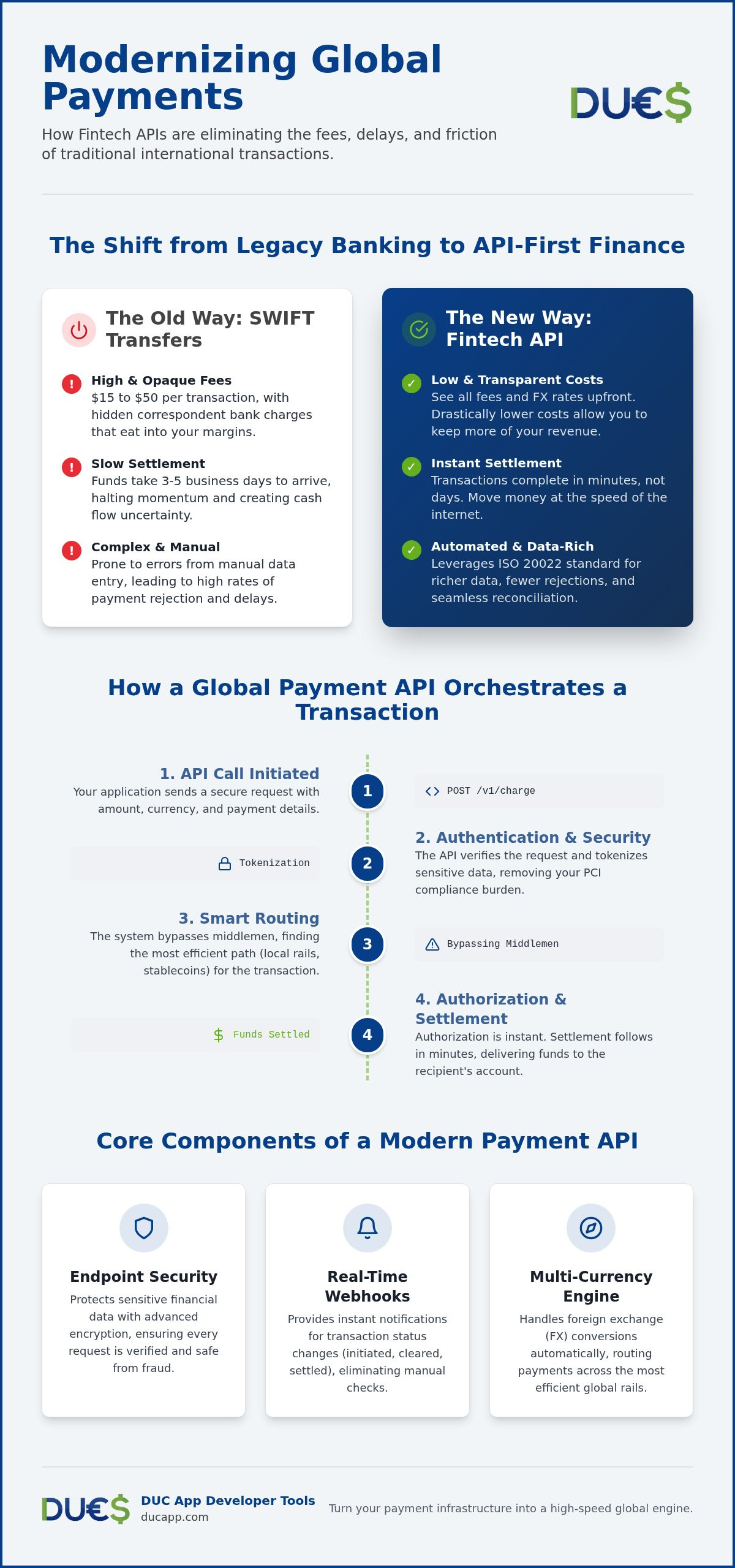
Traditional SWIFT transfers are becoming obsolete for modern digital businesses. They are slow and expensive; industry data from 2026 shows traditional wire fees still range from $15 to $50 per transaction. This friction kills margins and halts momentum. The rise of Financial technology (Fintech) has shifted the focus toward transparency and speed. With the global migration to the ISO 20022 messaging standard completed in late 2025, APIs now provide richer data and significantly fewer payment rejections. This shift empowers users in underserved regions. It gives them a seat at the global table without the burden of legacy bank accounts or physical branches. You get total visibility into every fee and exchange rate before the "send" button is even clicked.
Key Components of a Modern Payment API
Security is the foundation of any reliable integration. Endpoint security protects sensitive financial data using advanced encryption to ensure every request is verified and safe. You don't have to build the security infrastructure from scratch; the API handles the heavy lifting. Webhooks act as the heartbeat of the system. They provide real-time notifications for transaction status changes. Your system knows the moment a payment is initiated, cleared, or settled. This eliminates the need for manual polling or constant status checks. Multi-currency support is the final essential piece. Modern APIs handle FX conversions without manual intervention. They route payments across the most efficient rails, whether they are local banking networks or regulated stablecoin paths, to ensure your business stays fluid and responsive.
Stop fighting with old systems. A modern API integration turns your checkout or P2P platform into a high-speed global engine. It's about moving money at the speed of the internet, not the speed of a bank's back office. By leveraging these orchestration layers, you're not just sending money; you're building a borderless digital lifestyle for your users. This autonomy is also reflected in tools like unCoded, which allows for self-hosted, non-custodial management of crypto assets and API keys on private servers.
How Global Payment APIs Orchestrate Cross-Border Transactions
The journey of a transaction is a high-speed relay race. It starts with a single API call and ends with a successful settlement on the other side of the planet. When you use a fintech api for international payments, you are essentially hiring a digital conductor. This conductor manages the "middleman" layer between different regional banks and varied payment methods. Instead of you manually navigating the corridors of local clearing houses, the API routes the data through the most efficient path available in 2026. It handles the handshakes between disparate systems so your user never sees the complexity happening behind the scenes.
Security is integrated into this orchestration through tokenization. This process replaces sensitive card data with a unique, non-sensitive identifier. By using tokenization, you keep PCI-sensitive information off your own servers. This reduces your compliance burden and protects your customers. DUC App simplifies this entire architecture. It handles the complex backend logic, security protocols, and bank communications while you focus on building a beautiful, intuitive UI for your users. You can start building your global platform today without worrying about the underlying financial plumbing.
The Request-Response Cycle Explained
Initiating a charge requires specific data points: the amount, the currency code, and the payment method. Once the request is sent, the authentication layer takes over. The API verifies the identity of the sender using secure keys and multi-factor protocols to prevent fraud. It's vital to distinguish between authorization and settlement. Authorization happens in seconds; it's the bank saying "yes, the funds are there." Settlement is the actual movement of those funds into your account. Modern APIs use real-time rails to shrink this settlement window from days to minutes.
Handling Foreign Exchange (FX) and Currency Spreads
Managing multiple currencies used to be a nightmare of hidden fees and manual calculations. Today, APIs calculate real-time exchange rates for international transfers instantly. They pull data from global markets to provide transparent currency spreads before the transaction is finalized. This automation is a massive win for e-commerce merchants. You can sell in Euros and settle in Dollars without touching a calculator. For a deeper look at how these systems handle growth, check out our Global Payment Processing API Guide. Automated FX ensures that your global customers see familiar pricing while your business maintains predictable margins.
Evaluating API Features: Sandbox, Plugins, and P2P Support
Choosing a fintech api for international payments isn't just about comparing fee tables. It's about the developer experience and the flexibility of the tools provided. A sandbox environment is non-negotiable for developers in 2026. You need a safe space to break things before they go live. As global payment networks migrate to real-time settlement rails, testing your logic in a simulated environment prevents costly production errors. The DUC App sandbox allows for risk-free testing of P2P flows, ensuring your transfers are bulletproof before the first dollar moves. Beyond the code, look for an API that acts as a polyglot. It should support Visa, Mastercard, Apple Pay, and Google Pay to meet users wherever they are.
Custom API vs. E-commerce Plugins
Custom API integrations are ideal for building unique fintech apps from the ground up. They offer total control over the user journey and data flow. However, speed is often the priority for digital storefronts. Using WooCommerce or Odoo plugins provides a massive speed advantage. You can go from zero to global sales in hours, not weeks. These plugins handle the complex mapping between your product catalog and the global financial rails automatically. DUC App supports both paths to ensure maximum flexibility for your specific business model. Whether you are building a bespoke platform or launching a store, the integration should feel like a natural extension of your existing stack.
Beyond Payments: P2P and Mobile Top-up Capabilities
Don't limit your vision to just "buying" goods. The global economy is shifting toward versatile financial interactions that occur outside the traditional checkout page. Your fintech api for international payments should support more than just standard merchant transactions. Look for capabilities like remittances, peer-to-peer transfers, and international recharges. There is a massive, growing demand for P2P transfers as users seek to bypass traditional banking borders. This is about more than commerce; it's about building a digital lifestyle. For more context on this shift, explore our P2P Money Transfer App Guide. A comprehensive API allows you to offer a complete suite of services, handling everything from bill payments to instant mobile top-ups within a single, streamlined interface.
The best APIs are those that remove obstacles. They provide the documentation you need to scale and the security you need to sleep at night. By evaluating these features early, you ensure that your platform is ready for the high-speed demands of the 2026 financial landscape.
How to Integrate an International Payment API: A 5-Step Roadmap
Integrating a fintech api for international payments doesn't have to be a multi-month engineering project. In 2026, the process is streamlined and modular. You focus on the user experience while the API handles the heavy lifting of global compliance and banking rails. Follow this 5-step roadmap to go from a local shop to a global powerhouse.
- Step 1: Obtain your API keys and access the developer sandbox. This is your risk-free playground to build and break things.
- Step 2: Configure your environment. Whether you use WooCommerce, Odoo, or a custom SDK, this is where you link your platform to the financial network.
- Step 3: Implement the payment flow and handle webhook responses. Your system needs to "listen" for transaction updates in real-time.
- Step 4: Conduct rigorous testing in the sandbox with "test" cards. Simulate successes, failures, and edge cases to ensure stability.
- Step 5: Complete KYC/AML compliance checks and go live. This is the final gate to unlock real-world transactions.
Setting Up Your Developer Environment
Your journey begins in the developer dashboard. Generate your API credentials and secure them immediately; never hardcode these into your client-side scripts. If you are using an e-commerce platform, installing the DUC App plugin for WooCommerce or Odoo is the fastest path. It automates the connection between your store and the global rails. Once installed, configure your currency settings. Choose your settlement currency and the display currencies for your international reach. This ensures your customers see prices they understand while you receive funds in the currency you need. Access your developer dashboard and grab your test keys to start today.
Testing and Launching Your Global Payment System
Don't rush the sandbox phase. A common pitfall is ignoring error codes during testing. Your system must handle failed transactions and error messages gracefully to prevent user churn. Use the provided test cards to simulate various scenarios, including insufficient funds and expired cards. Testing these edge cases ensures a smooth experience for your real customers. Ensure your launch complies with Secure International Money Transfer standards to protect both your business and your users. Once your tests pass, switch to your production keys and begin facilitating instant global transfers.
Scaling Your Global Reach with DUC App’s Developer Tools
DUC App acts as a smart companion for developers who need to move money across complex financial borders without the typical stress. Most providers offer a simple pipe; we provide the orchestration logic required to navigate a fragmented global landscape. It is the fintech api for international payments designed specifically for innovators who value their time and demand immediate results. By automating the backend heavy lifting, we empower you to build a seamless digital lifestyle for your users. You don't have to be a compliance expert to launch a global product. Our infrastructure handles the shifting regulatory environment of 2026 so you can focus on your core product.
A unified platform is your greatest competitive advantage. Instead of stitching together multiple vendors, you get access to transfers between peers, international recharges, and gift cards through a single integration. This reduces technical debt and simplifies your stack. Whether your users are sending email payments or topping up a mobile plan halfway across the world, the experience remains fluid and consistent. DUC App removes the traditional obstacles that slow down scaling, allowing your business to expand into new markets with a few lines of code. This growth often requires physical support as well; for those moving cargo across North America, you can learn more about integrated logistics services.
Specialized Support for High-Friction Corridors
Many API providers avoid high-friction corridors because the regulatory hurdles are too steep. DUC App leans into these challenges. We have established ourselves as the leader for recharging Cubacel from the USA, managing the complex compliance requirements that others find too difficult. We handle the KYC/AML complexities and regional restrictions on your behalf. This reliability makes DUC App the go-to choice for sensitive international remittances. You can offer your users secure paths to send support where it is needed most, knowing the transaction is backed by a robust, secure infrastructure.
Join the DUC App Developer Community
Speed to market is everything in the digital economy. Our comprehensive documentation and dedicated support team are here to ensure your integration is successful from day one. You don't need a massive engineering team to go global. By leveraging our specialized plugins for WooCommerce and Odoo, you can launch a fully functional international store in days, not months. These tools are built to scale with you as your transaction volume grows. Stop letting borders dictate your business strategy. Ready to break borders? Integrate DUC App API today and start building the future of frictionless finance.
Master Your Borderless Financial Future
Legacy banking systems are relics of a slower era. Your business deserves a future defined by speed and transparency. Integrating a fintech api for international payments is the most direct path to that liberation. You've seen how modern orchestration layers replace the friction of traditional wires with instant global reach. By utilizing a documented API and sandbox environment, you ensure your platform is secure and ready for the 2026 landscape before you move a single real dollar.
DUC App is your smart companion in this digital evolution. We provide the specialized WooCommerce and Odoo plugins you need to launch in days; not months. Our infrastructure handles the heavy lifting of high-friction corridors while offering global support for Apple Pay and Google Pay. You focus on the user experience; we handle the complex backend financial plumbing. There's no reason to let traditional borders limit your growth potential any longer.
The digital economy moves in milliseconds. Don't get left behind. Start Building with the DUC App API today and turn your vision into a global reality. Build fast. Scale without limits. Welcome to the era of frictionless finance.
Frequently Asked Questions
What is the difference between a payment gateway and a fintech API?
A payment gateway is a rigid checkout interface, while a fintech api for international payments is a programmable infrastructure layer. Gateways are built for simple "buy" buttons. APIs are designed for developers who need to build custom financial flows, like peer-to-peer transfers or automated e-commerce settlements, directly into their own software. One is a finished product; the other is a powerful building block.
How long does it take to integrate a fintech API for international payments?
Integration speed depends on your technical path. If you use pre-built plugins for WooCommerce or Odoo, you can go live in a few hours. Custom SDK integrations for bespoke applications typically take between two and four weeks. This window includes development time, rigorous sandbox testing, and the completion of necessary compliance checks to ensure a secure launch.
Is it safe to use a payment API for sending money to high-risk countries?
It is safe if your provider specializes in high-friction corridors. DUC App manages the regulatory complexities of sensitive regions so you don't have to. The API automatically handles KYC and AML screenings for every transaction. This ensures your business remains compliant with international standards while providing a reliable path for remittances and recharges in areas traditional banks often avoid.
Do I need a banking license to use a fintech API for P2P transfers?
You don't need your own banking license to offer peer-to-peer transfers. The API provider holds the required licenses and acts as the regulated financial entity. You simply integrate their technology into your app or website. This allows you to offer sophisticated financial services like P2P or international recharges under the provider's legal and regulatory umbrella.
What are the costs associated with using a global payment API?
Costs generally consist of a small percentage per transaction and a currency exchange spread. Some providers may also include a monthly platform fee for access to advanced developer tools or higher volume tiers. Always check the specific rates for the corridors you plan to use, as high-friction regions often have different fee structures than standard domestic transfers.
Can I test my integration without using real money?
Yes, you should always utilize a developer sandbox for initial builds. This environment uses "test" cards and simulated balances to mirror real-world transaction cycles. It allows you to break things and fix them without any financial risk. Testing in the sandbox ensures your webhooks and error-handling logic are bulletproof before you flip the switch to production.
How does a fintech API handle currency conversion rates?
The API pulls real-time market data to calculate exchange rates the moment a transaction is initiated. It automates the foreign exchange process, eliminating the need for you to manage multi-currency accounts manually. This ensures your customers see transparent, up-to-the-minute pricing while your business receives funds in your preferred settlement currency without manual intervention.
What e-commerce platforms are compatible with DUC App plugins?
DUC App offers dedicated, ready-to-use plugins for WooCommerce and Odoo. These plugins allow you to connect your digital storefront to global financial rails in minutes. For businesses using custom-built platforms or other CMS options, our documented API and SDKs provide the flexibility to build a bespoke integration that fits your specific operational needs.


