

What if your expansion into Latin America or the Caribbean didn't require a six-month integration timeline and a mountain of compliance paperwork? You likely already feel the sting of watching potential revenue evaporate through high hidden currency conversion fees and rigid legacy systems. It's exhausting to manage a dozen different providers just to reach a global audience that expects instant results. To win, you need a global payment processing api that moves as fast as your ambition.
This guide helps you master the technical and strategic essentials of borderless commerce to scale your business with zero friction. We'll show you how to move beyond traditional limitations to embrace a truly empowered financial experience. You'll learn to implement a single, unified integration that offers real-time FX transparency and provides a developer sandbox for risk-free testing. From ready-to-use WooCommerce plugins to specialized remittance corridors, we're breaking down exactly how to connect your brand with the world. Let's build a payment stack that empowers your growth instead of holding it back.
Key Takeaways
- Understand how a modern global payment processing api serves as a digital nervous system, evolving from a simple gateway into a unified commerce orchestration platform.
- Trace the journey of a cross-border transaction and learn how tokenization secures sensitive data to keep your business compliant and your customers safe.
- Discover how to cut development cycles and boost efficiency by consolidating all your international payouts and reporting into one intuitive dashboard.
- Get a step-by-step roadmap for integrating DUC App with WooCommerce or Odoo, starting with a risk-free developer sandbox environment.
- Explore the power of a versatile platform that handles everything from e-commerce sales to international recharges and peer-to-peer transfers.
What is a Global Payment Processing API in 2026?
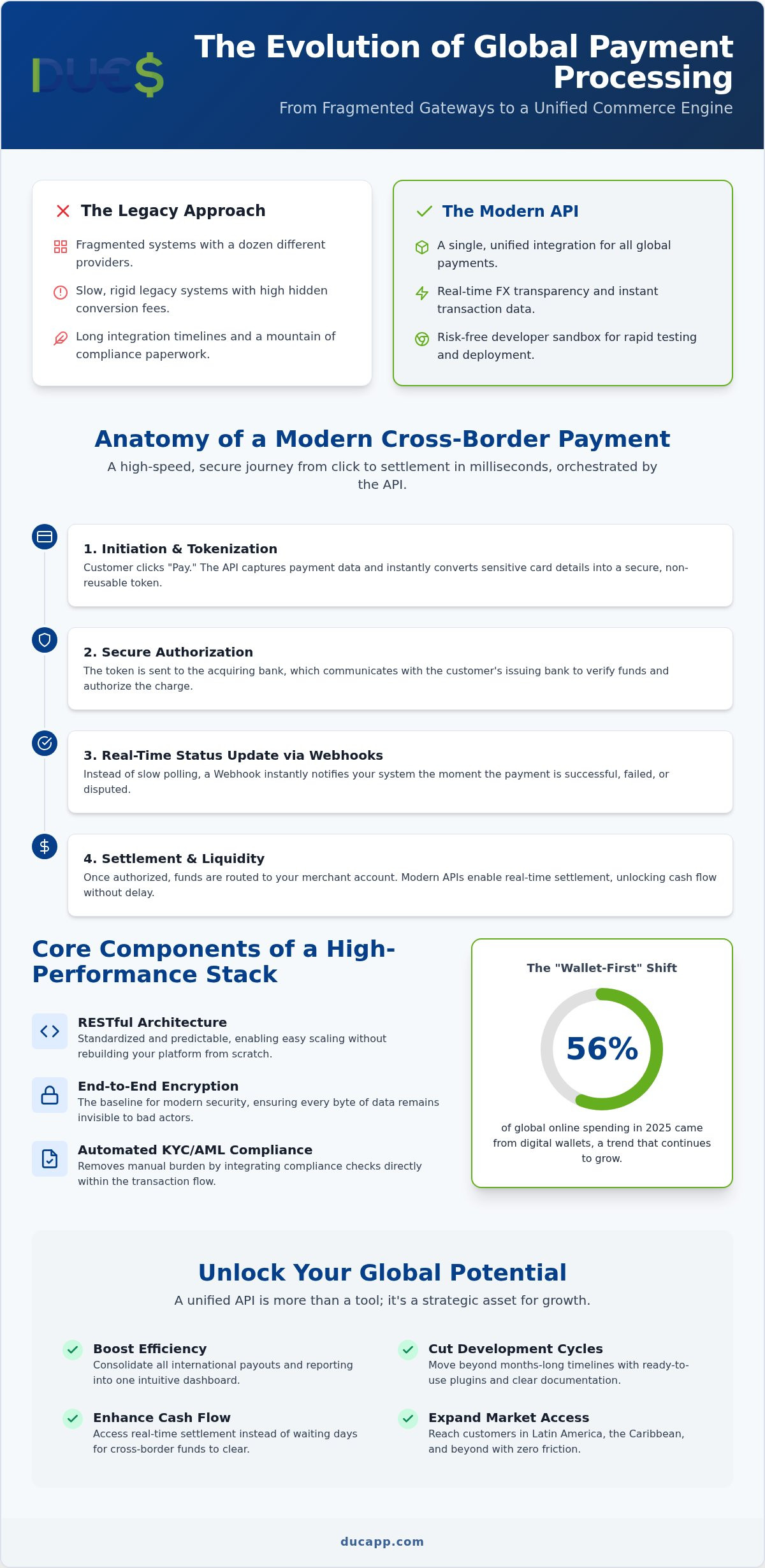
Think of the global payment processing api as the digital nervous system of your e-commerce engine. In the past, businesses relied on fragmented systems that felt like a patchwork of old wires and slow connections. Today, that has changed. A modern API doesn't just pass card numbers; it pulses with real-time data, connecting your storefront to a global web of liquidity, currency exchanges, and fraud prevention tools. It's the bridge between a customer's intent and a merchant's growth.
We've moved beyond the era of the simple Payment gateway. While those traditional systems acted as a basic tunnel for data, 2026 is defined by "Commerce Orchestration." This means your API now manages the entire lifecycle of a transaction, from local compliance checks in Latin America to instant currency conversion for a shopper in Europe. By integrating DUC App, you're not just adding a checkout button. You're building a foundation for borderless finance that bypasses the friction and delays of legacy banking networks.
The Core Components of a Modern API Stack
A high-performance API operates on a rapid Request-Response cycle. When a customer clicks pay, the system sends a structured request to the server, which validates the credentials and returns an immediate status update. This happens in milliseconds. Developers prioritize RESTful architecture because it's standardized and predictable, making it easy to scale your platform without rebuilding from scratch. Security is no longer an optional add-on; end-to-end encryption is the baseline for 2026 security to ensure every byte of data remains invisible to bad actors.
Why 2026 Demands More Than Just a Gateway
Modern APIs also handle the heavy lifting of regulatory compliance. They now integrate KYC (Know Your Customer) and AML (Anti-Money Laundering) checks automatically within the transaction flow. This automation removes the manual burden from your team and speeds up the path to settlement. Instead of waiting days for cross-border funds to clear, merchants can now access real-time settlement. This liquidity is what allows small businesses to compete on a global stage, turning local shops into international powerhouses overnight.
How Global Payment APIs Work: Under the Hood
When a customer clicks the "Buy" button, a complex sequence of events unfolds in milliseconds. Your global payment processing api acts as the conductor of this high-speed orchestra. First, it captures the payment data and sends it to the acquiring bank, which is the financial institution that processes credit or debit card payments on your behalf. The acquiring bank then communicates with the customer's issuing bank to verify funds and authorize the transaction. This isn't just about moving numbers. It's about a secure, verified handshake that spans continents.
This process is becoming more efficient thanks to global initiatives like the G20 Roadmap for Enhancing Cross-Border Payments. These standards push for greater transparency and speed, reducing the friction that used to plague international sales. Once authorized, the funds are routed to your merchant account before being settled into your business bank account. In 2026, we don't rely on slow "polling" to check transaction status. Instead, modern APIs use Webhooks. These are automated messages sent from the payment server to your app the exact moment a payment is successful, failed, or disputed, ensuring your records are always in sync without manual refreshes.
A unique advantage of modern systems is the intersection of peer-to-peer (P2P) transfers and e-commerce. DUC App allows customers to use their P2P balances to fund e-commerce checkouts directly. This creates a closed-loop ecosystem that is particularly powerful in regions with limited traditional banking access. You can explore our developer documentation to see how this unified approach simplifies your stack.
Tokenization vs. Encryption: Securing the Payload
Tokenization is the gold standard for PCI DSS compliance in 2026. While encryption scrambles data, tokenization replaces sensitive card details with a unique, non-sensitive string called a token. DUC App handles this heavy lifting so your servers never actually touch raw cardholder data. We also utilize "Vaulting," which securely stores these tokens. This allows your returning customers to checkout with a single click and enables seamless recurring payments for subscription models without compromising security.
The Magic of Real-Time FX and Currency Conversion
Hidden fees often kill international conversion rates. A robust global payment processing api solves this by fetching mid-market rates for instant, transparent conversion. By using Dynamic Currency Conversion (DCC), you give customers the choice to pay in their local currency. This builds immense trust at the checkout. DUC App focuses on minimizing the "conversion spread," ensuring that the rate your customer sees is fair and competitive. This transparency removes the "sticker shock" of hidden bank fees, leading to higher completion rates for your global storefront.
Strategic Benefits: Why Your Business Needs a Unified API
Speed is the ultimate currency in 2026. Integrating a robust global payment processing api allows your team to skip the months of manual coding usually required to connect with diverse international banking networks. By leveraging pre-built modules and documented environments, businesses often reduce their development timelines by up to 70%. This isn't just about saving hours; it's about capturing market share in emerging regions before your competitors even finish their first sprint.
Operational efficiency follows speed. Instead of toggling between five different platforms to track sales in Europe and mobile recharges in the Caribbean, you consolidate everything. One dashboard. One set of reports. One payout schedule. This unified view empowers you to manage liquidity with precision. Meanwhile, automated fraud detection and chargeback management tools work in the background. They stop suspicious transactions before they reach your bottom line, protecting your revenue without manual intervention.
Customer trust is built on familiarity and ease. When a shopper sees Apple Pay, Google Pay, or SEPA at checkout, they feel an immediate sense of security. Providing these local payment methods through a single interface ensures you don't lose sales at the final hurdle. With 66% of businesses now moving toward multi-provider payment stacks to ensure resilience, having a global payment processing api that handles diverse methods is a survival requirement for modern e-commerce.
Accessing Underserved Markets (The DUC Advantage)
Traditional payment processors often ignore high-potential regions due to perceived complexity. DUC App changes this by providing specialized expertise in corridors like Cuba. This opens doors to the global remittance market, which saw flows reach approximately $860 billion recently according to World Bank data. Beyond simple transfers, our API facilitates "Lifestyle Payments." This allows your customers to purchase international recharges and gift cards alongside traditional e-commerce goods. It turns your platform into a comprehensive financial hub for users who need to support family across borders.
Scaling Without Technical Debt
Growth shouldn't come at the cost of your system's stability. A unified API prevents the "spaghetti code" that typically results from stacking multiple, conflicting integrations. By using a cloud-native payment architecture, you ensure your platform can handle sudden traffic spikes during holiday sales or viral product launches. We focus on future-proofing your business. As new payment methods or regulations emerge, DUC App’s evolving feature set incorporates them automatically. You stay at the cutting edge of financial technology without ever having to rewrite your core integration.
Implementation Guide: Integrating Payments into WooCommerce and Odoo
Launching a global storefront shouldn't feel like a high-stakes gamble. While many providers focus exclusively on custom "high-code" builds, the modern global payment processing api landscape offers a full spectrum of integration paths. Whether you're a lean startup using a no-code approach or an enterprise requiring a low-code connection, the goal remains the same: total control without the technical headache. DUC App simplifies this journey into a clear, four-step roadmap that prioritizes speed and security.
- Step 1: Create your DUC App Developer account to generate your unique API keys. These keys are the secure credentials that link your store to our global network.
- Step 2: Utilize the Developer Sandbox. This risk-free environment allows you to simulate transactions, test different currencies, and verify error handling without touching live funds.
- Step 3: Deploy your chosen plugin. For most merchants, this means installing our ready-to-use modules for WooCommerce or Odoo to enable instant go-live.
- Step 4: Configure your Webhooks. As discussed earlier, these automated signals ensure your order fulfillment triggers the moment a payment is confirmed.
WooCommerce Payment Integration: A 10-Minute Setup
Integrating with WooCommerce 10.9.x is remarkably straightforward. Once the DUC App plugin is active, you can map local currencies directly to your global store settings. This ensures that a customer in Latin America sees prices that make sense to them, while you receive funds in your preferred currency. The result is a hassle-free checkout experience that eliminates the friction often found in cross-border sales. You don't need to be a senior developer to build a world-class payment experience; you just need the right tools. Get started with our WooCommerce plugin today to unlock your store's global potential.
Enterprise Efficiency with Odoo Integration
For businesses running on Odoo 19.3, the integration goes beyond the checkout page. By syncing your global payment processing api with your ERP data, you streamline your entire accounting workflow. Every transaction, including peer-to-peer (P2P) transfers and international recharges, is automatically recorded and reconciled within your Odoo dashboard. This positions DUC App as a reliable global connector for B2B operations. It removes the need for manual data entry and reduces the risk of human error in complex international bookkeeping. You gain a unified view of your global capital, allowing you to make faster, more informed strategic decisions.
Choosing DUC App: The Future of Global Payment Processing
Choosing DUC App means choosing a partner that thrives where legacy systems falter. We combine bold innovation with the steady pulse of a reliable global connector. While many platforms shy away from "difficult" regions, we embrace them. Our specialized expertise in the Cuba remittance corridor is a testament to our commitment to true borderless commerce. You aren't just integrating a global payment processing api; you're gaining access to a network designed to reach every corner of the map. We've solved the hard problems so you don't have to.
Security remains our cornerstone. Whether you're facilitating international remittances or managing high-volume e-commerce sales, our infrastructure is built to withstand the pressures of 2026. We handle the complexities of crypto-to-fiat conversions and multi-layered compliance with ease. This peace of mind allows you to focus on what matters most: growing your brand and serving your community. Our architecture is designed for high performance, ensuring that your global payment processing api stays resilient even during the most demanding traffic spikes.
Beyond Payments: A Complete Financial Ecosystem
Our platform is more than a tool. It's a synergy between our user-facing P2P app and our robust developer suite. By integrating gift cards and email payments into your storefront, you offer a level of versatility that standard gateways can't match. This ecosystem allows your customers to move money, pay bills, and shop globally within a single, trusted environment. You can offer international recharges alongside your core products, turning your checkout into a comprehensive lifestyle hub. DUC App serves as the bridge to a borderless financial experience.
Developer-First Support and Documentation
We believe that developers should feel empowered, not frustrated. That's why our documentation is written by experts who understand the realities of integration. It's clear, accessible, and designed to get you from sandbox to production without the usual friction. We provide the technical clarity you need to move fast. When you use tools designed for high performance, you'll feel the difference in your code and your results. Our support team acts as a helpful guide, ensuring you're never left guessing about a feature or an endpoint.
Don't let borders define your business potential. Explore the DUC App Developer Portal today and start building the future of commerce. Our team is ready to support your journey as you scale your reach and redefine what's possible in the global marketplace. The tools are here. The network is ready. It's time to build.
Build Your Borderless Future Today
The future of commerce isn't just about accepting payments; it's about removing the friction that separates your brand from a global audience. You've seen how a modern global payment processing api acts as a digital nervous system, turning complex cross-border logistics into a competitive advantage. By moving away from legacy delays and embracing unified orchestration, you secure your revenue and build lasting trust with users in every region.
Whether you're leveraging our documented Sandbox environment for risk-free testing or deploying seamless WooCommerce and Odoo plugins for an instant go-live, the tools for liberation are at your fingertips. With global support for Apple Pay and Google Pay, you can provide the familiar, high-performance experience that today's shoppers demand. It's time to stop managing fragmented systems and start scaling with a partner that understands the nuances of borderless finance.
Start your borderless integration with the DUC App API and unlock new markets with confidence. Your global expansion starts with a single, powerful connection. We're ready to help you bridge the gap between local potential and global reach.
Frequently Asked Questions
What is a global payment processing API and how does it differ from a gateway?
A global payment processing API is a set of protocols that allows different software applications to communicate and process international transactions seamlessly. While a traditional gateway acts as a simple tunnel for data, an API offers a deeper integration that manages the entire transaction lifecycle. It handles currency conversion, fraud detection, and settlement within your own app's interface for a more cohesive user experience.
How long does it take to integrate the DUC App API into a WooCommerce store?
Integration typically takes about 10 minutes when using our dedicated WooCommerce plugin. You simply install the plugin, enter your API keys, and configure your basic settings. This streamlined process removes the need for custom coding. It allows you to go live with international recharges and global sales almost immediately, ensuring you don't miss out on market opportunities.
Does the DUC App API support cryptocurrency-to-fiat transactions for merchants?
What security certifications (like PCI DSS) are handled by the payment API?
The global payment processing api handles the heavy lifting of PCI DSS 4.0 compliance through advanced tokenization. By replacing sensitive card data with non-sensitive tokens, our infrastructure ensures that raw financial information never touches your servers. This significantly reduces your compliance burden. It protects your customers from potential data breaches while maintaining a high standard of financial security.
Can I test the payment integration without using real money?
You can use our fully documented Sandbox environment to test every aspect of the integration without any financial risk. This allows developers to simulate successful payments, failed transactions, and currency conversions in a controlled setting. It's the best way to ensure your checkout flow is perfect before you process a single live transaction. You can break things safely while you build.
What are the fees associated with international remittances via the API?
Fees for international remittances vary based on the specific corridor and the volume of transactions your business processes. We focus on transparency by providing real-time FX rates and minimizing conversion spreads. You'll always see the exact cost before a transfer is finalized. This ensures there are no hidden surprises for you or your customers, building long-term trust in your platform.
Does DUC App support local payment methods like Interac or SEPA?
DUC App provides broad support for essential local payment methods, including SEPA for European markets and major digital wallets like Apple Pay and Google Pay. We constantly update our global payment processing api to include regional preferences that drive higher conversion rates. This versatility allows you to offer a localized checkout experience regardless of where your customers are located.
How does the API handle high-demand corridors like sending money to Cuba?
Our API uses specialized routing and local expertise to handle high-demand corridors such as the Cuba remittance market. We've optimized the technical path to ensure that transfers are fast, compliant, and reliable. This focus on difficult regions allows your business to provide vital financial services where traditional banks often fail. It turns a complex logistical challenge into a simple API call.


