

Imagine hitting the "deploy" button and accidentally triggering a real-money transfer of $5,000 during a routine API test. It's the ultimate nightmare for any fintech engineer. You need to build fluid global P2P flows and robust e-commerce checkouts, but the fear of accidental charges or broken cross-border logic often slows your momentum. Utilizing a robust developer sandbox for payments is the only way to move from cautious coding to high-speed innovation without risking your balance or your reputation.
We understand that testing financial infrastructure feels high-stakes because it is. This guide empowers you to master sandbox environments to eliminate every ounce of integration anxiety. You'll learn how to simulate complex global transfers and handle edge-case errors with total precision. We'll explore how to mirror production logic for international recharges and gift cards while ensuring your WooCommerce or Odoo plugins perform flawlessly. By the end of this deep dive, you'll have the roadmap for a zero-error production launch that moves as fast as your code. Let's turn those integration hurdles into a streamlined path for your 2026 digital strategy and beyond.
Key Takeaways
- Discover why a mirror environment is essential for security and how it eliminates compliance risks associated with real-card testing.
- Utilize a dedicated developer sandbox for payments to create virtual buyer and seller personas for end-to-end transaction testing.
- Validate complex logic for international remittances and P2P transfers, ensuring currency conversion and balance movements are flawless.
- Integrate seamlessly with WooCommerce or Odoo by mastering "Test Mode" configurations within pre-built payment plugins.
- Execute a secure launch by following a final audit checklist that covers everything from key removal to graceful UI error handling.
The Role of a Developer Sandbox in Modern Payment Integration
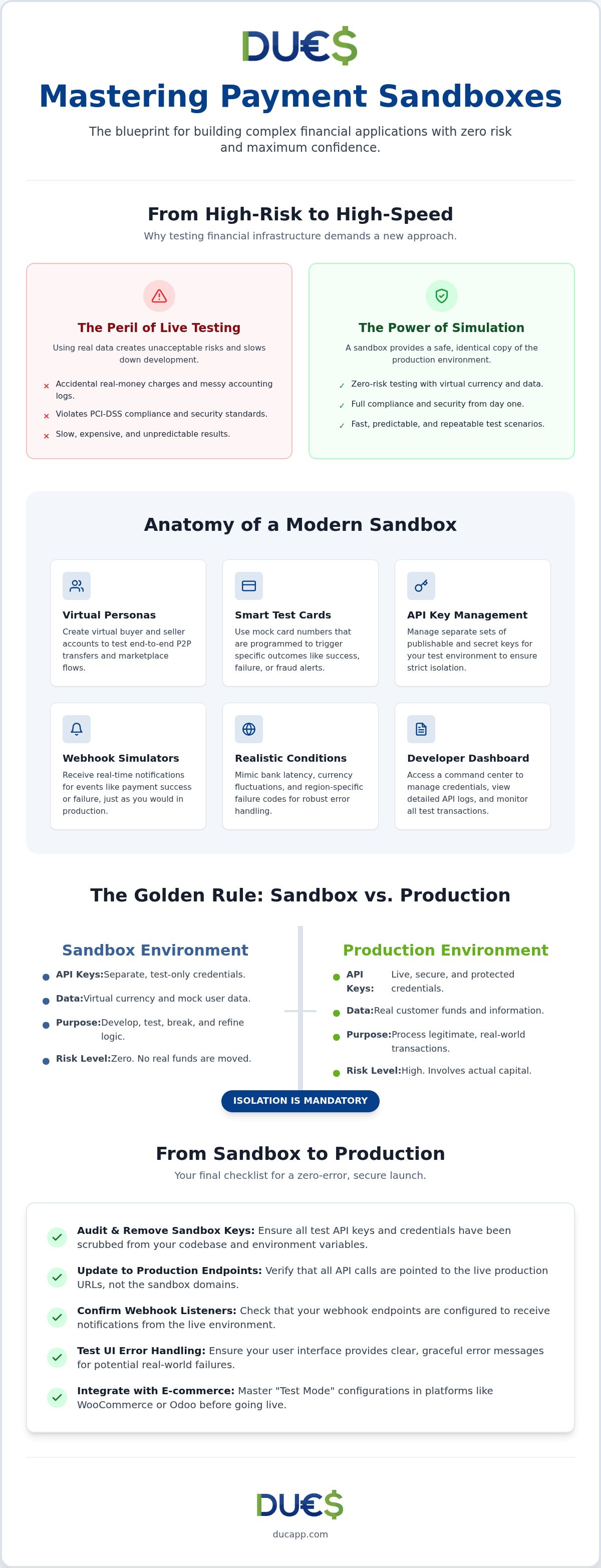
A payment sandbox isn't a luxury. It's a high-fidelity mirror of the live production environment. Think of it as a parallel dimension where your code interacts with a financial ecosystem that feels real but carries zero risk. In this space, you can trigger API calls, simulate complex P2P transfers, and test e-commerce checkouts without moving a single cent of actual capital. It's the ultimate safety net for the modern engineer.
Testing with real credit cards is a critical security and compliance risk that no professional team should take. It violates PCI-DSS standards and creates messy, irreversible logs in your accounting software. Beyond the legal hurdles, real-world testing is slow and expensive. A developer sandbox for payments solves this by replacing volatility with predictability. It has evolved from simple API mocks into complex behavioral simulators. These modern environments mimic bank latency, currency fluctuations, and specific regional failure codes, giving you a 360-degree view of your integration's health.
DUC App empowers developers to build borderless financial tools with total confidence. By providing a documented API and a sandbox that mirrors live production logic, DUC App ensures your international recharges and gift card integrations are battle-tested long before the first user signs up. It's about moving from development to deployment with a sense of high-tech empowerment.
Why "Test-First" is Mandatory for Fintech in 2026
The cost of a failed transaction isn't just financial. It's reputational. In a world of instant digital feedback, one broken checkout flow can alienate a customer forever. Regulatory standards for international money transfers are also tighter than ever. You must prove your system handles cross-border logic, fee calculations, and anti-fraud checks with precision. Using a sandbox allows you to simulate the entire user journey. You can validate balance transfers between virtual wallets and ensure that gift card redemptions trigger the correct webhooks every time. It's the only way to meet 2026's high expectations for frictionless finance.
The Difference Between Sandbox and Production Environments
Isolation is the golden rule of payment integration. Your development logic must live in a separate space with its own dedicated API keys and endpoints. This prevents accidental data leaks and ensures that test transactions never mix with real customer records. In the DUC App sandbox, you work with "Virtual Currency." This digital asset behaves exactly like real funds, following the same rules for global remittances and P2P transfers. However, it stays within the digital playground. Always keep your sandbox keys in your local environment files and reserve production credentials for the final, secure launch. This separation is what allows for true speed and momentum during the build phase.
Anatomy of a Payment Sandbox: Essential Tools and Features
A developer sandbox for payments is a structured toolkit designed for precision. It goes beyond a simple endpoint. It provides the infrastructure to build, break, and refine your financial logic without real-world consequences. To master this environment, you must understand the specific components that make up its anatomy. Each tool serves a distinct purpose in ensuring your code is production-ready.
Virtual accounts are the foundation. They allow you to create buyer and seller personas. This is vital for testing P2P transfers or international recharges. You can simulate a user in one country sending a gift card to another, verifying that the balance updates correctly on both ends. Test credentials follow this. Use mock credit card numbers and CVVs from the documentation to trigger specific transaction paths. These aren't just random digits. They are programmed to return specific API responses based on the data you send.
API key management is where security begins. Always distinguish between your Publishable and Secret keys. Your Publishable key handles client-side tokens. Your Secret key lives on your server to authorize sensitive actions. To stay updated on transaction status, use webhook listeners. These allow your system to receive real-time notifications when a payment succeeds or fails. If you're ready to dive in, the DUC App developer dashboard offers all the tools you need to get started.
Managing Your Developer Dashboard
Your dashboard is the command center for your integration. It's where you generate and rotate sandbox credentials to keep your development environment secure. Don't just look at the "Success" logs. Monitor test logs to identify silent integration errors that might not crash your app but could degrade the user experience. If your test data becomes too cluttered, use the reset function. It provides a clean slate for major version updates, ensuring your logic remains sharp and focused.
Mock Data and Predictable Responses
Predictability is the ultimate goal of testing. Use specific test amounts to trigger different states. You can program $10.00 to return a "Success" while $55.00 triggers a "Declined" response. This lets you see exactly how your UI handles a rejected card. Go further by simulating network latency. It's important to know how your application behaves during a timeout scenario. Finally, always test 3D Secure (3DS) and SCA prompts. These are essential for secure, borderless transactions in 2026.
Advanced Simulation: Testing Cross-Border and P2P Flows
Testing global financial movement requires more than a simple success response. It demands a simulation of the friction, regulations, and conversions that define international finance. A high-performance developer sandbox for payments acts as a global laboratory. Here, you aren't just testing a button; you're validating the entire logic of borderless value exchange. This stage of development is where you refine the spread logic that governs how your platform handles currency exchange rates across different markets.
Simulating international remittances involves testing these conversions in real-time. You need to know exactly how much the recipient receives after fees are applied. In the sandbox, you can trigger specific regional restrictions to see if your compliance checks hold up. Mobile top-up mocks are equally critical. They allow you to verify communication with global carrier APIs without actually purchasing airtime. This ensures your system can handle carrier-specific response codes and varying latency levels. This level of detail ensures that when you go live, your system handles every edge case with high-tech confidence and total reliability.
Testing International Remittances to Cuba and Beyond
Remittances to specific regions like Cuba involve unique variables. While you are sending money to Cuba securely, your code must handle MLC transfers and ensure the recipient's credit is applied correctly. The DUC App sandbox mirrors this production logic perfectly. You can test various payment methods, including Visa, Mastercard, and Apple Pay, to see how each handles the cross-border flow. It's about ensuring that a transfer initiated in Miami or Madrid lands exactly where it should, with the correct currency value and zero friction.
P2P and Digital Product Logic
Instant peer-to-peer payments are the heartbeat of modern fintech. Your integration must validate balance transfers between two virtual wallets with millisecond precision. Utilizing a developer sandbox for payments allows you to simulate these P2P flows to ensure that funds are deducted and credited simultaneously. This testing extends to digital products like gift cards. You can purchase a mock gift card and verify that the delivery logic works as intended. Finally, ensure that email-based payment notifications trigger correctly. A user should receive their confirmation the moment the transaction clears. This end-to-end validation builds the trust and reliability your users expect from a modern digital lifestyle app.
This level of precision is vital for platforms catering to the global entertainment sector, where professionals like high-earning performers require seamless financial tools to manage their careers; for an inside look at the business of being a DJ, click here.
Seamless E-commerce Integration: Sandbox Testing for WooCommerce and Odoo
Your online store is where code meets commerce. It's the most visible part of your digital ecosystem. Launching without a rigorous staging phase is a risk you don't need to take. A developer sandbox for payments allows you to build a perfect replica of your store's checkout flow. You can break things in private so they stay fixed in public. This environment lets you verify that every tax calculation and shipping fee aligns perfectly with the final transaction total. It's about maintaining a sense of calm and reliability as you scale your business globally.
Setting up a local staging environment is the first step toward a frictionless launch. It provides a safe space to install updates and test new features without impacting live sales. By using the DUC App sandbox, you can simulate the purchase of international recharges or digital gift cards. This ensures your backend handles the delivery of these digital assets the moment the payment is confirmed. If you're ready to scale your store's capabilities, you can get started with DUC App integration today.
WooCommerce Testing Workflow
Integrating a new payment method into WordPress should be effortless. Start by installing the payment API for WooCommerce within your development site. Once installed, toggle the DUC App plugin into "Test Mode." This simple switch redirects all API calls to the sandbox. Now, walk through the customer journey. Add a product to the cart. Proceed to checkout. Use your test card credentials to complete the order. Your objective is to verify that orders move from "Pending" to "Processing" automatically. This automation is what creates the liberating, efficient experience your customers expect.
Odoo Payment Gateway Configuration
Odoo users require precision across complex business flows. Linking your Odoo instance to the DUC App developer sandbox is direct and secure. Within the Odoo dashboard, enter your sandbox credentials to activate the gateway. This is the time to test recurring billing and subscription logic. Ensure that monthly cycles trigger correctly without manual intervention. You should also validate tax and fee calculations for international customers. The sandbox allows you to simulate buyers from different regions, confirming that regional pricing stays accurate. Debugging these elements in the developer sandbox for payments ensures that common plugin conflicts are resolved long before they reach a single customer. It's about building a system that is both cutting-edge and deeply reliable. This proactive approach prevents the cold, bureaucratic hurdles of failed payments from ever touching your user base.
From Sandbox to Production: Your Checklist for a Secure Launch
The transition from a developer sandbox for payments to a live environment is the defining moment for your fintech stack. You've built the logic and tested the flows. Now, you must move from the playground to the real world with high-tech confidence. This phase isn't about writing more code. It's about auditing your environment to ensure every transaction moves with total fluidity and security. Precision at this stage prevents the friction that leads to failed launches.
Start with a final security audit. Scour your frontend code to ensure no sandbox keys are hardcoded. These credentials should live exclusively in your server-side environment variables. Next, validate your error handling. A live user should never see a raw API error. Your UI must gracefully handle declined payments or network timeouts with clear, helpful messaging. Once you're ready, perform the "Penny Test." Use real credentials to process a small, real-money transaction in your production environment. This confirms that the entire plumbing, from your server to the global banking network, is connected and functional.
Finally, update your API base URL. Switching from the sandbox endpoint to the live production endpoint is a small change with massive implications. Double-check that your system is pointing to the correct live servers before you open the doors to your customers.
The 5-Step Production Readiness Review
- Step 1: Rotate all API keys. Generate fresh production credentials and verify that your environment variables are correctly mapped.
- Step 2: Perform an end-to-end test. Execute a real, small-value transaction to confirm the funds land in the destination account as expected.
- Step 3: Secure your webhooks. Verify that your webhook endpoints are reachable, secured with SSL, and ready to receive real-time status updates.
- Step 4: Audit compliance. Ensure your integration meets the standards of a secure international money transfer app to protect user data.
- Step 5: Final UI/UX walkthrough. Navigate the checkout flow as a customer to ensure the experience is liberating and efficient.
Post-Launch Monitoring and Support
Your job doesn't end at deployment. Set up automated alerts for high failure rates or unexpected API latency. Monitoring these metrics allows you to act proactively before a minor glitch impacts your user base. If you encounter a hurdle, use the DUC App support channels for real-time troubleshooting. Our team acts as your smart companion, helping you navigate complex backend processes. Always implement a fallback payment method for critical business continuity. Having a secondary path ensures your service remains a frictionless solution, even during rare third-party downtime. By leveraging a developer sandbox for payments and following this checklist, you ensure your 2026 launch is as seamless as the digital transactions you facilitate.
Elevate Your Fintech Integration Strategy
The path to a flawless 2026 launch is paved with precision and high-tech confidence. You've seen how a dedicated developer sandbox for payments turns complex global logic into a predictable playground. By mastering virtual accounts and simulating cross-border P2P flows, you eliminate the risk of accidental charges or broken logic. You've also learned that a secure launch depends on a rigorous final audit of your environment variables and endpoints. This methodical approach is what separates a disruptive innovator from the status quo.
DUC App is your smart companion in this journey. We provide a fully documented API for global fintech and a dedicated sandbox for risk-free testing. Our seamless WooCommerce and Odoo plugins ensure your e-commerce integration is efficient, secure, and deeply reliable. Don't let the friction of traditional banking slow your momentum. It's time to build borderless financial tools that empower your users to live without constraints. Start building with the DUC App Developer Sandbox today and take the first step toward a liberated digital lifestyle. Your zero-error production launch is closer than you think.
Frequently Asked Questions
What is the difference between a payment sandbox and a staging environment?
A payment sandbox is a mock environment specifically for financial logic and API responses. A staging environment is a full replica of your entire application. You use a developer sandbox for payments to test transaction flows within that staging setup. This separation ensures your code handles virtual currency and mock responses perfectly before you ever touch a live production server. It's about isolation and precision.
Do I need a real credit card to use the DUC App developer sandbox?
You don't need a real credit card to use the DUC App sandbox. Using real cards creates unnecessary security risks and accidental charges. We provide a list of mock card numbers and CVVs in our documentation. These credentials allow you to simulate international recharges and P2P transfers using virtual balances. It's a risk-free way to validate your financial logic without touching your actual bank account.
Can I test Apple Pay and Google Pay transactions in the sandbox?
Yes, our sandbox supports testing for Apple Pay and Google Pay integrations. The environment simulates the tokenization and authorization process used by these mobile wallets. This allows you to verify that your checkout UI handles digital wallet responses with the same fluidity as standard card payments. Testing these flows ensures a modern, frictionless experience for your users across all devices and platforms.
How do I simulate a declined transaction for testing purposes?
You simulate a declined transaction by using "trigger" data points like specific test amounts or card numbers. For instance, an amount of $55.00 might be programmed to return a "declined" status. This helps you verify that your UI gracefully handles errors and provides clear feedback to the user. Check the DUC App developer dashboard for the full list of magic values and their corresponding error codes.
Is the sandbox environment free to use for all developers?
The DUC App developer sandbox for payments is free for all engineers. We believe in removing obstacles to innovation. You can access the fully documented API, generate test keys, and build your entire integration without any upfront costs. This allows you to perfect your P2P flows and WooCommerce plugins at your own pace. You only move to production when you're ready for live global transactions.
How long does it take to move from sandbox testing to production?
Transitioning to production is rapid once your sandbox testing is finalized. If your integration is clean, the switch takes less than a day. You simply rotate your API keys and update the base URL in your environment variables. After a successful "Penny Test" with real credentials, your system is live. This speed reflects our commitment to high-tech efficiency and immediate results for your business.
Can I test cryptocurrency-to-fiat conversions in the sandbox?
DUC App focuses on streamlining international recharges, gift cards, and P2P transfers. Our sandbox is optimized for these global remittance flows and mirrors production logic for traditional currencies. While we utilize modern digital infrastructure, you should consult our latest API documentation for specific conversion capabilities. For developers building on the blockchain, comparing web3 API pay per call pricing can help in selecting a robust infrastructure partner. We prioritize movement and fluidity in value exchange to keep your integration simple and effective for your target users.
What should I do if my webhook isn’t receiving sandbox notifications?
Start by checking if your listener URL is publicly reachable and secured with an SSL certificate. Sandbox environments require a secure endpoint to deliver transaction notifications. Review your dashboard logs to see if the DUC App attempted the delivery. If the logs show a timeout or error, verify your server's firewall settings. Ensuring your endpoint can handle POST requests is critical for receiving real-time status updates.


