
In 2026, sending money to Cuba isn't just about the exchange rate; it's a high-stakes race against shifting regulations and outdated banking hurdles. You need a reliable way to send money to cuba securely without watching your hard-earned funds get trapped in a web of sanctions or hidden fees. The traditional routes often feel like a gamble. Between the official Segment III rate of 596 CUP and the informal market hitting 673 CUP, the math is already complicated enough. You shouldn't have to worry if your family will actually see the notification on their phone.
We understand the anxiety of waiting days for a transfer only to find it frozen due to a technicality. It's frustrating when legacy systems can't keep up with your life. This guide changes that. You'll master the technical, legal, and practical steps to ensure your money reaches your family in Cuba safely and instantly. We're breaking down the latest 2026 OFAC guidelines, explaining how to navigate MLC account requirements, and showing you how high-level encryption keeps your personal data locked down while your funds move at the speed of light.
Key Takeaways
- Define the 2026 security standard that combines technical encryption with delivery guarantees to ensure your funds reach their destination.
- Compare the speed of digital P2P transfers against legacy banking delays to minimize the time your money spends in transit.
- Navigate regulatory requirements like the Electronic Remittance Affidavit to prevent your funds from being blocked by compliance filters.
- Follow a specific step-by-step process to verify MLC account details and enable multi-factor authentication to send money to cuba securely.
- Leverage versatile payment methods like Apple Pay and Google Pay to build a redundant, fail-safe bridge for your international transfers.
What Does it Mean to Send Money to Cuba Securely in 2026?
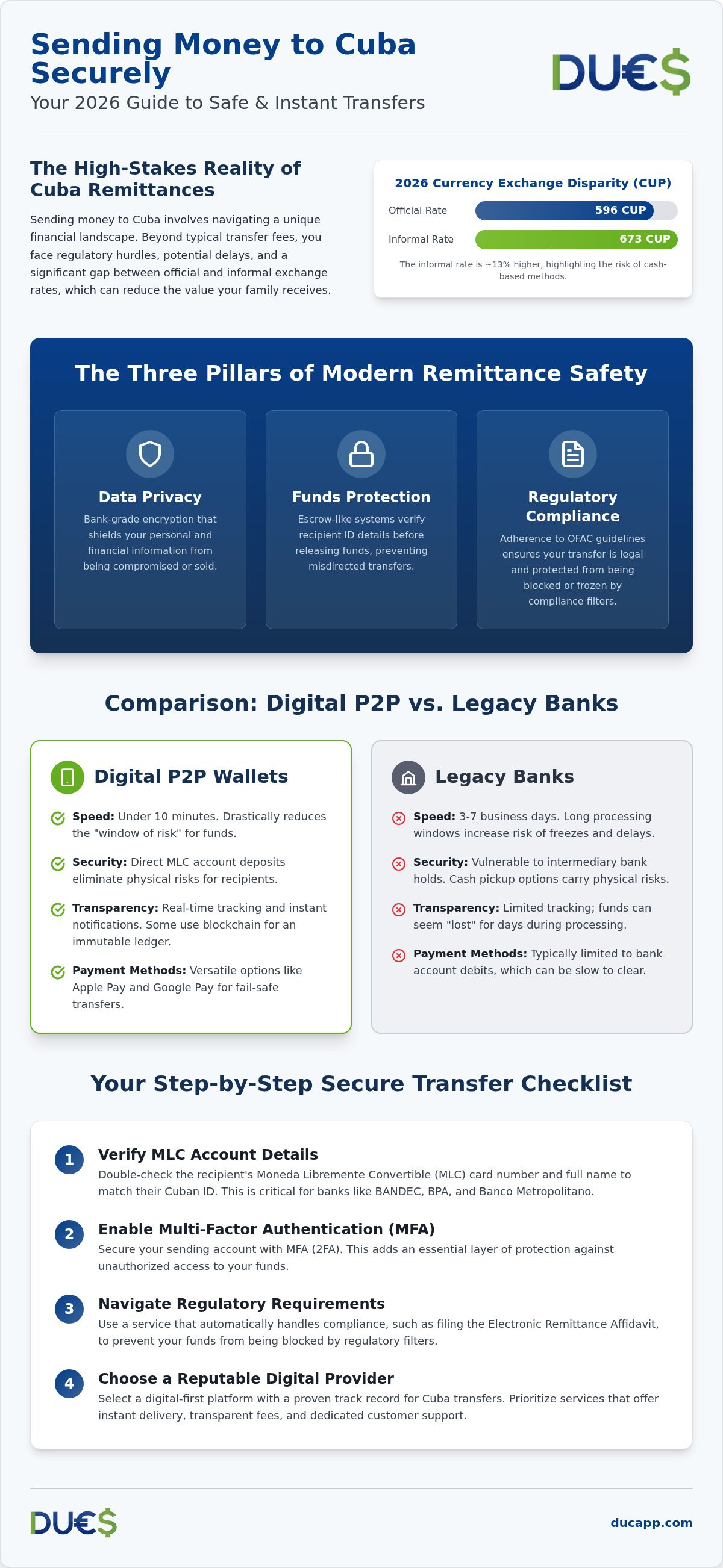
Security in 2026 isn't just a checkbox. It's a multi-layered shield. When you send money to cuba securely, you're navigating a financial environment unlike any other. Most Caribbean nations use standard international banking, but Cuba operates under a complex regulatory framework shaped by the U.S. embargo against Cuba. This unique status means a standard wire transfer isn't just slow; it's vulnerable to being frozen. True security in this corridor combines bulletproof cybersecurity with a delivery guarantee. You need a system that ensures your money won't vanish into a compliance black hole or get eaten by the massive spread between the official 596 CUP rate and the 673 CUP informal market rate.
Avoiding informal street-level scams is the first rule of 2026 safety. While "mules" carrying cash were once a necessity, they offer zero protection and no digital trail. Today's secure landscape relies on fiscal transparency. If a provider can't show you exactly where your money is at every second, it's not secure. Digital-first platforms have replaced risky informal networks. They allow you to send money to cuba securely by offering instant notifications and verified endpoints, removing the uncertainty that used to plague family support.
The Three Pillars of Remittance Safety
Cybersecurity is only half the battle. To protect your family's future, your provider must master three specific areas:
- Data Privacy: Bank-grade encryption shields your financial information from third parties. Your ID and card details shouldn't be a product for sale on the dark web.
- Funds Protection: Modern systems use escrow-like mechanisms. Money is only released when the system verifies the recipient's details match their Cuban ID card.
- Regulatory Compliance: Following OFAC guidelines and General License 1 ensures your transfer remains legal and protected from sudden policy shifts.
MLC Accounts and Cuban Bank Security
In 2026, Moneda Libremente Convertible (MLC) is the essential digital currency for accessing food and medicine in Cuba. Securely reaching accounts at BANDEC, BPA, or Banco Metropolitano requires a specialized technical bridge. These institutions have updated their security protocols, but they still operate on legacy timelines. While bank-to-bank audits provide a necessary paper trail, they can create bottlenecks that increase the "window of risk" for your funds. This is why digital wallets have become the preferred secure endpoint. They provide the high-level encryption required by Cuban banks while eliminating the delays associated with traditional processing. It's a faster, safer way to ensure funds land exactly where they're needed.
Comparing Secure Methods: Digital Wallets vs. Legacy Banks
Legacy banks offer a sense of traditional safety, but in 2026, their complexity is often a liability. While these institutions follow strict regulations, their multi-day processing windows create a "window of risk" where funds can be flagged, held, or delayed by intermediary banks. This often leads to the nightmare of "lost" wires that take weeks to resolve. In contrast, digital P2P apps allow you to send money to cuba securely by prioritizing speed. When a transaction completes in minutes, there's less time for external interference or technical glitches to derail the delivery. You aren't just paying for convenience; you're paying for a shorter exposure time.
According to expert policy analysis, digital solutions are increasingly vital for overcoming the inherent bottlenecks of the Cuban financial system. Physical cash pickup, once the standard, now carries the highest risk for recipients. Carrying large amounts of currency through city streets exposes family members to physical theft and the extreme volatility of informal exchange rates. Digital transfers directly to MLC accounts remove these physical dangers entirely, keeping your family safe and their funds private.
The Speed-Security Correlation
Speed is a vital security feature. When transfers take under 10 minutes, you significantly reduce the opportunity for "Man-in-the-Middle" attacks. End-to-end encrypted apps ensure your data remains shielded throughout the entire lifecycle of the transfer. DUC App focuses on this efficiency, minimizing transit time to protect your capital from the second you hit send. If you want to experience this level of protection, you can start your first secure transfer today and see the difference speed makes.
Payment Method Safety: Apple Pay vs. Credit Cards
Your choice of payment method adds another layer of defense. Tokenized payments like Apple Pay and Google Pay are superior to manual credit card entries. They don't share your actual card number with the platform, using a unique one-time code instead. This prevents data breaches from compromising your main accounts. For senders in Europe and Canada, SEPA and Interac offer direct-from-bank security with built-in fraud monitoring. These methods provide the chargeback protections you need for international peace of mind, ensuring your financial journey is as safe as it is fast.
Navigating Regulations: Compliance as a Shield, Not a Barrier
Compliance often feels like red tape, but in the context of Cuban remittances, it's actually your strongest legal bodyguard. When you use a platform to send money to cuba securely, the regulations act as a shield for your personal assets. The Electronic Remittance Affidavit is a prime example. While some legacy providers treat it as a tedious hurdle, this document legally certifies your transaction. It ensures you're operating within the authorized bounds of the OFAC Cuba Sanctions regulations, effectively protecting you from any potential legal blowback or fund seizures. It's your proof that the money is for family support and not for prohibited entities.
Reputable apps must implement strict Know Your Customer (KYC) protocols. If a platform doesn't ask for your ID, it's a major red flag. Unregulated services might seem convenient, but they lack the Anti-Money Laundering (AML) monitoring that keeps the entire network clean. Licensed payment institutions are audited to ensure they aren't funneling money to restricted parties. By verifying your identity, these platforms ensure your transaction is tagged as a legitimate family remittance. This verification is the key to ensuring your transfer isn't blocked by international intermediary banks during transit.
OFAC and International Sanctions
In 2026, the legal path for US residents is clearer than ever. While Executive Order 14404 expanded some sanctions in May 2026, General License 1 ensures that personal remittances to family members remain authorized. Secure apps automate this compliance by checking recipient names against restricted lists in real-time. This means you don't have to be a legal expert to send money to cuba securely. In 2026, OFAC's role is to define the safe lanes for family support while blocking transactions to prohibited government officials.
The Importance of Transaction Receipts
A digital audit trail is your most vital security asset. Every transfer should generate a unique transaction ID immediately. This ID is your proof of delivery and your primary tool for tracking funds in real-time. If there's a discrepancy, a formal receipt allows for a secure resolution protocol. You should never rely on verbal promises or informal messages. A legitimate platform provides a downloadable, timestamped record that serves as your legal receipt, ensuring that every cent is accounted for and traceable from your bank account to your recipient's MLC card.
Step-by-Step Guide to Executing a Secure Transfer
Execution is the bridge between your intention and your family's financial relief. To send money to cuba securely, you must adopt a technical mindset that prioritizes data accuracy and encrypted protocols. In the 2026 landscape, a single typo in an MLC account number can lead to an investigation by compliance officers, potentially freezing your funds for weeks. This guide removes that risk by focusing on a disciplined, five-step workflow designed for maximum reliability and speed.
Step 1: Verify your recipient’s MLC account number and ID details twice. Precision is your first line of defense. Step 2: Choose a platform with multi-factor authentication (MFA) enabled. This ensures that even if your password is compromised, your funds remain untouchable. Step 3: Select a secure payment method. Opt for tokenized debit cards or direct bank transfers to minimize the exposure of your primary financial data. Step 4: Review the exchange rate and service fees for hidden spreads. Ensure the amount you send aligns with the expected value in Cuba. Step 5: Confirm the transfer and share the tracking link with your recipient. Immediate transparency reduces anxiety for everyone involved.
Recipient Verification Checklist
Accuracy begins with the Carnet de Identidad. Before you initiate any transaction, ask your recipient for a photo of their ID and their bank card from BANDEC, BPA, or Banco Metropolitano. The name on the transfer must match the bank's records exactly. Confirm the specific account type; sending USD to a CUP account can trigger automatic conversions at unfavorable rates. For first-time transfers, we recommend the "Small Test Transfer" strategy. Sending a minor amount first confirms that the digital bridge is active and the recipient can access the funds. Once the test succeeds, you can proceed with the full amount with total peace of mind. To start your first verified transfer, connect with the DUC App ecosystem today and see how easy secure delivery can be.
Securing Your Own Account
Your personal device is the gateway to your capital. Enable biometric locks like FaceID or fingerprint scanning to ensure that you are the only person who can authorize a transaction. This physical security layer is essential in a fast-paced digital world. Never send money to cuba securely while connected to public Wi-Fi networks in airports or coffee shops without a VPN. These unencrypted connections are prime targets for hackers looking to intercept sensitive financial data. Additionally, train yourself to recognize phishing attempts. Your transfer app will never ask for your full credentials or MFA codes through an unsolicited text or email. Legitimate communication happens through secure in-app notifications, keeping your identity and your money under your control.
DUC App: The Bold Standard for Secure Cuba Transfers
DUC App represents a shift from the friction-heavy methods of the past toward a borderless fintech ecosystem. When you need to send money to cuba securely, you shouldn't have to choose between speed and safety. We've built a platform that combines the rapid pace of P2P transfers with the ironclad protection of bank-grade encryption. This isn't just about moving numbers from one account to another. It's about providing a secure digital bridge that bypasses the traditional banking bottlenecks that often lead to frozen funds and endless delays. By focusing on a digital-first approach, we ensure your capital moves with the same speed as your life.
The DUC experience is designed to be completely hassle-free. Whether you are sending from the USA, Canada, or Europe, you have access to the local payment methods you already trust. Our platform supports Visa, Mastercard, Apple Pay, and Google Pay, creating a redundant security layer for every transaction. This versatility means you can authorize a transfer using tokenized payments, keeping your primary card details shielded from the network. This commitment to removing friction extends to our advanced features, including international recharges and secure crypto-to-fiat options that provide a hedge against currency volatility.
Why DUC is the Reliable Global Connector
Technical robustness is the foundation of our trust. Unlike legacy providers that hide their processes in a black box, we offer a documented API and transparent developer tools. This openness proves our platform is built on a high-performance architecture capable of handling complex global integrations. The DUC ecosystem is a versatile vault where you can manage P2P transfers, purchase gift cards, and execute email payments from a single interface. We act as your helpful guide throughout the process, providing a tech-savvy expert persona that has already solved the hard problems of compliance and delivery so you don't have to.
Getting Started with DUC
The signup process is lean and direct, matching the efficiency of the service itself. We've removed the unnecessary preamble of traditional banking, allowing you to create an account in minutes. Once you're in, linking your first payment method is a seamless experience guided by active prompts. We prioritize your peace of mind by ensuring that every step, from ID verification to the final confirmation, is protected by multi-factor authentication. You deserve a financial tool that empowers you rather than slows you down. Experience the future of secure transfers to Cuba with DUC App and join a community that values speed, security, and global connection.
Take Control of Your Global Financial Freedom
Remittance security in 2026 is no longer a mystery. Speed is your greatest ally against risk, and regulatory compliance is a powerful shield for your assets. By moving away from legacy banking delays and choosing a digital-first approach, you ensure your family receives their funds without the stress of frozen accounts or hidden fees. It's about combining technical precision with a platform that understands the unique Cuban landscape. You can now send money to cuba securely by following a verified workflow that prioritizes your peace of mind and your recipient's convenience.
DUC App is ready to be your reliable global connector. We've solved the hard problems of integration and security so you can focus on supporting your loved ones. Our ecosystem features end-to-end encryption, OFAC compliant protocols, and global payment support including Apple Pay to make your experience completely hassle-free. Don't let outdated systems stand in your way. Send Money to Cuba Securely with DUC App and experience the speed and safety you deserve. Your family is waiting. Let's bridge the distance together.
Frequently Asked Questions
Is it legal to send money to Cuba from the USA in 2026?
Yes, personal remittances to Cuban nationals remain authorized under the U.S. Treasury’s General License 1. While Executive Order 14404 expanded certain sanctions in May 2026, it didn't block your right to support your family. You simply must verify that your recipient isn't a prohibited government official or a member of the Cuban Communist Party. Using a compliant platform ensures your transfer stays within these legal lanes.
How long does a secure transfer to an MLC account take?
Secure transfers to an MLC account can arrive in as little as 10 minutes when you use a digital P2P platform. Traditional bank wires often take between 5 to 7 business days, which significantly increases the time your capital is in transit. Choosing a faster digital route minimizes this window of risk and ensures your family gets their funds exactly when they need them most.
What is the safest way to send money to someone in Cuba without a bank account?
International recharges or digital gift cards are the safest digital alternatives for recipients who don't have a formal bank account. These methods bypass the need for an MLC card while providing immediate value for communication or essential goods. You should avoid physical cash "mules" at all costs; they offer no legal protection or digital trail to send money to cuba securely.
Can I send money to Cuba using cryptocurrency securely?
Yes, you can use cryptocurrency as a secure bridge through platforms that offer crypto-to-fiat conversion directly into Cuban accounts. This method utilizes an immutable blockchain ledger to track your transaction with total transparency. It's a modern way to circumvent traditional banking bottlenecks while maintaining the high-level encryption required for international financial safety and peace of mind.
What documents do I need to provide for a secure money transfer?
You need a valid government-issued ID, the recipient's full name as it appears on their Cuban ID card, and their specific MLC account details. Reputable platforms also require you to sign an Electronic Remittance Affidavit. This document is a vital legal requirement that protects you by certifying the transfer is a legitimate family remittance and fully compliant with current 2026 regulations.
How do I know if a money transfer app for Cuba is a scam?
A legitimate app will always require identity verification (KYC) and have a documented history of successful deliveries. Look for features like multi-factor authentication and biometric login as standard security measures. If an app promises unrealistic exchange rates or asks for your password via text, it's a scam. Stick to platforms with transparent fee structures and verified app store ratings to stay safe.
Are there limits on how much MLC I can send securely per month?
Monthly limits often depend on the recipient’s bank, such as BANDEC or BPA, rather than just the transfer platform itself. While there's no longer a specific quarterly cap on family remittances from the U.S., individual providers often set daily limits, such as $2,000 per transaction. Always check your recipient's current bank limit to ensure you send money to cuba securely without hitting unexpected ceilings.
Does DUC App protect my data with 256-bit encryption?
Yes, DUC App utilizes bank-grade encryption to shield every piece of your personal and financial data from the moment you log in. This technical standard ensures that your information is unreadable to unauthorized third parties during transit. We prioritize your privacy alongside delivery speed, creating a secure vault for your transfers that meets the highest modern cybersecurity requirements for global financial services.


