

Sending money to Cuba from the U.S. can be legal, but the recipient must be eligible. Personal remittances to eligible Cuban nationals are generally authorized under the Cuban Assets Control Regulations. Senders can’t transfer funds to certain restricted parties, including senior Cuban government officials and members of the Cuban Communist Party. If you want to send money to Cuba online, start by understanding these limits.
It makes sense to get clear answers before choosing a transfer method. The rules, fees, exchange rate and delivery options can all affect how much your recipient receives and how they can access it.
This guide explains when U.S. transfers are allowed, what to compare between online transfer options and how different delivery methods work. You’ll also find practical steps for sending money online, so you can choose an option that suits your recipient and how you plan to pay.
Key Takeaways
- Personal remittances from the U.S. to eligible Cuban nationals are generally authorized, but restricted parties cannot receive funds.
- Compare the exchange rate, transfer fee, payment method, and amount the recipient will receive before choosing an option.
- Cash pickup can involve collection at a partner location with a Cuban national identity card and transfer reference number.
- Learn what steps to take if a transfer is delayed, incorrect, or needs to be canceled.
- Follow a simple online transfer process, from entering recipient details to reviewing the final transfer information before payment.
Is it legal to send money to Cuba from the U.S.?
Yes, certain personal remittances from U.S. residents are generally authorized. The recipient must be an eligible Cuban national, and the transfers are governed by the Cuban Assets Control Regulations. U.S. senders can’t send funds to certain restricted parties, including senior Cuban government officials and Cuban Communist Party members. Check the recipient’s eligibility before entering payment details.
There is no hard quarterly cap on family remittances under current U.S. rules. That does not remove provider transaction limits or screening. Transfer companies may set limits based on verification and the transaction. Keep the purpose and recipient details accurate. A mismatch can trigger processing review or delay.
To send money from the U.S. to Cuba online, choose a transfer service that supports this route. Payment methods and delivery options vary, so compare the available ways to fund the transfer and the payout options before you start.
Available funding methods include direct bank payment and cash. ACH bank transfers usually take a day or two days to clear before a transfer company sends funds to Cuba. Cash-funded international transfers carry a 1% federal tax beginning January 1, 2026. Compare the full payment amount and the expected amount received, not just the listed transfer fee.
| Payment option | How it works | What to consider |
|---|---|---|
| Direct bank payment | Choose bank funding and enter the requested payment details. | ACH clearing usually takes a day or two days before dispatch. |
| Cash funding | Pay cash through a transfer service that accepts it. | A 1% federal tax applies to cash-funded international transfers beginning January 1, 2026. |
A transfer service is needed to process either option. A covered U.S. remittance transfer company must show the exchange rate, fees and expected amount received before payment. Review these figures together: the exchange rate can matter as much as the fee because it affects the amount your recipient gets.
Keep border rules separate from online payment rules. According to the Financial Crimes Enforcement Network, the U.S. border declaration rule applies when physically carrying more than $10,000 across the border. That rule concerns carrying funds across a border, not sending an online transfer. Choose direct bank payment or cash based on the service’s available funding method and your preferred processing path.
Cancellation and error-resolution rights
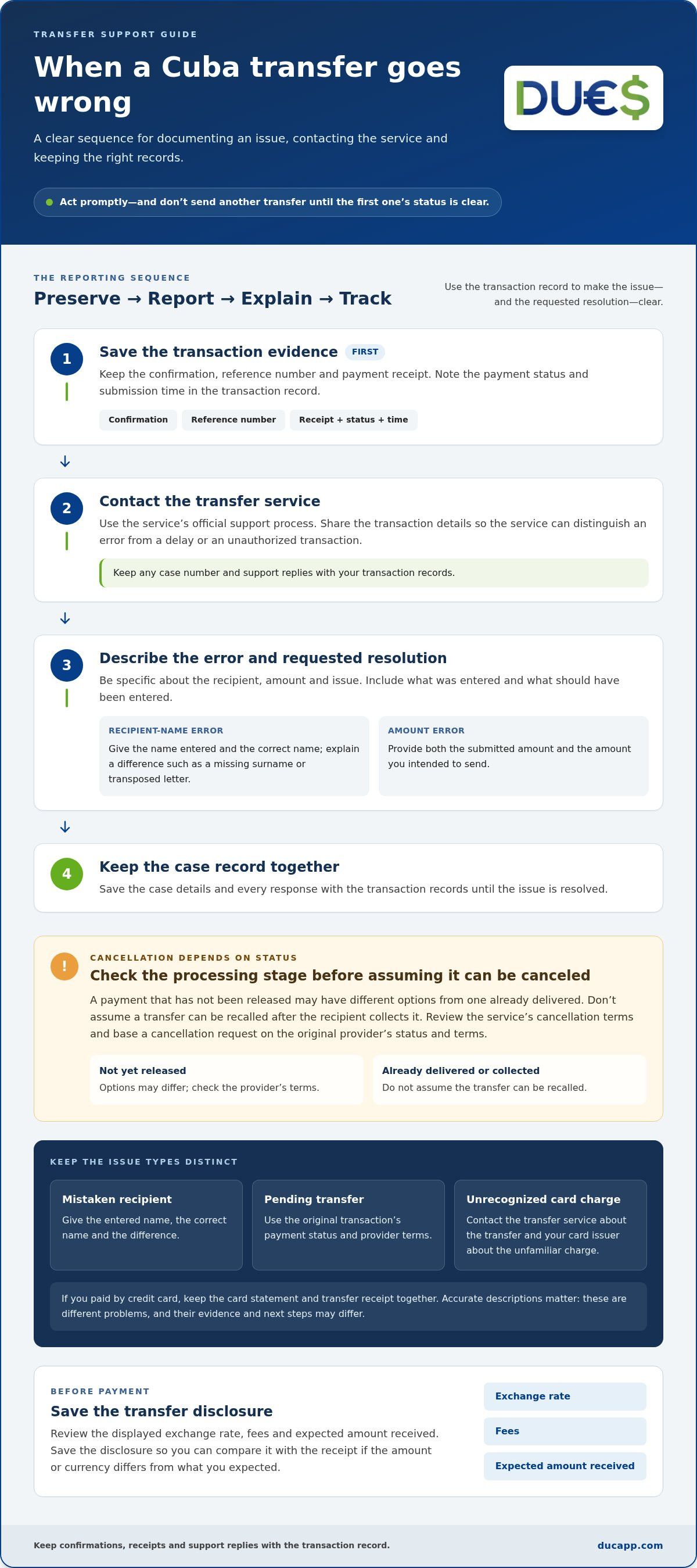
Act promptly if a transfer has the wrong recipient, amount or destination. Open the transaction record and note its reference number, payment status and submission time. Then report the issue through the transfer service’s support process. Clear details can help distinguish a typing error from a delayed payment or an unauthorized transaction.
Whether you can cancel depends on the transfer’s processing stage and the service’s terms. A payment that hasn’t been released may have different options from one already delivered. Don’t assume a transfer can be recalled after the recipient collects it. Review the cancellation terms before submitting, and save a copy of the confirmation screen.
For an incorrect recipient name, give the service the name entered and the correct name. Explain the difference, such as a missing surname or transposed letter. For an amount error, provide both the submitted amount and the amount you intended to send. Don’t send another transfer until the first transaction’s status is clear.
Use this sequence to report a problem:
- Save the confirmation, reference number, and payment receipt.
- Contact the transfer service through its official support channel.
- Describe the error, recipient, amount, and requested resolution.
- Keep the case details and any response with your transaction records.
If you paid by credit card, keep the card statement and transfer receipt together. Contact the transfer service about the transfer, and contact your card issuer about any charge you don’t recognize. Describe the issue accurately: a mistaken recipient, a pending transfer and an unfamiliar charge are different problems, and the evidence and next steps may differ.
Before paying, check the displayed exchange rate, fees and expected amount received. A covered U.S. remittance transfer company must show those details before payment. Save the disclosure so you can refer to it if the receipt later shows a different amount or currency than expected.
Choose a provider regulated as a money services business by FinCEN, and keep its transaction records. Follow the provider’s stated process for international transfers rather than relying on informal messages. If the service gives you a case number, include it in follow-up communications and keep the replies until the issue is resolved.
For a separate digital transaction, review the available online payment options and keep its confirmation with your records. For a Cuba transfer, base any cancellation request on the original provider’s status and terms.
Cash pickup and cash delivery
Recipients in Cuba may be able to collect cash at partner locations. Some providers also offer payouts in Cuban pesos (CUP) or MLC, a digital currency used at certain state-run stores. These are different ways to receive funds, so choose a payout the recipient can access.
For cash pickup, the recipient generally needs a Cuban national identity card and the transfer reference number. Share the reference securely and make sure the recipient’s name matches the identification they’ll present. Differences can make collection difficult. Keep the transfer receipt until the recipient confirms the funds have been received.
Recipients in Cuba may receive money by bank deposit, mobile wallet or cash pickup, depending on the service and payout route. Cash pickup is available through partner locations, while some providers offer CUP or MLC payouts. MLC transfers may go to a bank account. Check which options the selected service offers.
Choose the delivery method before paying. Ask the recipient which currency is useful and whether they can collect cash or access an MLC account. Cash pickup suits someone who can reach a partner location. An MLC transfer may suit someone who uses that digital currency at certain state-run stores.
- Cash pickup: The recipient collects cash at a partner location with their Cuban national identity card and transfer reference.
- CUP delivery: The recipient receives funds in Cuban pesos, where the provider offers that option.
- MLC delivery: The recipient receives MLC, used at certain state-run stores.
Delivery timing can depend on the payout method. Local conditions in Cuba, including power supply and public holidays, can delay an MLC bank transfer. Consider this if the recipient needs funds for a particular purchase or date. Cash pickup and an MLC bank transfer use different delivery routes, so don’t assume they have the same processing conditions.
Before sending, confirm the recipient’s full name, preferred payout method and collection details. Review the transaction summary, including the selected currency and expected amount received. For cash pickup, share the reference number only with the intended recipient. For MLC, verify the bank account details before submitting payment.
If the recipient can’t reach a partner location, cash pickup may not suit their needs. If they don’t use MLC, an MLC payout may not be practical either. Choose based on where they can collect or use the funds, rather than simply selecting the first option in the transfer flow.
Cheapest provider comparisons
The lowest advertised fee may not offer the best value for your recipient. Compare the total cost, including the exchange rate and amount received. A covered U.S. remittance transfer company must show the exchange rate, fees and expected amount received before payment. Consider all three together.
Start with an identical transfer amount and payout currency for each comparison. If one quote pays out in Cuban pesos and another in MLC, their final amounts aren’t directly comparable. The displayed mid-market rate is 1 USD = 24.0258 CUP. Provider exchange rates may differ, so use the rate shown in each live quote.
Then compare the available ways to fund the transfer. Direct bank payment and cash are listed funding methods, and the payment method can affect the total. ACH bank transfers usually take a day or two to clear before the transfer company can send funds to Cuba. Factor in that clearing time if speed matters, rather than comparing fees alone.
| Comparison point | Bank-funded transfer | Cash-funded transfer |
|---|---|---|
| Funding method | Direct bank payment, including ACH where offered | Cash through a service that accepts it |
| Processing factor | ACH clearing usually takes a day or two | Depends on the service’s cash-payment process |
| Quote details | Compare exchange rate, fees, and amount received | Compare the same details and account for applicable tax |
For cash-funded international transfers, a 1% federal tax applies beginning January 1, 2026. Compare quotes after accounting for that tax. It can change the effective cost even when a displayed transfer fee looks low. Don’t treat the fee as the full amount you pay.
Use a simple comparison sequence:
- Enter the same send amount and recipient payout currency.
- Record each quote’s exchange rate, fees, and expected payout.
- Compare the amount received after funding costs and applicable tax.
- Check the delivery method and estimated processing time.
Provider transaction limits can also affect your comparison. If the planned amount exceeds a displayed limit, the comparison may not apply to the full transfer. Verification level and payment method can affect the available limit.
Finally, confirm that each quote matches the recipient’s intended payout route. A cash pickup and an MLC payout serve different needs. One market snapshot lists 20,000 CUP as the most-transferred amount to Cuba, but your comparison should use the amount and currency your recipient actually needs. Choose the quote with the strongest combination of received value, suitable delivery, and workable processing.
Steps to send money online
To send money to Cuba online, follow the transfer steps in order. First, confirm the recipient is eligible under the U.S. rules discussed earlier. Then choose a service that supports the U.S.-to-Cuba route. It should show the exchange rate, fees and expected amount received before you pay.
Prepare the recipient’s details before opening the form. Enter a name that matches their identification or payout account. Choose a delivery method they can use, such as cash pickup or an available MLC option. Make sure the destination is correct: cash pickup uses a partner location, while an MLC transfer may involve a bank account.
- Choose the route. Select Cuba as the destination and the payout method the recipient can access.
- Enter recipient details. Match the name and account or collection information to the chosen delivery method.
- Enter the amount. Review the amount to send, payout currency, exchange rate, fees, and expected amount received.
- Select payment. Choose an available funding method. Direct bank payment and cash are listed options.
- Review and submit. Check every field before authorizing payment, then save the confirmation and reference.
The funding method can affect processing. ACH bank transfers usually take a day or two to clear before a transfer company can send money to Cuba. Allow for that clearing period if the recipient needs funds by a particular date. A transfer held for review may be delayed one to three business days.
Review the displayed figures before you authorize the transaction. Compare those details carefully with the exact amount and currency your recipient needs. If the payment method is cash, include the applicable 1% federal tax on cash-funded international transfers, effective January 1, 2026.
After submitting, keep the confirmation, payment record and transfer reference together. Share the reference securely if the recipient needs it for cash collection. Track the transaction through the service you used. If a detail is wrong, contact the service promptly with the reference number and a clear description of the error.
For a separate peer-to-peer transfer, explore online peer transfers with DUC App. That option is for transfers between peers, not a substitute for a Cuba cash-pickup service. For this money transfer, follow the recipient’s chosen payout route and retain the confirmation until funds are received.
DUC App: International recharges
DUC App offers international recharges for mobile top-ups, a different option from sending cash for pickup. Choose a recharge when your goal is to support someone’s mobile connectivity, rather than transfer funds to a bank account or arrange cash collection. DUC App also offers peer-to-peer transfers and gift cards for other digital payment needs.
For the Cuba transfer steps in this guide, choose a money transfer service that supports the recipient’s required payout method. International recharges serve a different purpose and aren’t cash delivery. Be clear about your goal: top up mobile service, send funds between peers or use another suitable digital option.
Visit DUC App online to explore its digital services.
Make your next step count
Before you send money to Cuba online, decide what your recipient needs the funds for. Cash collection, an account-based payout and mobile connectivity address different needs. Match the transfer route to the purpose, and keep your recipient’s access and preferred delivery method at the center of your decision. For those supporting relatives abroad while navigating immigration or family reunification processes, MJ Law offers guidance on legal options.
For other digital needs, DUC App offers international recharges, peer-to-peer transfers and gift cards. Each option serves a different purpose, so choose the one that fits your goal rather than treating it as cash pickup or traditional banking.
Take a moment to identify the right digital service for your situation, then explore the available options at visit DUC App. A clear purpose makes it easier to move forward with confidence.
Frequently Asked Questions
Need to send a large amount of USD to Cuba?
There is no federal cap on how much of your own money you can send electronically abroad, but Cuba transfer providers set transaction limits. For a larger amount, plan around the service’s per-transfer limit and recipient eligibility. Don’t split transfers to avoid screening or legal restrictions.
Which option should you choose for Cuba?
Choose a payout method your recipient can use. For example, cash pickup may suit someone who can reach a partner location, while MLC may fit someone who uses that digital currency. Compare the final payout currency and delivery route as well as the funding method. The right option meets the recipient’s needs, not simply the one shown first.
How do I track my transfer and know when the money has arrived?
Keep the transaction reference and use the transfer service’s transaction page or app to follow the status. A status update may show processing progress, but it doesn’t necessarily confirm that the recipient has collected cash. Ask the recipient to confirm receipt separately. If the status stops changing or the expected delivery window passes, contact the service with the reference number.
What ID does my recipient need to pick up money in Cuba?
Recipients generally need their Cuban national identity card and the transfer reference number to collect cash at a partner location. Send the reference privately, and make sure the recipient uses the name entered on the transfer. For example, a shortened first name may not match the full name on their ID. Keep the receipt until the recipient confirms collection.
What recipient data do I need?
Have the recipient’s full name and the details required for the selected payout method ready. For cash pickup, they’ll need their identity card and transfer reference at collection. An account-based payout requires the relevant account details. Enter every field carefully, including the name spelling and any requested location information. The required fields depend on the delivery route selected in the transfer form.
What are the transfer limits and fees?
Limits and fees vary by provider, amount, payment method and sender verification level. Before paying, compare the displayed fee with the exchange rate and the amount the recipient is expected to receive. For a larger transfer, the provider’s transaction limit may determine whether you can send it in one transaction.
What is the minimum transfer amount, and can I send a small test transfer first?
The transfer service sets the minimum amount and displays it in the transaction flow. If the service allows it, a small test transfer can help confirm the recipient details and payout route. Treat it as a separate transaction: enter the recipient information carefully, then review the displayed costs and payout before submitting.
Where else can you send money?
DUC App lists Bangladesh, Canada, China, Colombia, Cuba, Ecuador, El Salvador, Haiti, India, Ireland, Mexico, Nepal, Pakistan, the Philippines, Spain, Switzerland and the United Kingdom as destinations. The transfer type depends on the destination. Outside Cuba, the listed service type is bank deposit. Select a destination first to see which option applies.


