

The lowest transfer fee can still leave your recipient with less. To find a low cost international remittance service from the USA, compare the full cost: the transfer fee, the exchange-rate markup, and any cost associated with funding the payment. Focus on how much the recipient will receive, not just the fee shown upfront.
Sending money internationally starts with choosing a transfer method, entering the recipient’s details and destination, and comparing the final payout across available options. The payment method matters too: card, bank, and other funding choices can affect the overall cost and convenience. A fast transfer may not be the cheapest, so weigh delivery timing against the amount received.
This guide explains the fees and exchange rates that shape a transfer from the USA. Learn how to compare funding methods, spot costs beyond the headline fee, and use a simple decision guide to choose an option that fits your priorities.
Key Takeaways
- Compare the amount the recipient gets, not just the transfer fee. Exchange-rate markups and other deductions can change the true cost.
- Match the transfer method to your priorities, weighing delivery speed against fees and the final amount received.
- Consider how you fund a transfer: card and physical payment methods can affect its overall cost.
- For sending mobile credit instead of cash, international recharges offer a different way to support someone abroad.
Comparing transfer fees and exchange-rate markups
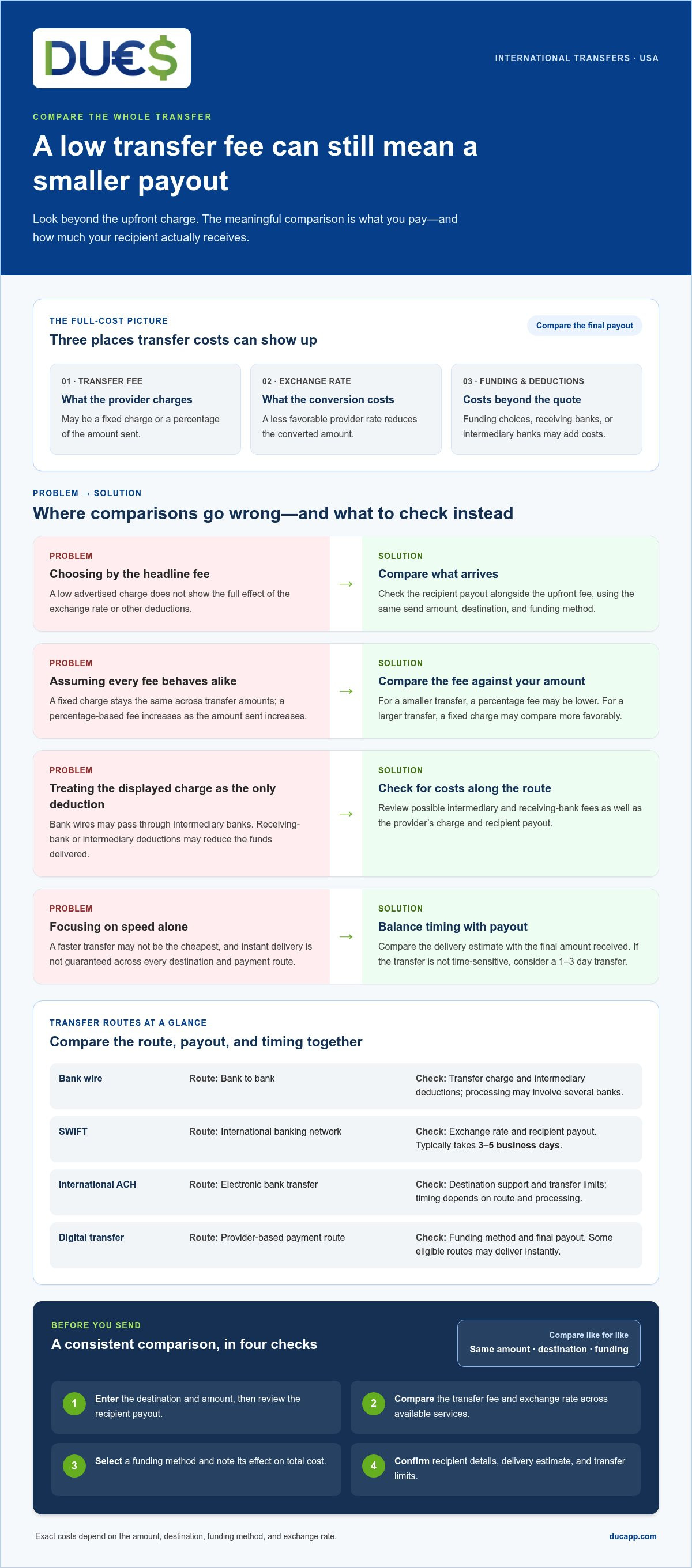
Compare the total cost and recipient payout, not just the advertised transfer charge. Different transfer methods can have different processing times and fees, so check the expected timing and any deductions before sending.
A low-cost international remittance service should make it easy to compare what you pay with what the recipient receives. Start with the amount, destination, and funding method.
Fixed and Percentage-Based Fees
A fixed fee stays the same across transfer amounts, while a percentage-based charge increases with the amount sent. For a smaller international money transfer, a percentage fee may be lower; for a larger one, a fixed charge may compare more favorably. Banks may also route wires through intermediary banks, which can deduct fees before the funds arrive.
Exchange-Rate Markups and Hidden Fees
An exchange-rate markup means the provider’s rate is less favorable than the reference rate, reducing the converted amount. Compare the recipient’s payout alongside the upfront fee. Also consider possible receiving-bank or intermediary deductions, since the displayed charge may not show every cost. Credit cards can affect the total too, so compare funding methods separately.
Provider Cost Comparisons
Use the same send amount, destination, and funding method when comparing providers. Record the final payout, delivery estimate, and any transfer charge. Then review minimum amounts and maximum transfer limits, which can determine whether a service fits your needs. Bank wires and SWIFT transfers can suit bank-to-bank payments; international ACH may be another route, depending on the destination and provider.
SWIFT transfers typically take three to five business days to clear. Digital transfers may offer instant delivery on eligible routes, but no method guarantees instant arrival across every destination and payment route.
| Transfer option | Route | What to compare | Timing consideration |
|---|---|---|---|
| Bank wire | Bank to bank | Transfer charge and intermediary deductions | May involve processing through several banks |
| SWIFT | International banking network | Exchange rate and recipient payout | Typically three to five business days |
| International ACH | Electronic bank transfer | Destination support and limits | Depends on route and processing |
| Digital transfer | Provider-based payment route | Funding method and final payout | Some eligible routes may deliver instantly |
Choose the route that gives your recipient the best final payout within your timing and transfer-limit needs.
Your exact transfer cost depends on the amount, destination, funding method, and exchange rate. Compare the quote for your specific transfer before sending.
How can I send money internationally from the USA?
Start with the recipient’s needs, then compare eligible services and payment methods. The right choice depends on the destination, delivery timing, funding, and how the recipient will use the money.
Services for Different Sender Needs
Match the transfer type to its purpose. For household support, compare services that deliver funds to the recipient’s account or another supported destination. If the recipient needs mobile credit rather than money for general expenses, an international recharge may be a better fit. For recurring support, consider how easily you can repeat the process and enter the recipient’s details accurately.
International Remittance Providers
Compare providers using the same destination, send amount, and funding method. Review the transfer fee, exchange rate, estimated arrival, recipient payout, and available delivery options together. Check that the route supports the recipient’s country and preferred way to receive funds. A provider’s limits and transfer requirements can also determine whether it suits a one-time payment or regular sending.
International Payment Methods
Choose funding based on convenience and total cost. Bank funding may suit senders prioritizing account-based payments, while cards can offer a different checkout experience. Credit-card-funded transfers can carry high costs, and card issuers typically treat them as cash advances with immediate interest. Compare the final payout before confirming, and consider a 1-3 day transfer when the payment isn’t time-sensitive.
Use this quick sequence before sending:
- Enter the destination and amount, then review the recipient payout.
- Compare the transfer fee and exchange rate across available services.
- Select a funding method and note its effect on total cost.
- Confirm the recipient details, delivery estimate, and transfer limits.
If the recipient needs phone credit instead of a cash transfer, an international mobile top-up is another option to consider.
Credit-card and cash funding costs
Your funding choice affects what the recipient ultimately receives. Compare the payment method’s cost alongside the transfer fee and exchange rate before sending money internationally.
Funding Options and Eligible Accounts
Providers differ in which accounts and payment methods they accept. Common options include a bank account, debit card, credit card, or physical cash. Check which choices appear for your destination and transfer type, then compare the total shown before confirming. An estimate puts card or cash funding costs at 2%, assuming no fraud.
Credit cards can be especially expensive. Card issuers typically treat international transfers funded by credit card as cash advances, with interest accruing immediately. The cost can therefore extend beyond the transfer itself. For example, compare a credit-card payment with a bank-account payment and include any card interest in your decision.
Physical funding has a separate cost consideration. Starting January 1, 2026, a 1% US excise tax applies to international transfers sent using physical payment methods such as cash, checks, or money orders. Digital account funding isn’t one of those physical methods. Check the payment route shown at checkout to understand how you’re funding the transfer.
Finding the Cheapest Funding Method
There isn’t one cheapest method for every international money transfer. The result depends on the provider’s available methods, the destination, the transfer fee, and any card-related costs. Compare the same amount and recipient details using each available funding option. Focus on the final payout, not convenience alone.
- Bank account: Compare its total cost and processing time with card funding.
- Debit card: Review the displayed charge and recipient payout before paying.
- Credit card: Include possible cash-advance interest in the overall cost.
- Cash, check, or money order: Account for the 1% excise tax that applies from January 1, 2026.
Choose the method that delivers the needed amount without avoidable funding costs. For repeat payments, compare the same account and destination each time, since available methods and exchange rates can differ by route.
International remittance fees
International remittance costs combine a transfer charge and the exchange rate used to convert currency. Published benchmarks vary: the average cost across international remittance provider types is 6.36%, while the global average cost of sending money across borders is approximately 6.49%. A separate 2024 benchmark puts the global average cost of a $200 remittance at 6.65%. These figures use different scopes, so treat them as context, not interchangeable quotes.
Bank channels can cost more: their average sending cost is 14.99%. A provider may apply an exchange-rate markup, and a receiving bank or intermediary may deduct money before deposit. The recipient’s country, currency, payment route, and funding method all shape the final amount.
To compare providers, use the same send amount, destination country, and funding method. Review the transfer fee, exchange rate, recipient payout, and delivery estimate for each service. Then check whether the displayed total includes deductions that could affect the amount received. For example, a zero-fee offer may produce a lower payout if its exchange rate is less favorable.
- Upfront fee: Note the charge shown before sending.
- Currency conversion: Compare the provider’s exchange rate and the converted payout.
- Deposit route: Check whether intermediary or receiving-bank deductions may apply.
- Transfer scope: Compare the same amount and country across providers.
Use the final payout to make your decision. A small difference in the exchange rate can matter more than the visible fee, especially when the transfer amount or destination currency changes. Repeat this comparison each time, since providers may show different rates and fees for different routes.
For peer-to-peer transfers, explore a digital transfer option and compare the amount your recipient receives.
DUC App: International recharges
DUC App offers international recharges for people who want to send mobile credit rather than make a general money transfer. This can suit a recipient who needs airtime for calls or mobile use. For sending funds between people, DUC App also offers peer-to-peer transfers. Gift cards provide another option when a recipient can use one for their needs.
Choose the option that matches what you’re sending and how the recipient will use it. A recharge provides mobile credit; a peer-to-peer transfer sends money between people. These options serve different purposes, so match the recipient’s need to the payment type before proceeding.
Visit ducapp.com to explore DUC App’s available options.
Make your next transfer fit the need
Before sending again, consider the reason for the payment. Is the recipient managing everyday expenses, topping up a phone, or choosing a specific item? The answer can guide whether a conventional transfer or a more focused digital option makes sense. The best low cost international remittance service fits the recipient’s purpose and gives you a clear basis for deciding.
DUC App offers peer-to-peer transfers for sending money between people, international recharges for mobile credit, and gift cards for recipients who prefer that format. Choose the option that matches what you want to send, then review the details before proceeding. A considered choice can make repeat support simpler and more purposeful.
Ready to explore your options? Contact DUC App about sending money and take the next step with a clear purpose. Make your next transfer work for the person receiving it.
Frequently Asked Questions
Are there limits on how much I can send from the US?
There’s no single sending limit that applies to every US transfer. The maximum and minimum depend on the provider, destination country, payment method, and account verification. Enter the destination and funding method in the transfer flow, then review the allowed range before choosing an amount. If your planned amount exceeds the displayed cap, you’ll need a supported alternative route or transfer arrangement.
What information do I need about my recipient?
Prepare the recipient’s full name as it appears on their bank or payment account, along with their destination country and preferred payout details. A bank deposit may require account and routing information; a mobile recharge needs the correct phone number and country code. Confirm the spelling and digits with the recipient before sending, since a mismatch can delay or misdirect the payment.
Who can I send US dollar (USD) to?
You can send USD to recipients in countries supported by your chosen service and route; the payout currency depends on the option selected. DUC App lists destinations including Bangladesh, Canada, China, Colombia, Cuba, Ecuador, El Salvador, Haiti, India, Ireland, Mexico, Nepal, Pakistan, Philippines, Spain, Switzerland, and the United Kingdom. For destinations outside Cuba, DUC App offers bank deposits, not cash delivery.
Why Do Banks and Apps Charge Fees?
Providers charge fees to process payments, support cross-border payment networks, convert currency, and handle funding and delivery. Banks and apps can display costs differently: one may show a transfer charge upfront, while another builds part of the cost into its exchange rate. Intermediary or receiving institutions may also deduct a charge along the route, so compare the total paid with the recipient’s final amount.
What are the cheapest international money transfer services available in the US?
There’s no single cheapest service for every country, send amount, or funding method. Compare providers using the same destination and payment details, then rank the results by recipient payout rather than headline fee. DUC App offers peer-to-peer transfers and international recharges for different recipient needs.
How do international remittance fees and exchange rate markups compare across providers?
Compare providers using the same amount, destination currency, funding method, and quote time. One example compares a real rate of 1 USD = 0.95 EUR with a provider rate of 1 USD = 0.92 EUR. The provider rate converts each dollar into fewer euros before any separate transfer charge. Review both the exchange rate and final payout, then compare fees for that exact route.


