

Interac can move money from a bank account, but it doesn’t by itself authorize a transfer to Cuba. A Cuban remittance via Interac payment must pass through a formal channel eligible to process authorized Cuba-bound payments under 31 CFR § 515.314. The payment method and the provider’s eligibility are separate parts of the process.
It’s natural to expect a familiar Interac transfer to work like any other cross-border payment. But Cuba-related rules affect which financial institutions can forward funds and which remittances are authorized.
This article explains how Interac fits into a transfer, how U.S. OFAC eligibility rules affect remittances, and what formal channels mean for access to money in Cuba. You’ll learn where the payment route begins, what compliance can affect, and why choosing an eligible channel matters.
Key Takeaways
- Separate the Interac payment method from the formal channel that forwards funds, and understand why the channel’s eligibility matters.
- Learn how U.S. remittance authorizations define eligible transactions and recipients.
- See what can affect a transfer through a third-party provider, including compliance review and recipient details.
- Consider international mobile recharges when the recipient needs phone credit rather than a money transfer.
Access to international financial services
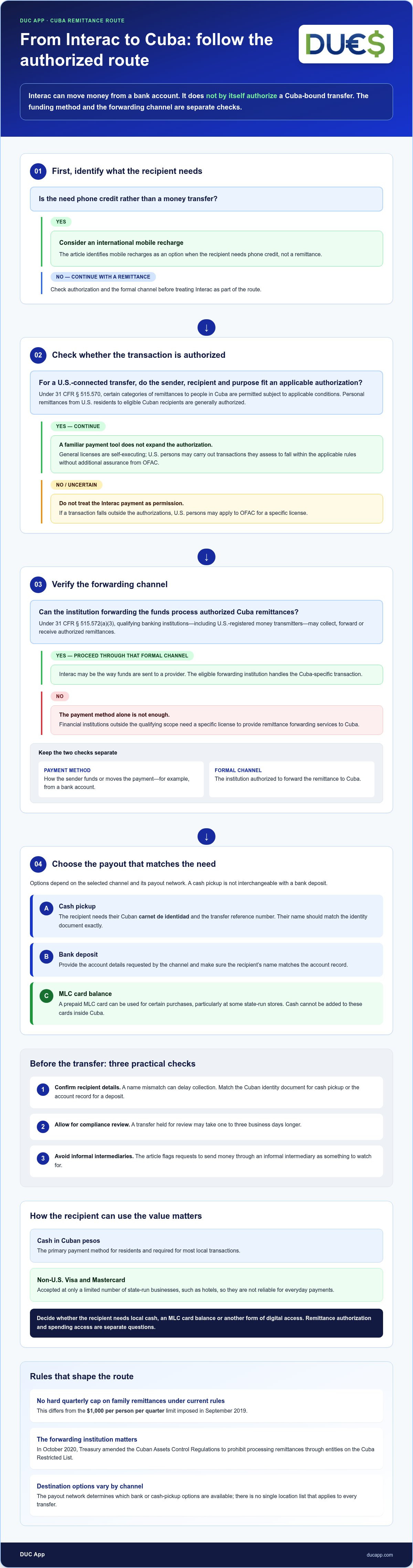
Interac can move funds from a sender’s bank account, but access to Cuba depends on the channel forwarding them. Under 31 CFR § 515.572(a)(3), qualifying banking institutions, including U.S.-registered money transmitters, may provide services for authorized remittances. Financial institutions outside that scope need a specific license to provide remittance forwarding services to Cuba. The payment interface and the institution’s authority are separate parts of the route.
For U.S. Cuba sanctions purposes, digital payments include mobile money, mobile wallets, digital bank accounts, credit or debit cards, online payments, and other digital technologies. This broad definition covers more than transfers between bank accounts. Digital access, however, does not remove a financial institution’s obligation to meet applicable regulations. OFAC prioritizes certain specific license applications intended to help remittances reach the Cuban people more freely through digital payments.
Interac e-Transfer lets users send and receive money directly from bank accounts, but its familiar process doesn’t make every international destination available. For example, a sender in Canada may use online transfer services or bank transfers to MLC cards in Cuba. These routes meet different needs: an MLC card is prepaid and can be used for certain purchases, particularly at some state-run stores. Cash can’t be added to these cards inside Cuba.
Watch for errors in recipient details, compliance holds, and requests to send money through an informal intermediary. The recipient’s name should match their Cuban identity document exactly, as a mismatch can delay collection. A transfer held for compliance review may take one to three business days longer.
Access also depends on how money is used after it arrives. Cash in Cuban pesos remains the primary payment method for residents and is required for most local transactions. Non-U.S. Visa and Mastercard cards are accepted at only a limited number of state-run businesses, such as hotels, so they aren’t reliable for everyday payments. Before sending, identify whether the recipient needs cash for local spending, an MLC card balance, or another form of digital access. That practical need helps distinguish a remittance channel from a way to pay directly for goods.
OFAC rules and eligible recipients
For U.S.-connected transfers, start with the authorization, not the payment tool. Under 31 CFR § 515.570, persons subject to U.S. jurisdiction may make certain categories of remittances to people in Cuba, subject to applicable conditions. Personal remittances from U.S. residents to eligible Cuban recipients are generally authorized under the Cuban Assets Control Regulations. The recipient and purpose matter: a transfer must fit an authorized category to qualify.
The channel has its own rule. Under 31 CFR § 515.572(a)(3), qualifying banking institutions, including U.S.-registered money transmitters, may collect, forward, or receive authorized remittances. A debit card, bank account, or digital wallet describes how funds are funded or moved. It doesn’t establish that the recipient or transaction meets OFAC requirements. Keep the sender, recipient, purpose, and payment route clear.
General licenses are self-executing. U.S. persons may carry out transactions they assess to fall within 31 CFR § 515.570 and 31 CFR § 515.572 without additional assurance from OFAC. If a transaction falls outside those authorizations, U.S. persons may apply to OFAC for a specific license. This distinction matters for remittances to Cuba: an exchange of funds through a familiar digital method doesn’t expand the legal scope.
There is no hard quarterly cap on family remittances under current rules. That differs from the $1,000 per person per quarter limit imposed in September 2019. In October 2020, the Treasury amended the Cuban Assets Control Regulations to prohibit processing remittances through entities on the Cuba Restricted List. Those changes make the forwarding institution relevant, not just the recipient’s national location or the sender’s accounts abroad.
Consider remittance eligibility separately from spending access. A Cuban recipient may need cash for local stores, while a prepaid MLC card can be used for certain purchases. A debit card’s acceptance and the exchange rate affect how funds can be spent, but neither determines OFAC authorization. Treat the remittance as a regulated transaction first, then consider how the recipient can access its value.
Formal remittance channels
A formal route connects the sender’s payment to an institution permitted to process the remittance. For Cuba, a digital payment provider must qualify as a banking institution under 31 CFR § 515.314, such as a U.S.-registered money transmitter, to process authorized digital payments. Interac can fund a transfer, but the forwarding channel handles the Cuba-specific transaction. Formal remittances provide access to funds from abroad; they are not direct payment for goods on the island.
For cash pickup, the recipient needs their Cuban carnet de identidad and the transfer reference number. Their name should match the identity document exactly, as a mismatch can delay collection. For a bank deposit, provide the recipient’s account details as requested by the channel and ensure the name matches the account record. The credit or debit card used to fund the payment is separate from the recipient’s account details or pickup identification.
Which Cuban banks and cash-pickup locations accept remittances? It depends on the selected channel’s payout network and destination; there is no single location list that applies to every transfer. The sender chooses from the options shown for that route, and the recipient follows the corresponding account or pickup process. A transfer arranged for cash collection can’t be treated as a deposit simply because the recipient has a bank account.
Use the destination and currency details shown for the selected channel. Cuban pesos are used for local transactions, while MLC cards cover certain purchases, especially in some state-run stores. These are different ways to access funds, not interchangeable forms of receipt. U.S. Treasury sanctions rules also affect which institutions can process authorized remittances, so a familiar name alone doesn’t establish eligibility.
Domestic settlement happens after cross-border forwarding and is a separate stage. Cuba has no officially published service-level agreement for domestic payment settlement times, and domestic electronic payments are generally considered final once recipients receive the funds. This distinction explains why the channel’s forwarding time and the recipient’s access time are separate parts of a transfer.
Can Interac e-Transfer be used to send money to Cuba through a third-party provider?
A Cuban remittance via Interac payment may be possible if the provider accepts Interac as a funding method and can legally forward the Cuba-bound payment. The process has two stages: Interac moves funds from the sender’s bank account to the provider, then the provider routes the remittance through its formal payout channel. Interac itself doesn’t make the destination or transaction authorized.
For authorized digital payments to Cuba, a provider must qualify as a banking institution under 31 CFR § 515.314, such as a U.S.-registered money transmitter. Under 31 CFR § 515.572(a)(3), qualifying institutions may provide services for collecting, forwarding, or receiving authorized remittances. These requirements concern the institution processing the Cuba leg, not simply the sender’s Interac account.
The payment path has distinct steps. First, the sender funds the transaction using an accepted method. Next, the provider assesses the destination, recipient, and transaction for compliance. Then, an eligible channel forwards the authorized funds using an available payout method. For example, Interac may fund a transfer while the provider arranges a permitted deposit or cash collection in Cuba.
Interac recorded 1.4 billion Interac e-Transfer transactions in 2024. That volume shows the system’s use, but doesn’t establish that a particular provider can route money to Cuba. A compliance review may delay a transfer by one to three business days. Accurate recipient details matter too: the recipient’s name should match their Cuban identity document exactly to help avoid collection delays.
Before sending, distinguish the funding method from the destination channel and payout type. A Cuban remittance via Interac payment still depends on the provider’s eligible route and the recipient’s chosen payout method. If your goal is to move funds between individuals, explore peer-to-peer transfers as a digital transfer option.
DUC App: International recharges
DUC App offers international recharges for a different need than a cash remittance: adding mobile credit to a recipient’s phone. If someone in Cuba needs phone credit rather than money for local purchases, a recharge may be a suitable digital option. It doesn’t replace a formal remittance channel or provide cash pickup.
DUC App also offers peer-to-peer transfers and gift cards. Each option serves a different purpose, so choose based on what the recipient needs. Keeping these distinctions clear helps you select a useful option without treating phone credit, a transfer, and cash as interchangeable.
For details about DUC App’s available options, visit ducapp.com.
Choose the next step around the recipient’s need
For a Cuban remittance via Interac payment, make the next decision practical: what would help the recipient most? A money transfer, mobile credit, or gift card serves a different purpose. Matching the option to the need keeps your plan focused and gives you a clear starting point.
DUC App offers peer-to-peer transfers, international recharges, and gift cards. Consider an international recharge when phone credit is the priority, or a peer-to-peer transfer when you want a digital way to send funds between people. Gift cards are another distinct option. These services meet different needs, so choose the one that best fits the support you intend to provide.
Explore the available options and decide which direction makes sense for your situation. Contact DUC App to discuss your options. A clear next step can make supporting someone abroad feel more manageable.
Frequently Asked Questions
How does the system work?
Interac can fund a payment to a third-party provider, which then processes the Cuba-bound remittance through its formal payout channel. The recipient gets funds according to the selected payout method, such as a deposit or cash collection. Think of it as two linked stages: Interac handles the sender’s payment to the provider, and the provider’s eligible channel handles delivery in Cuba.
Will the Cuban government allow it?
A transfer’s route depends on the payout options available through its channel in Cuba. U.S. authorization and access to payment in Cuba are separate questions: U.S. rules govern people and institutions subject to U.S. jurisdiction, while the receiving method depends on the channel’s local arrangements. A transfer to an account, for example, follows a different process from one intended for cash collection.
How long do remittances from the U.S. to Cuba take to arrive?
Timing depends on the funding method and whether processing triggers a compliance review. A compliance hold may delay a transfer by one to three business days, while ACH funding adds one to three business days before funds settle for pickup. These are separate timing factors. An ACH-funded transfer that also undergoes review may involve both stages.
What are the current U.S. rules and restrictions on sending remittances to Cuba?
Under 31 CFR § 515.570, people subject to U.S. jurisdiction may send certain authorized remittances to people in Cuba, subject to conditions. There is no hard quarterly cap on family remittances under current rules. Qualifying institutions may process authorized transfers under 31 CFR § 515.572(a)(3). Transactions outside those authorizations may require a specific license, and processing through entities on the Cuba Restricted List is prohibited.
What are safer alternatives to informal or peer-to-peer Interac payments for sending money to Cuba?
Use a formal remittance channel eligible to process authorized Cuba-bound payments, rather than sending funds informally to someone who promises to forward them. Confirm that the payout type matches the recipient’s needs, and keep the transfer reference and transaction record. If the recipient needs phone credit instead of funds, an international mobile recharge is a different option, not a cash remittance.


