

Cross-border transfers depend on what happens after you tap “send.” A cross border peer to peer payments platform moves a payment from one person to another across countries, with currency exchange and payout options shaping how the recipient gets the money. P2P payments are often completed in minutes, but the available route and local payment methods matter.
It makes sense to expect a simple transfer, while wondering whether the person receiving it can access the money easily. This guide explains how cross-border P2P payments work, who uses them, and why payout coverage and local payment methods can change the experience. You’ll also see how to distinguish a standard P2P app from a platform built to handle international transfers.
Key Takeaways
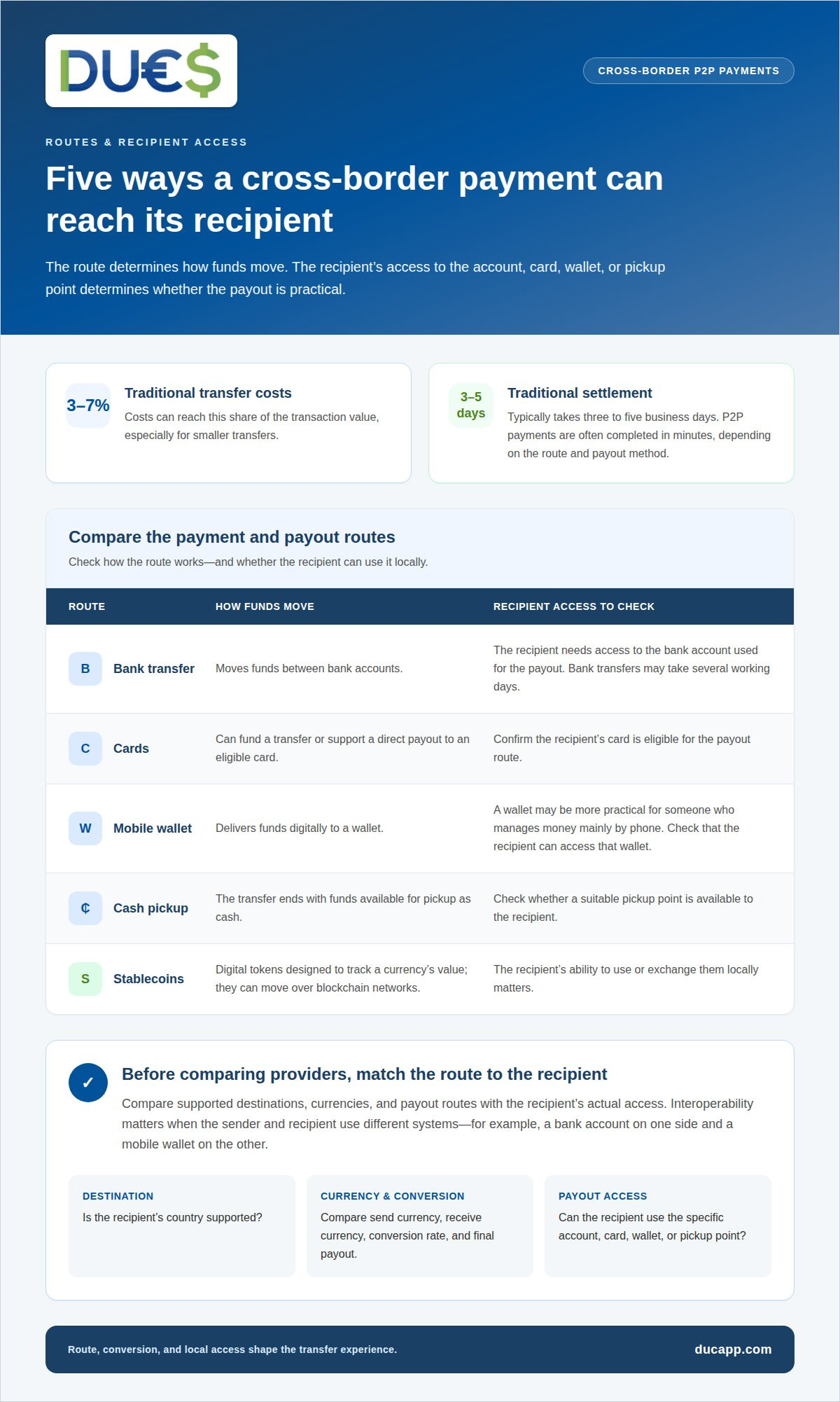
- Compare bank transfers, cards, mobile wallets, cash transfers, and stablecoins by how each route moves funds and reaches the recipient.
- Recognize how consumers and businesses use international payments for personal transfers, purchases, and commercial transactions.
- Match payout coverage and local payment methods to the recipient’s access needs, since the available options shape the transfer experience.
- Understand the convenience and limitations of P2P apps, then consider DUC App’s peer transfers or international recharges for relevant needs.
What are cross-border payments?
Cross-border payments move money between people or organizations in different countries. The transfer route, currency conversion, and recipient’s payout options determine how funds move and when they can be accessed.
Payment and Payout Methods
Payment and payout methods are the channels used to fund a transfer and deliver money to its recipient. Bank transfers move funds between accounts, while cards can fund a transfer or support direct payouts to eligible cards.
Mobile wallets let recipients access funds digitally, while some transfers end in cash pickup. Stablecoins are digital tokens designed to track a currency’s value and can move over blockchain networks. The key consideration is whether the recipient can access the specific account, card, wallet, or pickup point used.
Transfer Costs and Delivery Delays
Transfer costs and delivery delays reflect the fees, exchange rate, and payment infrastructure used to complete a transaction. Traditional cross-border payment costs can reach 3-7% of the transaction value, especially for smaller transfers.
Traditional cross-border payment settlements typically take three to five business days, while bank transfers may take several working days. P2P payments are often completed in minutes, but timing depends on the route and payout method. Limits also vary with the platform, funding method, account requirements, and destination; those factors determine how much can be sent and when it arrives.
Coverage and Foreign Exchange Transparency
Coverage describes the countries, currencies, and payout methods available for a transfer route. Depending on local access and the platform’s network, recipients may receive funds in a bank account or mobile wallet, or through cash pickup.
Foreign exchange transparency means seeing how the exchange rate affects the recipient’s amount. Compare the send currency, receive currency, conversion rate, and final payout before authorizing a transfer. International payment infrastructure may combine messaging systems and correspondent banking arrangements; Swift provides payment messaging, while correspondent banks support fund movement. Structured data standards such as ISO 20022 can carry richer transaction details.
US Rules, Taxes, and Reporting
In the United States, money transmitters involved in transfers must meet regulatory requirements. According to the Federal Reserve Board, they must register federally for Bank Secrecy Act and anti-money-laundering compliance, but broader federal oversight of payment system operators is not required.
A transfer’s tax treatment depends on what the money represents, such as income, a gift, or repayment. Moving money across a border does not by itself determine its tax category. Reporting obligations depend on the transaction and applicable rules. Keep records of the sender, recipient, amount, date, and purpose to document the payment accurately.
Businesses and consumers using cross-border payments
People use international payments to support relatives, repay friends, or share travel costs across countries. For example, a sender in the United States might send money to a family member abroad for everyday expenses. Currency conversion and the recipient’s access to bank accounts or digital wallets affect how useful the transfer is.
Businesses use cross-border payments to pay overseas suppliers, contractors, and partners. An online merchant may collect a customer’s payment in one currency, then settle with a supplier in another. International B2C payment flows are expected to increase by one hundred thirty one percent by 2032. That growth makes payment service choices relevant to companies serving customers in multiple countries.
P2P payment tools can also support business and merchant transactions, especially where individuals or small teams need to send funds directly. For example, a freelancer may receive payment from an overseas client, or a small seller may pay a service partner abroad. The distinction is purpose: personal transfers support relationships, while business payments need to fit invoices, bookkeeping, and company processes.
Digital payment services can help businesses reach customers in additional markets without building a separate payment flow for every country. As sales expand, companies need to account for local currencies, recipient preferences, reconciliation, and compliance. A process that works for one overseas partner may become harder to manage as customer payments and supplier payouts grow.
For merchants, an email payment option can give customers another way to complete a purchase, while keeping payment instructions accessible in their inbox. Businesses should map each use case before choosing a flow: who sends the funds, who receives them, what currency is involved, and how the transaction must be recorded. That simple map helps distinguish personal P2P transfers from customer collections and business payouts.
International payout coverage and local payment methods
A cross border peer to peer payments platform connects senders and recipients in different countries through available payment networks. Its destination coverage and local payout options determine whether recipients can access funds in a practical way.
Interoperability Between Payment Systems
Interoperability allows separate payment systems to exchange instructions or transfer funds between networks. This matters when a sender funds a transfer from one type of account and the recipient uses another, such as a bank account on one side and a mobile wallet on the other.
Before choosing a provider, compare its supported destinations, currencies, and payout routes with the recipient’s actual access. A mobile wallet may be more practical than a bank deposit for someone who manages money mainly by phone. Stablecoins can support international settlement over blockchain networks, but the recipient’s ability to use or exchange them locally matters too.
Sending International P2P Payments
To send from the United States, select a supported destination, enter the recipient’s details, choose a funding method and payout route, then review the exchange rate and amount the recipient will get. Check the recipient information before authorizing the payment, since incorrect account or wallet details can disrupt delivery.
The right platform depends on the route and recipient, not a universal ranking. A cross border peer to peer payments platform coordinates person-to-person transfers between countries, including any currency exchange and available payout options. Compare destination coverage, supported currencies, local payout methods, and the transfer details shown before sending.
Choose a cross border peer to peer payments platform that supports the recipient’s preferred method. If they rely on a mobile wallet, for example, a service limited to bank deposits may not suit their needs. Consider the transfer details alongside how the recipient can access the funds, so the payment route fits.
What are P2P payment apps?
A peer-to-peer payment app lets one person send money directly to another through a digital account. It connects users through a payment network, reducing the need to coordinate traditional banking details for every transfer. Across borders, the app must also handle currency exchange and compliance checks, which standard P2P services may not support.
Convenience is a key benefit: P2P payments are often completed in minutes. Apps may also use encryption, activity alerts, biometric authentication, and multi-factor authentication to protect account access. These tools strengthen security, but they can’t guarantee protection from scams or make a mistaken transfer easy to recover.
Recipient details deserve a careful review before sending. Match the beneficiary’s name and account information to the details they provided, then check the destination and amount on the payment screen. A small typo can route funds to the wrong account. Since P2P transfers typically cannot be reversed, send money only to someone you know and trust.
There’s a trade-off. An app may make it easy to connect with another user, but the recipient still needs an accepted account or payment method. A US-based app might work well for domestic transfers yet lack the currency exchange or compliance processes needed for international payments. That can limit its usefulness across countries.
Before authorizing a transfer, review the recipient, currency, and final amount. Treat urgent payment requests from unfamiliar contacts with care, even if an app displays security alerts. If a transfer seems suspicious, pause. A biometric check or encrypted connection does not establish that the recipient is genuine.
For a practical next step, explore digital payment options and consider which method fits your recipient and transfer.
DUC App: International recharges
DUC App offers international recharges for people who want to add mobile credit across borders, as well as peer-to-peer transfers for sending money to another person. Choose the service that matches the recipient’s need: a recharge adds mobile credit, while a peer transfer sends funds between people.
The distinction matters when the recipient needs phone credit rather than a general money transfer. DUC App also offers gift cards as another digital way to send value. E-commerce businesses can use API integration to connect payment functionality with their online operations.
Start with the purpose of the payment, then choose the relevant service. For a mobile top-up, use an international recharge. To send funds to another person, use a peer-to-peer transfer.
Contact DUC App to learn more about the option that fits your transfer.
Choose a payment path that fits your next move
Start with the recipient’s needs. Decide whether you want to transfer funds, add mobile credit, or send a digital gift. That choice helps you select a service suited to the task, rather than focusing only on how you prefer to pay.
A cross border peer to peer payments platform can simplify sending money between countries, but the right fit depends on the payment’s purpose and the recipient’s access. DUC App offers peer-to-peer transfers, international recharges, and gift cards, giving you distinct ways to send value in one place.
For your next transfer, focus on a clear recipient, a suitable payment option, and the outcome they need. If you’re ready to explore DUC App’s options, contact DUC App to discuss payment options. Take the next step with a payment choice that works for you and the person receiving it.
Frequently Asked Questions
How Do P2P Payments Work?
P2P payments work by letting a sender initiate a transfer to another person through a payment app or service. The sender selects a recipient, enters an amount, chooses an available funding method, and reviews the details before sending. The service routes the payment to the recipient’s account or wallet. For an international transfer, check the destination currency and payout details before confirming.
Are P2P Payments Safe?
P2P payments use security measures, but safe use also depends on who receives the money. Platforms commonly use encryption, activity alerts, biometric authentication, and multi-factor authentication. These measures help protect accounts and payment information, but they don’t verify every recipient’s identity or guarantee protection from scams. Use a strong, unique password and confirm the recipient through a trusted channel before sending.
Can you get scammed on P2P?
Yes, a scammer can pose as someone you know or create urgency to pressure you into sending money. For example, a message claiming to be from a relative might ask for an immediate transfer to a new account. Verify unusual requests using contact details you already trust. P2P transfers sent as part of a scam can be difficult to recover, so pause if a request feels unusual.
How do you set up a P2P payment account?
To set up a P2P account, use the payment service’s app or website, create a profile, and follow its account setup prompts. Add an available funding method, then complete any identity or account verification steps the service requests. Before sending money, review the recipient details and security settings. Turn on multi-factor authentication when offered, and keep sign-in credentials private.
What Are Peer-to-Peer Payments?
Peer-to-peer payments are digital transfers between individuals, rather than payments made directly to a business at checkout. For example, you might send your share of a group meal to the friend who paid. A payment service directs funds to the other person’s account or wallet, making it easier to settle personal expenses remotely.
What Is a P2P Payment System?
A P2P payment system is the combination of an app or website and the payment infrastructure that processes person-to-person transfers. The interface lets a user enter payment details, while connected networks handle funding and delivery to the recipient. For example, two people can use the same system to send funds between eligible accounts without exchanging cash in person.


