

A peer-to-peer transaction platform for worldwide transfers connects people sending money directly to one another. The sender enters a recipient’s phone number, email address, or username, then confirms the payment; the platform processes the transfer and notifies the recipient. Across borders, currency exchange and compliance checks can add steps to that flow.
The appeal is simple: sending money to another person can be easier than arranging a traditional transfer. But the details matter, especially when sender and recipient are in different countries. Check that the destination is supported and understand how the recipient will receive the funds before starting a payment.
This guide explains how P2P payments work, how money moves from sender to recipient, and why cross-border transfers can differ from local ones. You’ll also learn what affects timing, what to consider before confirming a payment, and how platforms support international transfers. The goal: make the process easier to understand before you send.
Key Takeaways
- Understand how a digital payment moves from one person to another, from entering recipient details to the recipient receiving funds.
- Learn why transfer timing and how recipients access money can vary between platforms and payment routes.
- See how currency exchange and compliance checks shape cross-border transfers.
- Discover when peer transfers or international recharges through DUC App may fit your needs.
How Do P2P Payments Work?
A peer-to-peer payment moves money between individuals through a digital platform. The platform coordinates the payment, while the sender and recipient exchange funds directly.
Peer-to-Peer Payment Basics
A P2P payment is a digital transfer between people, initiated with details such as a recipient’s phone number, email, or username. Unlike traditional banking, which typically moves money between bank accounts, a P2P app can hold funds in a digital wallet before withdrawal. That distinction matters: the recipient may use the balance within the app or move it to a linked account.
For example, roommates can use P2P payments to divide rent, while friends can settle shared travel costs. Transfers typically cannot be reversed, so confirm the recipient details before sending.
Payment Methods and Platforms
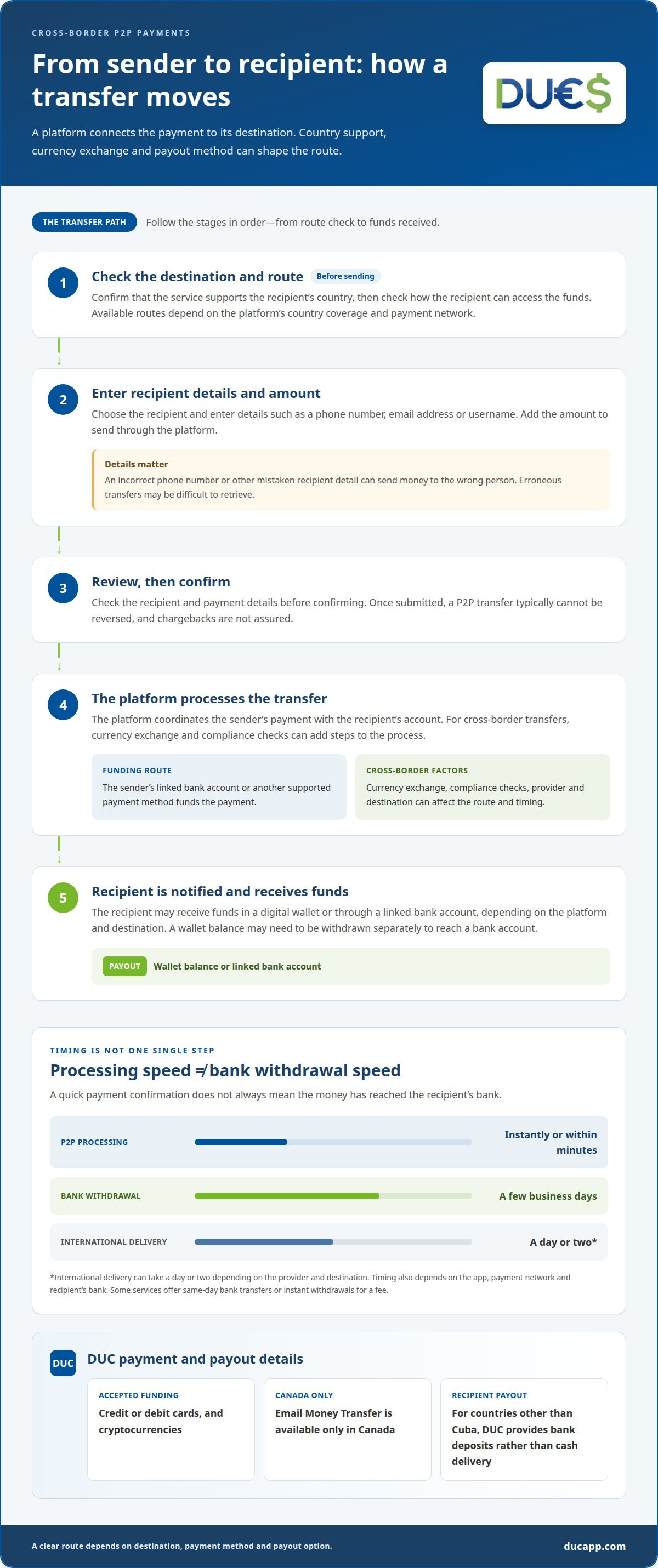
Payment methods vary by platform. DUC accepts credit or debit cards and cryptocurrencies; Email Money Transfer is available only in Canada. The recipient’s payout options depend on the destination. For countries other than Cuba, DUC provides bank deposits rather than cash delivery.
Bank transfers can serve as a funding source or a way to withdraw received money. Some social platforms also connect payment features with user accounts, making it possible to send money through a familiar interface. PayPal is one example of a service used for P2P payments. The available route shapes how the payment moves and how the recipient accesses it.
The global P2P payment market was valued at USD 2.21 trillion in 2022 and is expected to reach around USD 11.62 trillion by 2032. Everyday uses include splitting a meal, sharing travel expenses, or sending rent to a roommate.
Real-time payment systems can move funds 24 hours a day, seven days a week, but speed isn’t the same as credit availability. A payment platform transfers available funds; it doesn’t automatically provide credit. Credit-card funding, where offered, is a separate way to fund a payment, not proof of lending access.
Fraud, mistaken recipient details, and service failure can put funds at risk; erroneous transfers may be difficult to retrieve, and chargebacks aren’t assured. Protect privacy by considering how a service handles user data, since some services generate revenue through advertising or data sales. Encryption, fraud detection, and two-factor authentication are among the security measures P2P platforms may use.
How P2P transfers work
A P2P transfer moves through a platform that connects a sender’s payment with a recipient’s account. The app coordinates the process, while the selected funding route affects how money reaches its destination.
Transfer Process
A P2P transfer is a digital payment the sender submits through a platform for delivery to another person. The sender chooses the recipient, enters the amount, reviews the details, and confirms; the recipient is then notified and can receive funds in a digital wallet or linked bank account. This sequence matters because recipient details must be right before confirmation. An incorrect phone number can send money to the wrong person, and mistaken transfers can be difficult to retrieve.
Platforms and Linked Accounts
A P2P platform links a user account to a funding source and routes a payment through its system. Users create an account in the app, then connect a bank account or another supported payment method, such as a debit card. A platform may also hold received money in a wallet before the recipient transfers it to a bank account. That separation helps explain why a payment can be processed before a withdrawal reaches the recipient’s bank.
Identity and Account Requirements
Account requirements are the registration and funding steps a platform sets before users can send or receive payments. Users create an account and link a bank account or another supported method. Identity checks are handled through the platform’s own onboarding process, so requirements can differ between services. The setup matters because the linked account determines where funds come from or where the recipient can withdraw them. Keep account credentials private and never share passwords or one-time passcodes.
Timing depends on the app, payment network, and recipient’s bank. P2P payments typically begin processing instantly or within minutes, but a bank withdrawal may take a few business days. Some services offer same-day bank transfers for a fee, while instant withdrawals can also carry a fee. Sending speed and bank withdrawal speed are separate stages, so an instant confirmation doesn’t always mean funds have reached the recipient’s bank account.
For a direct digital way to send money between people, explore peer-to-peer transfers.
What Are Peer-to-Peer Payments?
International P2P transfers let people send money across borders through digital payment platforms. The route, currency exchange, and destination country can all shape how the recipient gets the funds.
International Providers and Transfers
A domestic P2P provider moves money between users within its supported country, while an international service handles transfers across borders. This difference matters because some P2P services operate only in specific countries, limiting their use for overseas payments. A transfer between countries can involve currency exchange and compliance checks. Delivery may take a day or two, depending on the provider and destination.
Before sending money internationally, confirm that the service supports the destination and understand how the recipient will receive the payment. A platform’s country coverage and payment network determine which routes are available.
Remittances and Payout Options
A remittance is money sent to someone in another country, often to support family or cover personal expenses. For a digital transfer, the recipient may receive funds in an app wallet or through a linked bank account, depending on the platform. Those payout choices matter: a wallet can keep money within the app, while a bank payout moves it to an account.
Currency exchange and compliance checks may affect the payment route. Before confirming, review the transaction details and make sure the recipient’s payout method suits their needs. Sending money is a payment, not a loan.
Platform Uses
The best platform depends on the payment purpose, destination, and recipient’s access. For personal transfers, services such as Venmo, Cash App, Zelle, and PayPal are examples of P2P payment providers. Their availability and functions vary, so a service suited to one domestic transfer may not support another country.
For business payments, digital wallets, QR codes, payment links, and e-commerce checkout integrations can support customer payments. Cryptocurrency trading is a different use: blockchain networks can enable users to make, process, and verify payments without a central currency issuer or clearinghouse. Compare the platform’s purpose and payment route before choosing.
Rules for P2P and cross-border transfers vary by country; there is no single worldwide framework. Central banks can influence domestic payment infrastructure, while private platforms manage user-facing services. Where an authority also operates infrastructure it oversees, governance should clarify responsibilities and manage potential conflicts of interest. Cross-border transfers may involve compliance checks alongside currency exchange, so requirements depend on the countries and payment route involved.
Global expansion and cross-border transfers
Global P2P growth depends on connecting local payment systems with routes that cross borders. For individuals, the practical question is whether the sender’s country and recipient’s destination both fit the payment route.
Global Reach and Expansion
A peer to peer transaction platform worldwide must account for the fact that payment infrastructure develops country by country. That matters because a transfer can use one local system on the sending side and another at the destination. Brazil’s Pix launched in 2020, while the U.S. Federal Reserve launched FedNow in July 2023. These examples show domestic infrastructure expanding, not an automatic international connection between systems.
Fast payment systems had been introduced in 72 countries at the time of writing. Cross-border reach requires more than access to a local real-time system: the platform also needs a route between the sender and recipient. Currency exchange and compliance checks can shape that route and add processing steps.
Supported Countries and Currencies
Supported countries and currencies determine where and how a platform can process transfers. DUC supports transfers to Bangladesh, Canada, China, Colombia, Cuba, Ecuador, El Salvador, Haiti, India, Ireland, Mexico, Nepal, Pakistan, Philippines, Spain, Switzerland, and the United Kingdom. For destinations outside Cuba, transfers are made by bank deposit.
Choosing a peer to peer transaction platform worldwide means considering country access and currency handling together. For example, a sender and recipient in different countries may use different local currencies. The platform’s supported route determines whether the transfer can proceed and how currency exchange fits into it. A phone number or account identifier helps identify the recipient, but it doesn’t establish that the destination is supported.
Before planning a cross-border payment, identify the sending country, destination, recipient’s available payout method, and transfer currency. These details help establish whether the route suits both people. Local systems such as Pix and FedNow illustrate why international connections cannot be assumed just because a domestic network supports fast transfers.
Explore digital peer payments for a way to connect senders and recipients.
DUC App: International recharges
DUC App offers international recharges and peer-to-peer transfers for people who want to handle these digital payments in one platform. If you’re sending money to another person, its P2P transfers fit that purpose; if you want to top up a mobile service, international recharges are the relevant option.
DUC App also offers gift cards and API integration for e-commerce businesses. These options serve different needs, from sending a digital gift to connecting payment functionality with an online store. Choose the service that matches your task, whether that is a person-to-person transfer, a gift card, or a mobile recharge.
To explore DUC App’s options, visit ducapp.com.
Make your next payment choice with confidence
Before choosing a peer-to-peer transaction platform worldwide, define what the transfer needs to accomplish. Identify the recipient, destination, and preferred way to access the funds. Then decide whether you need a personal transfer, a mobile recharge, or another service. This simple framework keeps your priorities clear as you compare digital options.
Cross-border payments are part of a wider shift toward connected digital transactions. The useful next step is to match a platform to the task in front of you, rather than assume one payment route suits every situation. Keep recipient convenience and the destination in view as you plan.
DUC App may fit your next digital payment need. Explore the platform and decide whether its options align with your plans. Contact DUC App to discuss your needs.
Choose your next step with clarity, and make each transfer with purpose.
Frequently Asked Questions
Are P2P Payments Safe?
P2P payments can be protected with platform security controls, but safe use also depends on your choices. A legitimate app may use encryption, fraud detection, and two-factor authentication; still, sending money to an impersonator or wrong recipient can leave funds difficult to recover. Verify the person through a trusted channel before approving a request. Don’t assume a chargeback can reverse a completed transfer, and avoid keeping large balances in an app wallet.
What Is a P2P Payment System?
A P2P payment system is a digital service that lets enrolled users send and receive person-to-person payments. For example, a platform can connect a sender’s app balance or linked funding source with another user’s account. This differs from a checkout payment, where a customer pays a merchant for a purchase. The label describes the payment relationship, not a promise that every service uses the same transfer route.
What does P2P mean in payments?
P2P means “peer-to-peer”: the payment is between individuals rather than from a customer to a business. The term describes who is paying whom, not whether the money travels directly between bank accounts. A platform, wallet, or payment network may still handle processing. For instance, sending a relative a personal gift is a peer payment, while paying a store through its checkout is a merchant transaction.
Why P2P payment apps have become so popular?
P2P apps make personal payments accessible through familiar digital accounts. Someone can reimburse a friend for a shared purchase without arranging cash or writing a check. Mobile access also makes it easier to manage payments away from a bank branch. These conveniences suit informal transactions, but each service has its own features and availability, so an app that works for one person may not fit every recipient or payment need.
Can you get scammed on P2P?
Yes. A scammer may pose as someone you know, send a false payment request, or exploit a mistaken transfer. Treat unexpected requests cautiously, verify recipients through a trusted channel, and never share passwords or one-time passcodes. Send P2P money only to people you know and trust. If a payment goes to the wrong account, recovery may be difficult; use the platform’s official app to find its support options.
How Can Businesses Accept P2P Payments?
Businesses can accept P2P payments through digital wallets, QR codes, payment links, or checkout integrations, depending on the platform. A small seller might display a QR code for customer payments, while an online store can connect payment processing through an API. DUC App offers API integration for e-commerce businesses. P2P platforms may be less suited to large or B2B payments requiring high-value infrastructure or extensive business-tool integration.


