

Choosing crypto checkout starts with deciding where the money should go, not which coin to accept. If you want to accept crypto payments on ecommerce sites without taking on unnecessary price risk or backend complexity, define your settlement approach first. It will shape the processor, integration, order records, and customer experience you need.
Crypto prices can move, and a completed on-chain payment generally can’t be reversed like a card charge. Any refund is a separate transaction. Stablecoins may make pricing and settlement more predictable, but they don’t remove the need for clear procedures, careful testing, and an understanding of the selected service’s terms.
This guide compares processor-managed and self-hosted checkout, explains how to map payment and settlement steps, and outlines tests for order confirmation, errors, and refunds. It also covers where documented APIs, a sandbox, and ecommerce plugins fit into integration planning. DUC App's ecommerce API, sandbox, WooCommerce and Odoo plugins, card processing, and separate cryptocurrency buying and selling are distinct capabilities. Keep them separate when evaluating merchant crypto checkout.
Key Takeaways
- Define your checkout goals first so the payment flow supports customer needs, geographic reach, and store operations.
- Map how the store platform, processor, wallet, and blockchain connect payment selection to order updates.
- Compare processor-managed checkout, direct wallet acceptance, and conversion-based settlement by custody, workload, and reconciliation needs.
- Test successful, pending, expired, underpaid, duplicate, and interrupted payments before launch.
- Choose an integration that fits your platform and recordkeeping. DUC’s documented ecommerce API, sandbox, and WooCommerce and Odoo plugins support integration planning, while its crypto buying and selling is a separate service.
Accept crypto payments on ecommerce sites: define the merchant goal first
Before comparing gateways or adding a checkout button, decide what you want crypto payment acceptance to achieve. A clear goal helps you choose a payment flow, settlement approach, and operating procedures your store can support. To accept crypto payments on ecommerce sites effectively, treat it as an order-management decision, not simply another payment button.
“Crypto checkout is a customer payment flow that records, confirms, and reconciles an online order paid for with cryptocurrency.” The buyer’s payment is only one part of that flow. Your store also needs to connect payment status to the correct order and define what happens if a payment is delayed or needs support. For background on the underlying concept, see What is Cryptocurrency?
Which ecommerce goals can crypto checkout support?
Start with evidence from your own store. Review customer questions, checkout feedback, order locations, and payment-method data. If buyers ask to pay with crypto, that can justify testing demand. If international orders are a priority, assess that separately. Adding a payment option alone doesn’t prove you’ll reach more markets or improve the customer experience.
Set a specific objective, such as responding to customer preference, adding checkout choice, or testing a new payment workflow. For example, a store could begin with a limited product range after receiving customer requests, then review how often buyers select the option and how much support it requires. Avoid assuming lower costs or faster settlement. Those outcomes depend on the selected model and its terms.
What should a merchant decide before implementation?
Define the customer journey and assign an internal owner before selecting integration tools. Decide who monitors payment status, resolves order mismatches, answers customer questions, and maintains procedures. Crypto acceptance doesn’t remove these responsibilities. Price volatility, compliance duties, and support needs still require attention, and obligations depend on your business and markets. Verify applicable legal, tax, and accounting requirements before launch; for example, merchants setting up regional entities may review guidance on fintech regulatory licensing UAE.
Set the boundaries of the first rollout and record decisions such as:
- Settlement: Will the business retain crypto or convert it to another currency?
- Scope: Which products, customer markets, and order types will be included?
- Customer experience: What payment instructions and status updates will buyers see?
- Operations: Who handles pending or mismatched payments, and how will orders be reconciled?
Keep the first version focused. A limited rollout makes it easier to see how payment status fits your existing order handling, customer support, and recordkeeping before you expand. Use these decisions as requirements when comparing payment models and integration options.
How crypto ecommerce payments flow from checkout to settlement
To accept crypto payments on ecommerce sites, map each handoff from the customer’s screen to your order records. A typical flow connects the store platform, a payment processor or merchant wallet, and a blockchain network. Steps and status labels vary by integration, so use its documentation to define what each status means and when it should update an order.
What happens after a customer selects crypto?
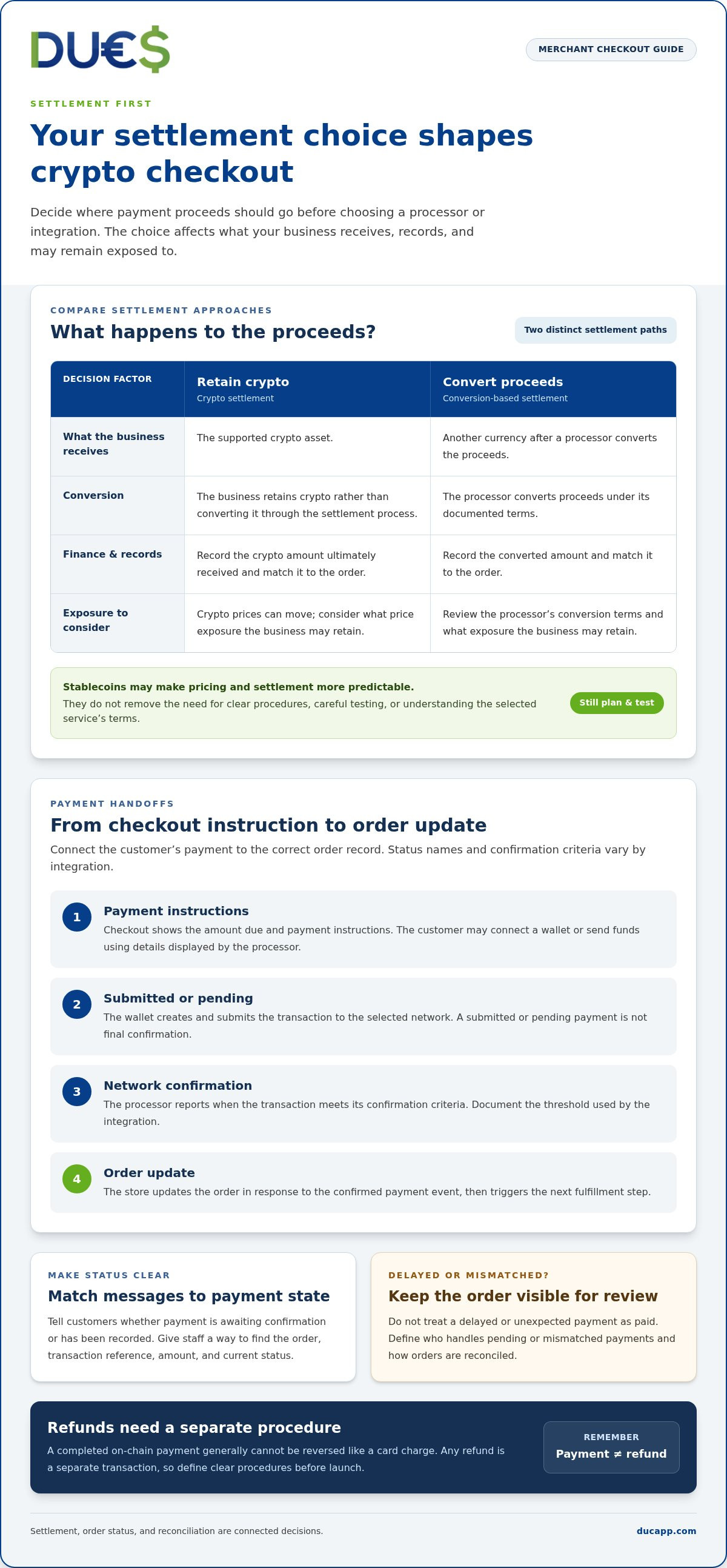
After a customer chooses crypto, checkout shows the amount due and payment instructions. Depending on the setup, the customer may connect a wallet or send funds using details displayed by the processor. The wallet creates and submits the transaction to the selected network. The network processes it, while the processor or store integration reports status updates and links the payment to the relevant order.
Keep the stages distinct:
- Payment instructions: The buyer sees how to initiate payment and any relevant deadline or network information.
- Submitted or pending: A transaction may have been sent, but the store shouldn’t treat this status as final payment confirmation.
- Network confirmation: The processor reports that the transaction meets its confirmation criteria. These criteria can vary, so document the threshold used by your integration.
- Order update: The store changes the order status in response to the confirmed payment event, then triggers the next fulfillment step.
Make receipts and support messages match these states. Tell customers whether payment is awaiting confirmation or has been recorded. Give staff a way to find the order, transaction reference, amount, and current status. If a transaction is delayed or doesn’t match the expected payment, keep the order visible for review instead of treating it as paid.
How do settlement and reconciliation affect daily operations?
Before launch, identify the records that connect each order to its payment: store order ID, transaction reference, asset, amount, status, any reported fees or adjustments, and settlement record. Reconcile these fields on a consistent schedule. Assign someone to investigate differences and record the outcome. Check the integration documentation for supported assets, settlement timing, and conversion terms instead of making assumptions.
Set a clear refund policy, too. Changing an order status doesn’t reverse an on-chain payment, so explain the process customers should follow and how staff record any approved refund as a separate transaction. DUC’s documented ecommerce API, sandbox, and WooCommerce and Odoo plugins support integration planning. Its cryptocurrency buying and selling is a separate service from merchant crypto checkout.
Compare crypto ecommerce payment models by control and workload
The right setup depends on how much control your team wants and how much payment handling it can manage. Processor-managed checkout can reduce manual tracking, while direct wallet acceptance gives the merchant more control and more responsibility. Conversion-based settlement describes where proceeds go and can be paired with a processor-managed flow.
The payment model determines who handles custody, payment matching, customer questions, and the records needed to reconcile each order. Compare the day-to-day workload, not just the customer-facing checkout.
Processor-managed checkout versus direct wallet payments
Direct wallet flows need careful handling of addresses and amounts. A mistaken address or unmatched transfer can complicate support and accounting. Choose this model only if your team can maintain secure wallet procedures and investigate discrepancies.
How should merchants assess risks and responsibilities?
Volatility and irreversible transfers call for clear procedures. Decide how your business will handle price movement between checkout and settlement, confirmation delays, mistaken transfers, and customer disputes. A blockchain payment generally can’t be reversed like a card transaction. Any refund should be treated as a separate payment and explained before purchase.
Write cancellation and refund policies for the specific payment rail, then train support staff to follow them consistently. Keep order and transaction records connected, and verify the legal, tax, and accounting obligations that apply in each market where you operate. To accept crypto payments on ecommerce sites responsibly, settle these questions before choosing a model, not after the first exception appears.
Set up and test crypto checkout before opening it to customers
A controlled launch turns integration choices into a checkout your team can operate. Before you accept crypto payments on ecommerce sites, define the payment flow, configure it in a test environment, exercise edge cases, and agree on who responds when something goes wrong. Then launch with clear records and fulfillment rules.
Configure the ecommerce integration and payment experience
Match the integration to your store platform and technical capacity. A plugin may suit a supported platform, while an API may fit a customized setup. DUC provides documented ecommerce API tools, a sandbox, and plugins for WooCommerce and Odoo. These support integration planning. DUC’s ecommerce API and card processing are distinct from its cryptocurrency buying and selling, which is not merchant crypto checkout. For broader integration context, consult this global payment processing API guide.
Before testing, write the customer-facing payment instructions, confirmation messages, and support escalation steps. Make the expected payment status clear, explain what customers should do if payment remains pending, and show staff where to find the relevant order and transaction records.
Run launch tests and prepare the operating team
Use a repeatable sequence. Assign an owner to each step and keep a record of the result:
- Define requirements: Set the checkout journey, settlement expectations, order rules, and launch scope.
- Configure: Connect the chosen integration in the test environment and map payment events to store order statuses.
- Test: Run successful and exception cases before enabling customer access.
- Document: Record expected outcomes, staff actions, customer messages, and escalation paths.
- Launch: Enable the agreed scope only after the team confirms the tests and operating procedures.
Test more than a successful payment. Include pending and expired transactions, an underpaid amount, a duplicate notification or payment, and a checkout interrupted before completion. For each case, check that the order status is correct, the customer receives an accurate message, the transaction can be matched in reconciliation records, and fulfillment stays blocked until your confirmation rules are met.
- Successful: Confirm the order updates only at the chosen payment-confirmation point.
- Pending or expired: Verify the order stays out of fulfillment and support staff can explain its status.
- Underpaid or duplicate: Check that exceptions are flagged for review rather than treated as complete.
- Interrupted: Confirm the customer can see what happened and the team can identify whether payment was submitted.
Train staff to use approved records to investigate delayed, expired, or unmatched payments. Before launch, review checkout wording, privacy notices, and market-specific legal, tax, and accounting requirements. For ecommerce integration planning, explore DUC’s ecommerce API integration, while keeping the crypto checkout workflow distinct.
Choose an ecommerce integration that matches your payment requirements
Your final choice should connect the customer’s payment experience to order handling, settlement, support, and financial records. If you plan to accept crypto payments on ecommerce sites, verify that the integration supports the specific flow your store intends to operate. A general crypto feature, wallet app, or card gateway alone doesn’t establish that a merchant crypto checkout is supported.
What should a merchant verify in an integration?
Compare documented capabilities with your store platform and processes. Confirm how payment instructions appear, which events update an order, what information appears in records, and how staff can investigate mismatches. Check supported assets, currencies, and settlement options in the relevant product documentation rather than assuming one integration supports every payment type.
- Payment flow: Identify how customers start payment and how the store receives status updates.
- Settlement: Confirm whether proceeds remain in crypto or are converted, and how settlement records connect to orders.
- Platform fit: Match available API tools or plugins to your ecommerce platform and technical setup.
- Support: Establish who handles pending, expired, or unmatched payments and which records they use.
- Policies and records: Align customer-facing terms, refund procedures, and bookkeeping with the selected payment rail.
Keep the service categories distinct in your evaluation. Merchant crypto checkout processes a buyer’s crypto payment for an online order. Crypto buying and selling lets a user acquire or sell cryptocurrency. Card processing accepts card payments. These are separate functions, even when they appear within a broader payments ecosystem. A secure digital wallet app guide can help explain wallet concepts, but a wallet alone doesn’t provide an ecommerce checkout and order-reconciliation flow.
How does DUC fit into a merchant's integration decision?
DUC provides documented API tools and a sandbox for ecommerce integration planning, along with plugins for WooCommerce and Odoo. These capabilities can help you assess platform fit and test an integration. DUC’s payment processing platform accepts credit and debit cards in any currency. Its cryptocurrency buying and selling is a separate service from merchant crypto checkout.
Keep that distinction clear when mapping your requirements. Consider the API, sandbox, and plugins as ecommerce integration capabilities, and assess card processing as a separate payment function. Neither capability establishes merchant crypto checkout support. For a broader view of how payment infrastructure can connect with ecommerce systems, review this global payment processing API guide.
Ready to plan an ecommerce integration? Explore DUC’s payment and integration services and compare them with your store’s technical requirements.
Turn your payment plan into a confident next step
A crypto checkout launch is a business decision, not a switch to flip. Keep the scope manageable: choose one customer journey, define how your team will handle exceptions, and use what you learn to decide whether to expand. That approach lets you explore how to accept crypto payments on ecommerce sites without committing to a setup that doesn’t fit your store.
As you review your wider payment needs, keep each capability in its lane. DUC offers ecommerce API integration, card processing, and cryptocurrency buying and selling as separate services. Its documented API, sandbox, and WooCommerce and Odoo plugins support ecommerce integration planning, while its payment processing platform accepts credit and debit cards in any currency. These services should not be mistaken for merchant crypto checkout.
For DUC cryptocurrency transactions, only validated accounts may add money for cryptocurrency. Conversions to USD, CAD, or euros are irreversible and can’t be refunded. Follow the platform’s instructions, use only the wallet address it provides, and complete the steps promptly because transactions expire if delayed.
Frequently Asked Questions
How do ecommerce sites accept cryptocurrency?
To accept crypto payments on ecommerce sites, a merchant connects a checkout integration that gives buyers payment instructions and sends payment status to the store. For example, an order system can hold an order until it receives the required confirmation, instead of releasing it for fulfillment when the buyer first submits payment. Match these rules to your store’s workflow, then verify applicable legal, tax, and accounting requirements for each market.
Is accepting crypto payments suitable for a small ecommerce business?
It can suit a small store if customer interest and team capacity justify adding another payment method. Consider who will review unusual transactions, answer payment questions, and update order records. A store with limited technical resources could begin with a narrow product range or customer segment, then assess the workload before expanding. Include staff training and policy updates in your planning.
Can ecommerce businesses accept crypto without holding cryptocurrency?
Some payment arrangements may convert crypto proceeds or settle them in another currency, while others send crypto to a merchant-controlled wallet. The available flow depends on the integration’s terms and supported options. Before choosing, check which currency appears in your settlement records, how conversion works, and whether the merchant must take additional steps. Don’t assume conversion happens automatically just because checkout accepts cryptocurrency.
What happens if a crypto payment is delayed or not confirmed?
The payment may remain pending, become incomplete, or expire, depending on the integration’s rules. Keep the order on hold until its status meets your fulfillment criteria. If a customer says they sent payment, support staff should compare the order details with the approved transaction records and explain the current status. Clear instructions can reduce confusion if the payment window expires before the transaction is completed.
Are crypto payments reversible or refundable?
A confirmed cryptocurrency transfer generally can’t be reversed through the payment network like a card charge. A merchant may have a separate refund policy, but any refund should be handled as a new transaction under the integration’s documented process. State the policy before checkout and don’t promise that a transfer can be undone. DUC’s cryptocurrency conversions to USD, CAD, or euros are irreversible and can’t be refunded. Only validated accounts may add money for cryptocurrency through DUC. When following its crypto instructions, use the wallet address provided by the platform and complete the steps promptly because transactions expire if delayed.
Does DUC's ecommerce API mean a store can accept crypto at checkout?
No. DUC provides ecommerce API integration with documented tools, a sandbox, and WooCommerce and Odoo plugins. Its payment processing platform accepts credit and debit cards in any currency. DUC’s cryptocurrency buying and selling is a separate service from merchant crypto checkout. Keep these capabilities distinct when describing your store’s payment options or evaluating an integration, and use product documentation to identify the functions each service supports.


