

The fastest-looking transfer isn’t always the quickest way for money to reach someone. With instant p2p financial transfers globally, timing can depend on the destination and how the recipient gets the funds. Fees and exchange rates matter too: a low upfront charge doesn’t necessarily mean your recipient receives more.
Look beyond the word “instant.” A service may move funds quickly on one route but offer different payment or receiving options on another. The right match depends on your destination, preferred way to pay, and the amount the recipient should receive.
This 2026 guide compares transfer options using practical criteria: speed, payment methods, total cost, and recipient experience. You’ll learn what “instant” can mean across borders, how currency conversion affects the final amount, and which route details to compare before sending. It also explains how DUC App’s peer-to-peer transfers and email payments fit into the comparison, alongside payment methods such as Visa, Mastercard, Apple Pay, Google Pay, SEPA, and Interac.
Key Takeaways
- Understand why “instant” can describe payment initiation without guaranteeing when the recipient gets the funds.
- Compare instant p2p financial transfers globally by route, total cost, payment method, recipient experience, and transaction visibility.
- Use a five-step checklist to match a transfer service to your destination and the recipient’s needs.
- See how DUC App’s P2P transfers and email payments fit into a broader comparison of digital transfer options.
- Assess payment methods such as Visa, Mastercard, Apple Pay, Google Pay, SEPA, and Interac without assuming they work for every route.
What “instant” means for global P2P financial transfers
An instant P2P transfer is one the platform can initiate or process quickly. That doesn’t necessarily mean the recipient can access the funds immediately. This distinction matters for cross-border transfers. The sender’s app may confirm a submitted payment before the steps required for the recipient to use the value are complete.
Peer-to-peer (P2P) transactions move value directly between people through a platform. For international transfers, however, the app is only one part of the journey. The destination, payment route, receiving method, and routine processing or verification checks can all affect when funds become available. So, interpret “instant” in context, not as a universal delivery promise.
How global P2P transfers move from sender to recipient
The sender chooses a payment method and submits the transfer through a platform. The platform processes the payment along the selected route, and the recipient gets the value through the available receiving method. A digital interface can make those steps feel simple, but it can’t remove the dependencies between them. For example, someone sending money to a relative abroad may see an app confirmation while the recipient’s chosen method is still processing.
What can change an international transfer’s timing?
Timing can depend on payment processing, accurate recipient details, the destination route, and how the recipient is set up to receive funds. A payment method that works smoothly on one route may involve different steps on another. Routine checks can also affect progress. Read the status carefully: confirmation may mean a payment was submitted or accepted, not that the recipient can already access the value.
Before sending, distinguish between two milestones:
- Transfer submission: The platform confirms the payment instruction or begins processing it.
- Recipient access: The recipient can use or access the transferred value through the selected receiving method.
This distinction makes “instant” claims easier to evaluate. Look for timing information tied to your specific route and payout method, and note which event the estimate describes. If the recipient needs the money for something time-sensitive, don’t treat a fast app notification as proof of completed delivery. For instant p2p financial transfers globally, the useful question isn’t only how quickly a transfer starts, but when the recipient can actually access it.
Which features matter when choosing a global P2P transfer app?
The right app is the one that fits your transfer, not simply the one with the longest feature list. Start with how you can pay, then consider how the recipient will receive and use the funds. For broader context on how P2P apps are evolving, see this P2P money transfer app guide.
Payment methods, currencies, and recipient experience
Next, consider the recipient’s side. What form will the transferred value take, and how can the recipient access or use it? A convenient payment flow for the sender may not be the best fit if the receiving option doesn’t suit the person getting the funds. If email-based payments suit your situation, compare them with app-based transfers. DUC offers both P2P transfers and email payments, giving users different digital ways to send value.
Fees, exchange rates, and transfer visibility
Look beyond the service fee. If a transfer converts currencies, the exchange rate also affects the amount the recipient receives. Review the fee, conversion details, and expected recipient amount together before approving. If any part of the total is unclear, pause to review the transaction terms instead of judging the cost by a single figure.
Visibility matters too. Check which transaction status updates are available and whether you can identify the transfer you’re reviewing. Clear details can help you follow a payment and understand its progress. For a general overview of how certain payment-app transfers may fit within electronic fund transfer rules, consult the Consumer Financial Protection Bureau’s consumer protection guidance for P2P payments.
A practical shortlist should answer four questions: Can you pay using a method supported for your route? Can the recipient use the receiving option? Can you understand the full cost before sending? Can you follow the transaction afterward? These checks are more useful than a blanket claim that one app is best for every transfer. Use them to compare instant p2p financial transfers globally against your specific needs. You can also explore DUC’s P2P transfer and email payment options as part of your comparison.
How to compare global P2P transfer options fairly
Start with the same transfer scenario for every option. Set the amount, sending and receiving currencies, destination, and receiving method. Then compare expected delivery, total cost, payment method, and transaction visibility. A speed label alone doesn’t tell you what the recipient will receive or when they can use it.
P2P apps versus bank transfers and other digital methods
P2P apps, bank transfers, and other digital payment methods can differ in setup, ways to pay, and how recipients access funds. The right fit depends on your route and the recipient’s preferences, not on an assumption that one method is always faster, cheaper, or safer. DUC is a financial technology platform, not a traditional bank. Cash pickup may appear as a market-wide comparison category, but compare it separately from digital transfer methods.
Use a simple framework to keep the comparison consistent:
| What to compare | What to record |
|---|---|
| Speed | Estimated processing time and when the recipient can access the funds |
| Total cost | Displayed service fee, currency conversion details, and expected amount received |
| Payment method | Options available to you for this specific transfer |
| Recipient route | How the recipient will receive and use the value |
| Transaction visibility | Confirmation details and status updates you can view |
A fair comparison of speed, fees, and delivery routes
Compare like with like. If one option sends a different amount, uses another currency, or delivers through a different receiving method, the comparison won’t be fair. Separate advertised processing speed from route-dependent delivery too. A platform may accept a transfer quickly, while later steps determine when the recipient can access the funds. The G20 roadmap for enhancing cross-border payments outlines broader priorities for improving cross-border payment speed, cost, and transparency.
Compare the amount received and the route, not the speed label alone. If you’re sending money to Cuba, include the route and payment method in your research. This credit-card transfer guide offers more context for that scenario. Apply the same criteria to each option you consider for instant p2p financial transfers globally, and let the recipient’s needs guide your decision.
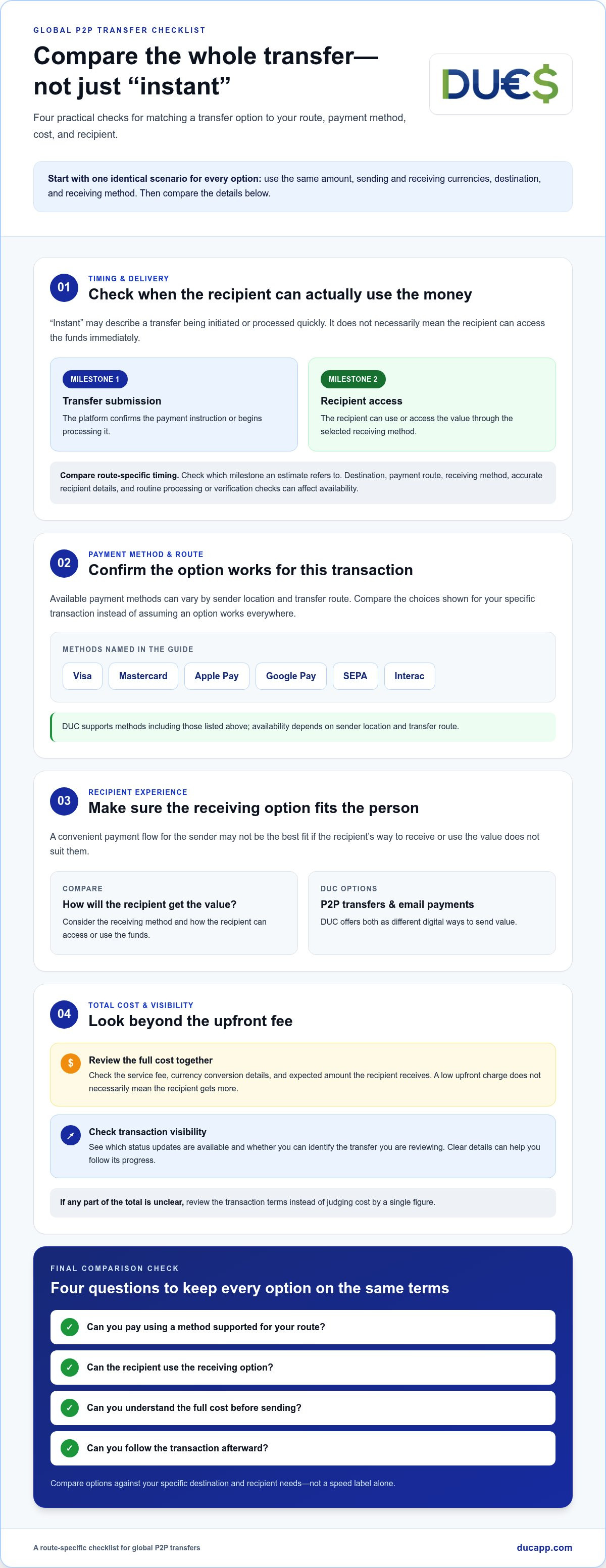
A five-step checklist for choosing a global transfer service
Base your choice on one real transfer, not a general promise of speed or global reach. Work through these five checks in order, keeping the destination, currency, amount, and receiving method consistent when comparing options.
- Define the route. Note where the money is coming from, the recipient’s destination, and the currency involved. Availability and delivery options can differ by route, so don’t assume one service works the same way everywhere.
- Confirm the recipient’s needs. Decide how the recipient can conveniently receive and use the value. Consider their preferred receiving method and whether they need a transfer or a different digital service. For Cuba-specific mobile credit needs, see this Cubacel recharge guide.
- Compare the total cost. Review the service fee and any currency-conversion information together. Compare the amount the recipient is expected to receive, not just the fee shown upfront.
- Check payment methods. Choose a payment option you can use for this transaction, then make sure it applies to your route. Payment methods can vary by sender location and destination.
- Review terms before sending. Read the transaction details, including expected delivery information, the receiving method, and any applicable conditions. Make sure you understand what the confirmation means and how to view the transfer’s status.
Start with the recipient and destination
The route sets the frame for every other decision. A method that suits one destination or recipient may not fit another. For example, if you’re sending value for someone’s mobile credit, a recharge may match their need better than a general P2P payment. Keep the intended currency and receiving experience in view, then compare options against that exact scenario.
Review payment, costs, and terms before sending
For a fair comparison, hold the assumptions steady. Use the same amount, currencies, destination, and receiving method for each option, then compare the expected amount received and delivery details side by side. This makes differences easier to spot and keeps a fast processing label from overshadowing the recipient’s actual experience.
Use this checklist to assess instant p2p financial transfers globally with your needs in focus. DUC’s digital transfer options include P2P transfers and email payments, which you can compare against your route and the recipient’s needs. Explore DUC’s digital transfer options.
How DUC App fits into global P2P transfer decisions
DUC App is a digital financial platform offering peer-to-peer transfers and email payments. Assess those options using the same questions you’d apply to any transfer: Does the route fit your destination? Can you use a supported payment method for this transaction? Does the recipient’s experience suit their needs? What do the transaction details show about timing and total value?
DUC features that may suit cross-border senders
DUC supports payment methods including Visa, Mastercard, Apple Pay, Google Pay, SEPA, and Interac. Having several payment methods and digital services within one platform gives senders options to compare, rather than limiting the decision to one way of paying or sending. The available method can depend on the sender’s location and intended route, so review the details for the transfer you’re planning rather than assuming every option applies to every destination.
Alongside P2P transfers and email payments, DUC offers international mobile top-ups and gift cards. These services can suit a recipient’s specific needs better than a general payment. DUC has a particular focus on services connected with Cuba, while also offering international services. Match the service to what the recipient actually needs.
Take the next step with a route-first decision
Start with the destination and receiving route. Then consider the payment method, recipient’s needs, expected timing, and total cost. Keep those factors together: a preferred payment method is useful only if it works for the transfer, and a quick processing estimate matters only if the recipient can access the value in a way that suits them. This is a practical way to evaluate instant p2p financial transfers globally without treating “instant” as a delivery guarantee.
When comparing DUC App with other options, review the transaction details, including the payment method, route, applicable fees or conversion details, and delivery information. Choose the path that fits your situation and understand the details before sending.
Explore DUC App and choose a transfer path that fits your needs.
Choose the transfer that fits your route
Choosing instant p2p financial transfers globally starts with looking beyond the speed label. “Instant” can describe how quickly a payment is initiated, not when the recipient can access it. Compare options using the same destination, currency, payment method, and receiving route, then review the total cost and recipient experience before you send.
DUC App offers peer-to-peer transfers and email payments, alongside digital payment methods including Visa, Mastercard, Apple Pay, Google Pay, SEPA, and Interac. It also offers international mobile top-ups, gift cards, and cryptocurrency transactions. Available methods can vary by transfer route, so focus on the options shown for your transaction and read its terms before approval.
Ready to compare transfer options for your needs? Explore DUC App and review its digital services. A clear route, a suitable payment method, and understood transaction details make it easier to send with confidence.
Frequently Asked Questions
Is an international P2P transfer always instant?
No. “Instant” may describe how quickly a transfer is submitted or processed, but it doesn’t guarantee that the recipient can access the funds immediately. Timing can depend on the destination, payment method, receiving route, and routine processing checks. Before sending, review the expected delivery details for your route. Don’t assume a service uses the same timing for every destination or receiving method.
Can I send money internationally with a P2P app?
Yes, some P2P platforms support cross-border transfers, but destinations, currencies, payment methods, and receiving routes vary. Check that the sender’s location and recipient’s destination are supported for the specific transaction. DUC App offers P2P transfers and supports payment methods including Visa, Mastercard, Apple Pay, Google Pay, SEPA, and Interac. Available methods can depend on the route, so review the options for your transfer.
How much does a global P2P transfer cost?
The total cost can include a service fee and the effect of currency conversion on the amount received. It can vary based on the route, payment method, currencies, and transaction details, so there isn’t one price for every international transfer. Review the fee and conversion information for your specific transaction before approving it.
What happens if an international transfer is delayed?
A delay may relate to the payment method, destination route, recipient details, or routine processing checks. Start by reviewing the transaction status and any instructions in the app you used. Keep the transfer reference and recipient details handy if you need to follow up. Remember that a “submitted” status doesn’t necessarily mean the recipient can already access the funds. Look for an update showing the transfer’s progress or completion.
Can I use Apple Pay or Google Pay for a global P2P transfer?
DUC App supports both Apple Pay and Google Pay as payment methods. Whether either option is available for your transaction can depend on your location and the transfer route. Review the payment methods shown for the intended destination, then check the transaction details before authorizing payment. Don’t assume that a method available for one route will also be offered for every other destination or transfer type.
Is a P2P transfer app the same as a bank?
No. A P2P transfer app is a digital platform for services such as person-to-person payments; a traditional bank provides banking services. DUC App is a financial technology platform, not a bank. Compare options based on the service you need, the payment methods available for your route, how the recipient receives the value, and the transaction terms. This keeps your decision focused on the transfer rather than the provider’s label.


