

A P2P currency transfer application moves money from one person to another through a digital platform, often bypassing traditional financial institutions, according to the Joint Chiefs of Global Tax Enforcement. Transfers can take anywhere from seconds to three business days, depending on the platform. The app may route money to a recipient’s account or hold it within its own system.
It’s easy to assume every peer-to-peer payment works the same way. But “peer-to-peer” describes a transfer between people, not a single payment method. Funding sources, delivery options, timing, and availability vary by service.
Learn how P2P payments move from sender to recipient, what types of peer-to-peer transfers apps support, and where convenience comes with tradeoffs. Then compare app-based payments with bank transfers to understand which method fits the payment you need to make.
Key Takeaways
- Compare app convenience with potential differences in fees, delivery speed, and availability before choosing how to send money.
- Understand how the funding method and the recipient’s setup affect the path a payment takes.
- Separate person-to-person payments from bank transfers by looking at how each route delivers funds and where it operates.
- Explore DUC App’s peer transfers and international recharges when those options fit the payment you need to make.
Advantages and disadvantages of P2P payment apps
A P2P payment sends money between people, often for shared costs, gifts, or household bills. For example, one roommate can send another their share of a utility payment through an app. A p2p currency transfer application can make that exchange simpler than coordinating cash or a separate bank transfer. The tradeoff is that each platform sets its own funding, delivery, and availability conditions.
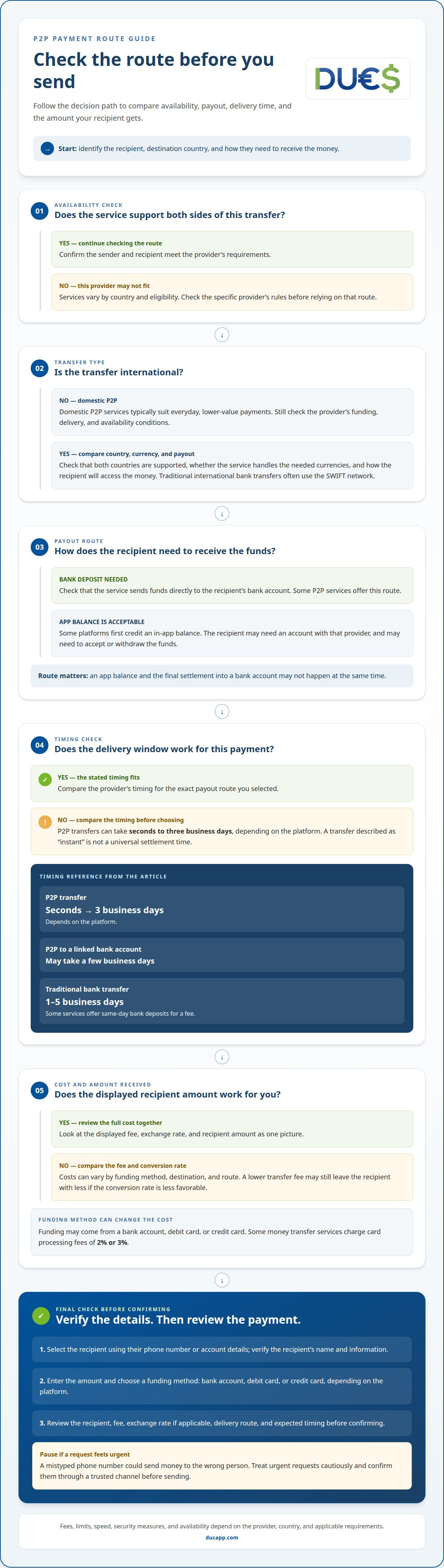
Convenience is a major advantage. P2P payment apps are available 24/7, and transfers are commonly designed to send funds in minutes. But the recipient may wait a day or two for delivery, depending on the provider and destination. A payment funded by bank account, debit card, or credit card can also follow different processing paths. Some money transfer services charge card processing fees of 2% or 3%, so the funding choice can affect the total cost.
Behind the screen, the app records the payment instruction and coordinates the transfer through its platform and the selected funding method. The balance shown in an app and the final settlement into a bank account may not happen at the same time. For example, sending money to another user’s app balance differs from sending it to a bank account. Fees, limits, speed, security measures, and availability depend on the provider, country, and applicable requirements.
Security also depends on careful use. Before confirming a payment, verify the recipient’s name and details. A mistyped phone number could send money to the wrong person. Treat urgent requests cautiously: scammers may use pressure to rush people into transferring money. Pause and confirm the request through a trusted channel before sending.
What tax rules apply to P2P payments in the United States? The tax treatment depends on what the payment represents. For federal income tax purposes, the Internal Revenue Service treats virtual currency as property, so general property transaction principles apply to transactions using it.
How Do P2P Payments Work?
A peer-to-peer currency transfer application lets people send money through a digital platform. To make a payment, select a recipient, enter an amount, choose a funding method, then review the details before confirming.
What P2P Transfer Apps Do
These apps connect a sender’s payment instruction with a recipient’s account or app profile. According to the Joint Chiefs of Global Tax Enforcement (J5), peer-to-peer platforms enable direct transfers between parties while bypassing traditional financial institutions. That can make everyday payments easier to coordinate through a mobile device, especially when friends need to split a shared expense.
Sending Money Through a P2P App
To send money, choose the recipient using their phone number or account details, enter the amount, select a funding method, then review and confirm. Depending on the platform, funding may come from a bank account, debit card, or credit card. Check the recipient information before submitting; an incorrect detail can direct the payment to the wrong person.
For example, five friends can each send $10 to the person who paid $60 for a group pizza order. The app records each payment and routes it through its platform. Transfers can take anywhere from seconds to three business days, depending on the platform. “Instant” describes the speed some transfers may reach an account, not a universal settlement time.
The destination matters. Some platforms first credit funds to an in-app balance, while others send them to a linked account. Depending on the service, the recipient may need to accept or withdraw the funds. This is why sending and receiving can feel simple even when the payment route differs between apps.
If you’re comparing digital ways to send money, explore peer-to-peer payment options as one possible route.
P2P vs Bank Transfers - What’s the Difference?
Both methods move money digitally, but the route and destination can differ. For international transfers, compare the destination, payout method, currency handling, timing, and eligibility.
Domestic and International Transfer Options
Domestic P2P services typically suit everyday, lower-value payments, while international options depend on the countries served. Some apps operate only in certain countries, so a sender and recipient may not both be eligible. Traditional international bank transfers often use the SWIFT network. Traditional bank transfers can take 1-5 business days, while P2P transfers to linked bank accounts may take a few business days. Some services offer same-day bank deposits for a fee.
Multi-Currency Support and Payout Methods
Transfer Fees and Exchange Rates
Fees and exchange rates affect the amount a recipient ultimately receives. P2P services can apply different charges based on the funding method, destination, and transfer route. Currency conversion can also change the final amount in the recipient’s currency. Before sending, review the displayed fee, exchange rate, and recipient amount together. For example, a lower transfer fee may not mean a better overall value if the conversion rate leaves the recipient with less.
Transfer Limits and Eligibility
Limits and eligibility requirements vary by provider, country, and regulatory requirements. They can affect who may use an app, which destinations are supported, and how much a user can send. No single limit applies across all P2P apps. Compare the sender’s country, recipient’s country, account requirements, and transfer amount against the specific service’s rules. These details determine whether an app can handle the payment before the sender begins.
Meaning and types of peer-to-peer transfers
Peer-to-peer, or P2P, describes a payment between people rather than a specific app or technology. The recipient might receive funds in a digital wallet or through a linked bank account. That distinction matters: “P2P” explains who is paying whom, while the platform and payout route explain how the money moves. A payment between friends for a shared meal and a transfer to family abroad can both be P2P.
Common types are easiest to distinguish by their destination and purpose:
- Wallet-to-wallet: The sender transfers funds to the recipient’s account on the same platform.
- App-to-bank: The service routes money to the recipient’s linked bank account.
- Cross-border: The sender pays someone in another country, where currency exchange or a different payout route may apply.
- Social-platform payment: A social media feature may let U.S. users send money internationally, although some countries are ineligible.
These types aren’t interchangeable. A wallet transfer, for example, may require both people to use the same platform, while a bank payout sends funds to an account outside the app. Before sending, identify where the recipient needs the money and whether the transfer crosses borders. This helps clarify which route and currency details to consider.
A platform name, such as PayPal, identifies a service, not a transfer category. P2P instead describes the relationship between sender and recipient. A digital wallet is one possible place to receive funds; it doesn’t define every P2P payment. Separating these terms helps you compare an app’s actual transfer route rather than judging by its label alone.
For direct person-to-person sending, explore DUC App peer transfers.
DUC App: International recharges
DUC App offers international recharges and peer-to-peer transfers for people handling different digital payment needs. If you want to send money to another person, its P2P transfer option fits that use. If your goal is to top up an international mobile account, an international recharge is the relevant service.
Choose a service based on what the recipient needs to receive. DUC App offers peer-to-peer transfers, international mobile top-ups, gift cards, and API integration for e-commerce businesses. These services serve different needs, so consider whether you’re sending money, recharging a mobile phone, or buying a gift card.
Explore DUC App for peer-to-peer transfers and international mobile recharges. Visit ducapp.com to learn more.
Choose the transfer route that fits your next move
A successful payment starts with matching the route to the recipient’s needs, not simply choosing the fastest-looking option. Before sending, consider where the funds need to arrive and whether the recipient can use that destination. These details help you choose a payment method with fewer surprises.
A p2p currency transfer application can be useful when you’re sending money to another person through a digital platform. For a different need, such as topping up mobile service or selecting a digital gift, choose the option that fits the purpose. Keep the recipient’s needs at the center of the decision.
Ready to explore a payment option for your situation? Contact DUC App and take the next step with clarity. A well-matched transfer starts with knowing what the recipient needs and where the money should go.
Frequently Asked Questions
What Is a P2P Payment System?
A P2P payment system is the digital setup that lets one person pay another through an app or platform. It connects the sender’s payment instruction with the recipient’s chosen destination. For example, friends settling a shared household bill can use a P2P system without exchanging cash. The system’s features determine how users identify one another and where received funds appear.
What does P2P mean?
P2P means “peer-to-peer”: a transaction between people acting as peers, rather than a purchase from a retailer. The term describes the relationship between the participants, not a specific app, currency, or technology. For instance, paying a friend back for a concert ticket is P2P. Paying the ticket seller directly is generally a consumer-to-business payment instead.
What is a P2P Money Transfer?
A P2P money transfer is a payment sent from one individual to another. It can cover personal exchanges such as contributing to a shared trip or repaying a borrowed item. The sender chooses a recipient and directs the payment through a digital service. Whether the recipient receives a wallet balance or funds through another route depends on the transfer arrangement.
Are P2P Payments Safe?
P2P payments involve risks, so safe use depends on protecting your account and confirming each transaction. Use a unique password, secure your phone, and avoid signing in on shared devices. Review the payment record after sending, and save it when you need proof of a personal reimbursement. Security measures differ between platforms, so understand the controls available in the app you use.
How do P2P transfers work?
A P2P transfer starts when the sender creates a payment instruction for a recipient. The service processes that instruction and routes funds according to its payment setup. For example, after a group trip, one person might send a contribution to the organizer through an app. The transaction record can help both people track what was sent and received.
What are peer-to-peer (P2P) payments?
Peer-to-peer payments are exchanges of money between individuals, often for personal reasons rather than a retail purchase. A family member might contribute toward shared travel, or a neighbor might repay someone for supplies. The phrase can describe payments made through different platforms and routes. Focus on the participants and purpose to distinguish P2P from business payments or merchant checkout.


