

The lowest displayed fee isn’t automatically the best option. To send money to Cuba online, match the transfer method to how the recipient needs to receive it: available options include direct bank payment or cash, while listed payout methods include bank account or cash delivery. Compare the total cost, transfer limit, delivery method, and timing before you choose.
It’s easy to focus on the fee and overlook details that determine whether a transfer suits the recipient. Compare what information they need to provide, which payout methods are available, and whether they can access the selected route.
This guide explains how to compare transfer costs, understand payout methods and recipient requirements, and assess provider trust. You’ll have a practical framework for choosing a route that fits the transfer.
Key Takeaways
- Compare the total transfer cost and delivery speed together; the fastest reported transfer time to Cuba was next day.
- Explore cash delivery as an alternative when the recipient doesn’t have a bank account, and consider how they’ll access and use the funds.
- Look beyond star ratings when assessing a provider: clear transfer terms and a suitable delivery method matter too.
- Prepare accurate recipient details and match them to the selected payout method to help avoid processing issues.
- For a different way to support someone’s mobile connectivity, learn how international recharges work and when they may suit your needs.
What are the transfer limits and fees?
Compare the total cost, provider limit, payout route, and delivery estimate together. A low advertised fee can matter less if the recipient can’t use the selected delivery method.
Provider Comparisons and Promotional Fees
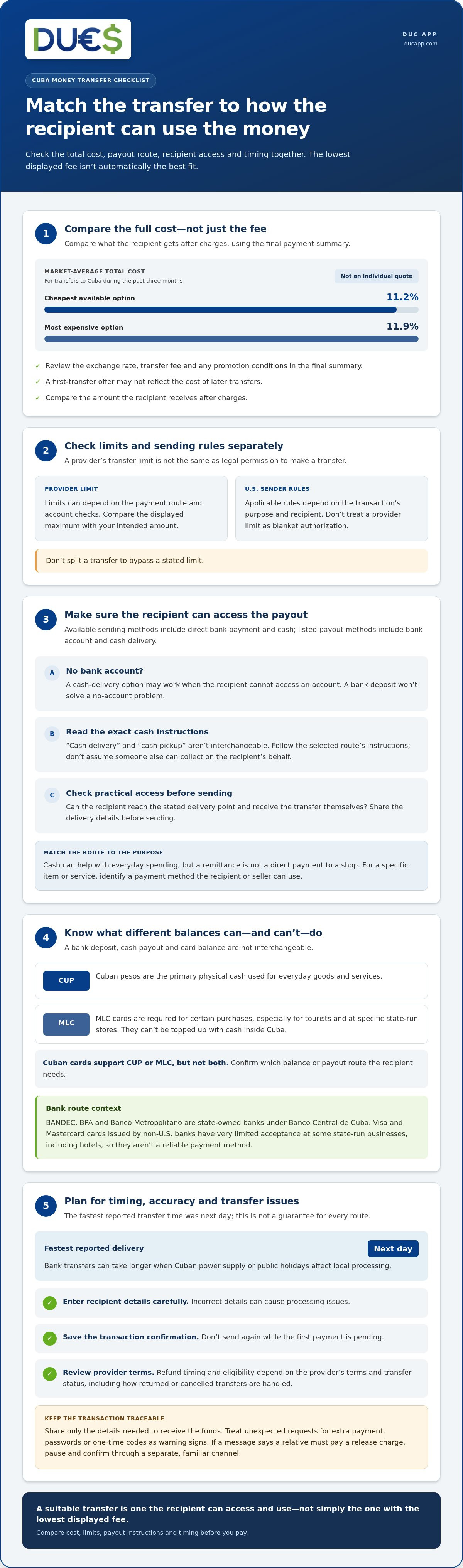
Compare providers using the amount the recipient receives, not just the transfer fee. During the past three months, the cheapest available option to Cuba had an average total cost of 11.2% of the transferred amount; the most expensive averaged 11.9%. These are market averages, not a quote for an individual transfer.
Promotional rates and first-transfer fees can change the initial comparison. Read the final payment summary, including the exchange rate, transfer fee, and any promotion conditions. Compare the amount the recipient will receive after charges. A first-transfer offer may not reflect the cost of future transfers.
U.S. Sending Rules and Limits
For U.S. senders, a provider’s transfer limit and legal permission are separate matters. Meeting one does not establish the other. Applicable rules depend on the transaction’s purpose and recipient, so don’t treat a provider limit as blanket authorization.
Transfer limits can also depend on the payment route and account checks. Before sending, compare the displayed maximum with your intended amount and review the transaction details. Don’t split a transfer to bypass a stated limit.
Payment methods available for sending to Cuba include direct bank payment and cash. Listed payout methods include bank-account and cash delivery. The fastest reported transfer time was next day, but bank transfers can take longer when Cuban power supply or public holidays affect local processing.
Recipient routes matter. BANDEC, BPA, and Banco Metropolitano are state-owned banks under Banco Central de Cuba. Cuban cards support CUP or MLC, but not both. Visa and Mastercard cards issued by non-U.S. banks have very limited acceptance at some state-run businesses, including hotels, so they aren’t a reliable payment method.
Cuban pesos are the primary form of physical cash used for daily goods and services. MLC cards are required for certain purchases, especially for tourists and at specific state-run stores; they can’t be topped up with cash inside Cuba. A bank deposit, cash payout, and card balance therefore aren’t interchangeable. For mobile wallet-style receipts, confirm that the selected payout route specifically names that destination.
Transfer problems can include incorrect recipient details, processing delays, or a failed payment. Power disruptions and public holidays can affect bank transfers. Enter the recipient’s details carefully, save the transaction confirmation, and don’t send again while the first payment is pending. Refund timing and eligibility depend on the provider’s terms and the transfer’s status. Review those terms before paying, including how returned or cancelled transfers are handled.
Alternatives for recipients without bank accounts
A recipient without a bank account may still be able to receive money through a cash-delivery option. Choose a route that doesn’t require them to access an account. Before paying, compare the displayed delivery method with what the recipient can actually receive or use. A bank deposit won’t solve a no-account problem.
Cash delivery and cash pickup aren’t interchangeable descriptions. The available payout listing may say cash delivery, but that wording alone doesn’t tell you whether funds arrive at a location or require collection. Follow the exact instructions shown for the selected route. Don’t assume a friend or relative can collect on the recipient’s behalf unless the transfer terms allow it.
Think through the recipient’s practical situation before choosing. Can they reach the stated delivery point? Can they receive the transfer themselves? Do they need the money for everyday spending, or for a specific purchase? These questions help distinguish a workable cash route from one that creates extra travel or handoff steps. Give the recipient the delivery details before sending.
Cash is useful when the recipient needs physical money for everyday goods and services. But a remittance isn’t the same as paying a shop directly. Formal remittance channels help people receive money from abroad; they aren’t a direct payment method for goods. If the goal is to pay for a particular item, identify a payment method the recipient or seller can use.
Keep the transaction traceable. Save the transfer confirmation and share only the details needed to receive the funds. Treat unexpected requests for extra payment, passwords, or one-time codes as warning signs. If a message claims that a relative must pay a release charge, pause and confirm the request with that person through a separate, familiar channel.
Email payments can be another route to consider when both parties can use that payment method. They aren’t the same as cash delivery, and an email payment shouldn’t be treated as proof that a recipient can collect physical money. Match the option to the recipient’s access and the purpose of the transfer. Explore email payment options when an email-based transaction fits the situation.
For someone without a bank account, first identify how they can receive funds, then compare the available payout instructions and consider what the money needs to cover. If cash delivery to a home is the practical fit, follow its stated process. If the recipient needs to pay for a particular service or purchase, choose a payment method designed for that transaction.
Provider ratings and trust
A high star rating can hide details that matter for a Cuba transfer. Read individual reviews about the payment route you plan to use, not just the provider’s overall score. Look for specific reports about completed transfers, delays, cancellations, and refunds. A review describing a bank deposit may not reflect a cash-delivery experience.
Check whether feedback describes a similar destination and transaction. A review about a transfer to another country, for example, may not explain Cuba-specific processing. Give more weight to comments that identify the payout method and describe what happened. Watch for repeated, recent complaints about unexplained deductions or unclear delivery updates.
Then inspect the provider’s transaction summary before paying. It should clearly show the transfer amount, fee, exchange rate, recipient amount, and delivery method. Compare the amount the recipient will receive in the stated currency, rather than judging the exchange rate alone. If the summary changes between the quote and payment screen, pause and review the revised terms.
- Review the transaction record. Save the confirmation and any reference number after payment.
- Read the refund terms. Find out how the provider handles a cancelled, returned, or delayed transfer.
- Check the recipient details. Compare the spelling and payout information with the recipient’s instructions.
- Assess the communication. Use the provider’s stated support route for a transaction question.
These steps make reviews more useful. A complaint about a name mismatch, for instance, highlights a detail you can verify before sending. A complaint about an unclear refund process points to terms worth reading. Ratings can help identify recurring experiences, but they don’t replace checking the actual transfer conditions.
Watch for messages that pressure you to pay an unexpected release charge or share a password or one-time code. Don’t use contact details supplied only in a suspicious message. Open the provider’s app or website independently, then compare the message with the transaction record. A request to resend funds to a different recipient deserves the same caution.
Trust also means understanding what a transfer can and can’t do. A remittance sends funds to a recipient; it doesn’t automatically pay a shop or guarantee access to a particular purchase. Match the payout method to the recipient’s needs and read the final terms. That gives you a clearer basis for comparing ratings, currency conversion, and the transfer experience.
Recipient details and delivery methods
Recipients in Cuba can receive transfers through a bank account or cash delivery. The identification needed depends on the selected payout route, so match the sender’s information and recipient’s documents to the transfer instructions.
Recipient Details for Online Transfers
For a card transfer, enter the recipient’s details exactly as requested. Compare each field with the information the recipient provides, including accents or name order if the form supports them. A mismatch between the transfer form and the account record can interrupt processing.
For cash delivery, use the recipient’s legal name as it appears on their identification. Share the transfer reference and delivery instructions privately. Don’t use a nickname if the payout instructions require the recipient’s official name.
Prepare the details before starting the payment. Ask the recipient to provide them through a trusted channel, then review every field before submitting. For example, check that the account number belongs to the intended recipient, not another family member. Keep the recipient’s address or contact details consistent with the form’s requested format.
Delivery Methods and Identification
Bank-account delivery sends the transfer to the account entered during setup. Cash delivery follows the collection process shown for that transfer. These routes aren’t interchangeable: selecting a bank payout requires suitable account details, while cash collection depends on the recipient meeting the stated collection conditions.
For cash delivery, the recipient should follow the provider’s instructions and have the identification specified for delivery. The name on that document should match the transfer record. Don’t assume a relative can receive funds using the recipient’s details; the payout instructions determine who can receive them.
Before sending, confirm that the recipient can use the chosen route. A recipient without an account needs a cash-delivery option, while a bank payout requires access to the named account. If the recipient can’t meet the stated identification or collection steps, choose a different available delivery method before paying.
Check the confirmation screen for the payout method, recipient name, and any collection reference. Save the receipt and share only the necessary reference details with the recipient. Never share passwords or one-time security codes as part of a collection handoff.
After submission, tell the recipient which route you selected and what details they’ll need. For example, a bank transfer requires them to monitor the account provided, while cash delivery requires them to follow its collection instructions. Clear coordination helps prevent confusion between a completed payment and funds the recipient can access.
Recipient information requirements
Accurate recipient information helps route a Cuba transfer to the intended person. Use the details requested for the selected method, then review them before submitting payment.
Start by confirming the recipient’s full name and preferred delivery route. For a bank-account transfer, enter the account information exactly as the recipient provides it. For cash delivery, use the name the recipient will present during collection. Don’t substitute a nickname or another person’s account simply because it seems easier.
The transfer form determines which fields you need to complete. Follow its instructions for spelling, name order, contact information, and account details. If the recipient uses a second surname or accented characters, ask how those details appear in their account or identification records. Keep the entered information consistent across the form.
Identification requirements depend on the payout method and its collection instructions. For cash delivery, the recipient should follow the stated identification process and use documentation matching the transfer name. For a bank deposit, account details must correspond to the intended recipient. Don’t assume one set of details works for both routes.
Use this quick preparation sequence before sending:
- Ask the recipient which delivery method they can access.
- Collect the exact name and account details required for that route.
- Compare the completed form with the recipient’s instructions.
- Review the payout method and recipient name on the final payment screen.
For example, if a recipient wants a bank deposit, confirm the account belongs to them before entering it. If they need cash delivery, share the transfer reference through a private channel after payment. Keep the receipt so you can identify the transaction if a detail needs correction.
Protect personal information throughout the process. Send account details only through a trusted communication channel, and don’t share passwords or one-time security codes. A request for those credentials isn’t a normal substitute for the recipient information shown in the transfer instructions. Use the provider’s official transaction interface rather than replying to an unexpected message.
A regulated payment process can include identity and transaction checks, so enter truthful, consistent details. If the payment form requests information you don’t have, pause before submitting instead of guessing. A guessed account number or misspelled name can send the transfer into review or prevent the recipient from accessing it.
For a payment workflow that uses email, explore email payment options and consider whether that format fits the transaction.
DUC App: International recharges
DUC App offers international recharges for situations where someone needs mobile credit rather than a money transfer. A recharge serves a different purpose: it helps with mobile connectivity, while a remittance gives the recipient funds through a payout method.
Choose based on what the person needs. If they need money for everyday expenses, consider the available transfer routes and recipient requirements described above. If they need mobile credit, an international recharge may be more relevant. DUC App also offers peer-to-peer transfers and gift cards, each suited to different payment needs.
Keep the goal clear before selecting a service, and choose the option that matches it. Use DUC App to explore international recharges, peer-to-peer transfers, and gift cards.
Choose the next step that fits your purpose
Before making another transaction, clarify what support your recipient needs. Money for personal expenses, mobile connectivity, and a particular purchase call for different solutions. That distinction helps you choose a useful next step instead of treating every need as the same transaction.
If you plan to send money to Cuba online, let the recipient’s needs guide your choice of transfer route. For other needs, DUC App offers international recharges, peer-to-peer transfers, and gift cards. Each option serves a different purpose, so choose the one that matches what you’re trying to do.
Keep the process simple: decide the goal, choose the relevant option, and review its details before proceeding. Contact DUC App for help exploring the available options. Take the next step with a clear purpose and confidence in your choice.
Frequently Asked Questions
Which option should you choose for Cuba?
Choose a payout route that fits what the recipient can access and use. Someone without a bank account may need a cash-delivery option, while a recipient with a suitable account may prefer a bank payout. Before you send money to Cuba online, consider whether the recipient needs spendable funds, a card transfer, or mobile credit. Then compare the available route and its terms.
What Recipient Data Do I Need?
Have the recipient’s full name and the details required for the chosen payout method ready. A card transfer requires the correct card details, while cash delivery uses the name needed for delivery. Ask the recipient to provide their name exactly as shown on their records. Keep the payment confirmation and reference details, but never share passwords or one-time security codes to help someone receive a transfer.
What is the minimum transfer amount, and can I send a small test transfer first?
The minimum depends on the service and payment route selected, so review the amount field before completing payment. A small test transfer can help confirm that the recipient details and chosen route work as expected, but it is a separate transaction with its own terms. Consider whether the recipient can access that first payment before sending the main amount.
What's the cheapest way to send money to Cuba?
To find a cost-effective way to send money to Cuba online, compare the total cost and the amount the recipient receives, not just the advertised fee. The exchange rate, payment method, payout route, and any first-transfer promotion can affect the final result. For a fair comparison, use the same sending amount and recipient method in each quote, then review the delivered amount and terms before payment.
Where else can you send money?
DUC App lists transfers to Bangladesh, Canada, China, Colombia, Cuba, Ecuador, El Salvador, Haiti, India, Ireland, Mexico, Nepal, Pakistan, Philippines, Spain, Switzerland, and the United Kingdom. Available services vary by destination. Outside Cuba, the listed service type is bank deposit. Other DUC App options include international recharges, peer-to-peer transfers, and gift cards.
Which online services can send money from the United States to Cuba?
DUC App lists Cuba services including sending Cuban pesos to a home, cash delivery of U.S. dollars to a home, and transfers to eligible Cuban cards. Its listed U.S.-dollar MLC card numbers are 9225, 9235, and 9245; CUP card numbers are 9204, 9205, 9206, and 9224. Compare the recipient’s card type with the service before starting a transfer.
Can money be sent to Cuba for cash pickup, bank deposit, or home delivery?
Available Cuba payout options can include bank-account and cash delivery, depending on the service selected. DUC App describes cash delivery to a home and transfers to Cuban cards; that differs from a cash-pickup service. Check that the recipient’s location and preferred delivery method match the option shown for the transaction. Don’t treat card funding, home delivery, and collection as interchangeable.
How do online money transfer services to Cuba compare in cost and reliability?
Compare providers using the same sending amount, payment method, and payout route. Review the amount delivered, exchange rate, fees, cancellation terms, and transaction updates. For reliability, look for reviews describing the same destination and transfer type, then assess recurring reports about delays or payment problems. A general rating alone may not reflect the experience of a Cuba transfer.


